

1 Chiral Coupling to Magnetodipolar Radiation
11
M
h d
wire
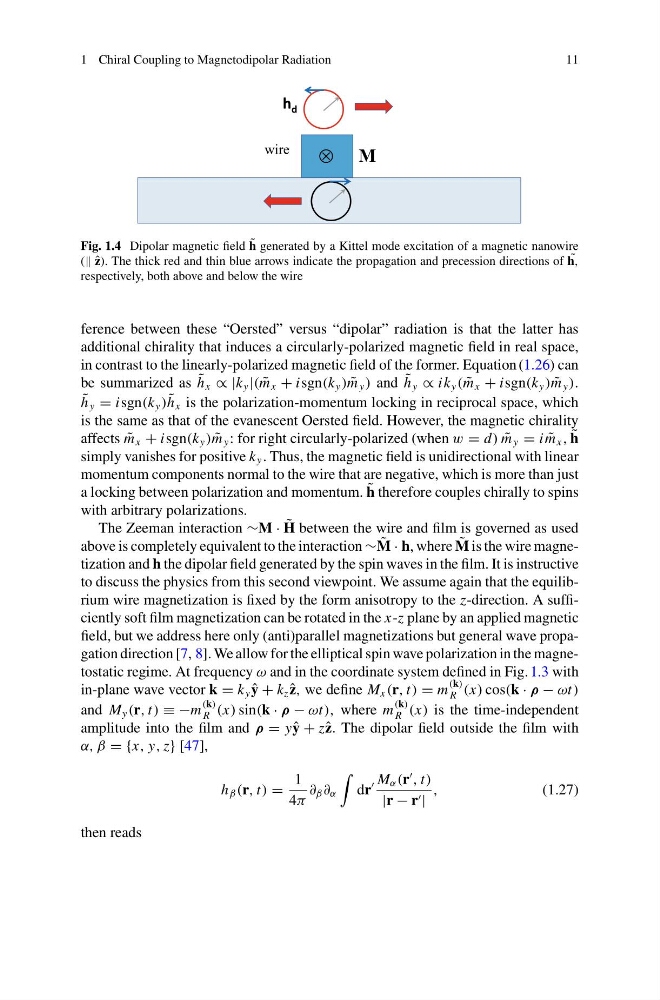
Fig. 1.4 Dipolar magnetic field ˜
h generated by a Kittel mode excitation of a magnetic nanowire
( ˆ
z). The thick red and thin blue arrows indicate the propagation and precession directions of ˜
h,
respectively, both above and below the wire
ference between these “Oersted” versus “dipolar” radiation is that the latter has
additional chirality that induces a circularly-polarized magnetic field in real space,
in contrast to the linearly-polarized magnetic field of the former. Equation (1.26) can
be summarized as ˜
h x ∝ |k y |( ˜
m x + isgn(k y ) ˜
m y ) and ˜
h y ∝ ik y ( ˜
m x + isgn(k y ) ˜
m y ).
˜
h y = isgn(k y ) ˜
h x is the polarization-momentum locking in reciprocal space, which
is the same as that of the evanescent Oersted field. However, the magnetic chirality
affects ˜
m x + isgn(k y ) ˜
m y : for right circularly-polarized (when w = d) ˜
m y = i ˜
m x , ˜
h
simply vanishes for positive k y . Thus, the magnetic field is unidirectional with linear
momentum components normal to the wire that are negative, which is more than just
a locking between polarization and momentum. ˜
h therefore couples chirally to spins
with arbitrary polarizations.
The Zeeman interaction ∼M · ˜
H between the wire and film is governed as used
above is completely equivalent to the interaction ∼ ˜
M · h, where ˜
M is the wire magnetization and h the dipolar field generated by the spin waves in the film. It is instructive
to discuss the physics from this second viewpoint. We assume again that the equilibrium wire magnetization is fixed by the form anisotropy to the z-direction. A sufficiently soft film magnetization can be rotated in the x-z plane by an applied magnetic
field, but we address here only (anti)parallel magnetizations but general wave propagation direction [7, 8]. We allow for the elliptical spin wave polarization in the magnetostatic regime. At frequency ω and in the coordinate system defined in Fig. 1.3 with
in-plane wave vector k = k y ˆ
y + k z ˆ
z, we define M x (r, t) = m
(k)
R (x) cos(k · ρ − ωt)
and M y (r, t) ≡ −m
(k)
R (x) sin(k · ρ − ωt), where m
(k)
R (x) is the time-independent
amplitude into the film and ρ = y ˆ
y + z ˆ
z. The dipolar field outside the film with
α, β = {x, y, z} [47],
h β (r, t) =
1
4π
∂ β ∂ α
dr
M α (r
, t)
|r − r |
,
(1.27)
then reads
11
M
h d
wire
Fig. 1.4 Dipolar magnetic field ˜
h generated by a Kittel mode excitation of a magnetic nanowire
( ˆ
z). The thick red and thin blue arrows indicate the propagation and precession directions of ˜
h,
respectively, both above and below the wire
ference between these “Oersted” versus “dipolar” radiation is that the latter has
additional chirality that induces a circularly-polarized magnetic field in real space,
in contrast to the linearly-polarized magnetic field of the former. Equation (1.26) can
be summarized as ˜
h x ∝ |k y |( ˜
m x + isgn(k y ) ˜
m y ) and ˜
h y ∝ ik y ( ˜
m x + isgn(k y ) ˜
m y ).
˜
h y = isgn(k y ) ˜
h x is the polarization-momentum locking in reciprocal space, which
is the same as that of the evanescent Oersted field. However, the magnetic chirality
affects ˜
m x + isgn(k y ) ˜
m y : for right circularly-polarized (when w = d) ˜
m y = i ˜
m x , ˜
h
simply vanishes for positive k y . Thus, the magnetic field is unidirectional with linear
momentum components normal to the wire that are negative, which is more than just
a locking between polarization and momentum. ˜
h therefore couples chirally to spins
with arbitrary polarizations.
The Zeeman interaction ∼M · ˜
H between the wire and film is governed as used
above is completely equivalent to the interaction ∼ ˜
M · h, where ˜
M is the wire magnetization and h the dipolar field generated by the spin waves in the film. It is instructive
to discuss the physics from this second viewpoint. We assume again that the equilibrium wire magnetization is fixed by the form anisotropy to the z-direction. A sufficiently soft film magnetization can be rotated in the x-z plane by an applied magnetic
field, but we address here only (anti)parallel magnetizations but general wave propagation direction [7, 8]. We allow for the elliptical spin wave polarization in the magnetostatic regime. At frequency ω and in the coordinate system defined in Fig. 1.3 with
in-plane wave vector k = k y ˆ
y + k z ˆ
z, we define M x (r, t) = m
(k)
R (x) cos(k · ρ − ωt)
and M y (r, t) ≡ −m
(k)
R (x) sin(k · ρ − ωt), where m
(k)
R (x) is the time-independent
amplitude into the film and ρ = y ˆ
y + z ˆ
z. The dipolar field outside the film with
α, β = {x, y, z} [47],
h β (r, t) =
1
4π
∂ β ∂ α
dr
M α (r
, t)
|r − r |
,
(1.27)
then reads