

10
T. Yu and G. E. W. Bauer
˜
h β (r, t) =
1
4π
∂ β ∂ α
˜
M α (r
, t)
|r − r |
dr
=
1
4π
∂ β ∂ α
dz
d
0
dx
w
2
−
w
2
dy
˜
m α e
−iωt
z 2 + (x − x ) 2 + (y − y ) 2
. (1.23)
We use the Coulomb integral [6, 41]
1
z 2 + (x − x ) 2 + (y − y ) 2
=
1
2π
dk x dk y
e
−|z
|
√
k 2
x +k 2
y
k 2
x + k 2
y
e
ik x (x−x
)+ik y (y−y
)
,
(1.24)
a variation of the Weyl identity used in (1.4), to express the magnetic field below the
nanowire (x < 0) with partial Fourier components k y
˜
h β (k y , x, t) =
h β (r, t)e
−ik y y dy
=
1
π
dk x (k x ˜
m x + k y ˜
m y )k β e
ik x x−iωt
1
k 2
x + k 2
y
1 − e
−ik x d
ik x
sin(k y w/2)
k y
.
(1.25)
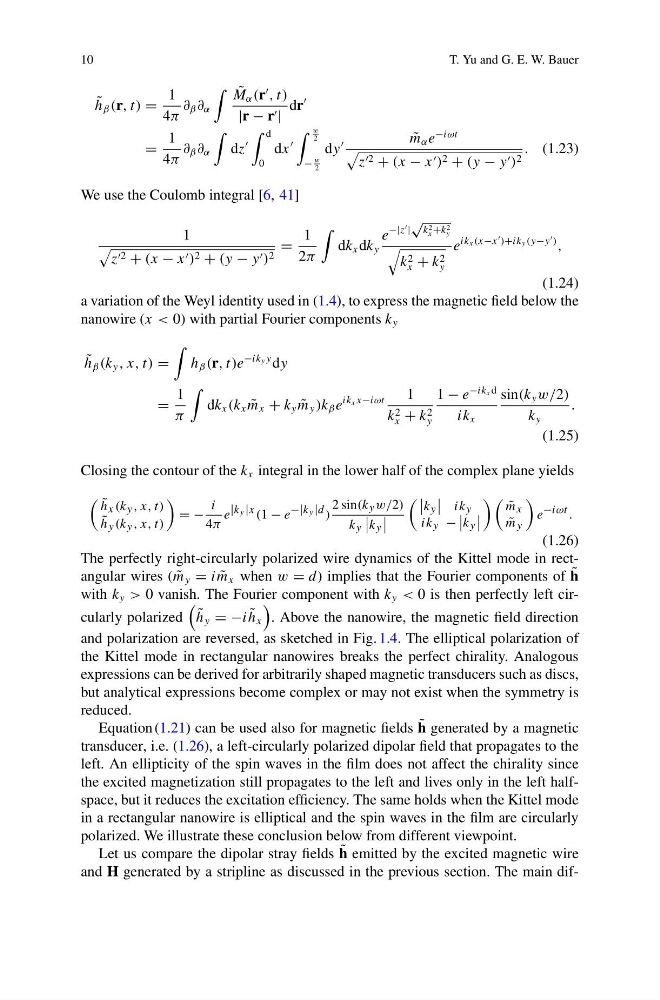
Closing the contour of the k x integral in the lower half of the complex plane yields
˜
h x (k y , x, t)
˜
h y (k y , x, t)
= −
i
4π
e |ky|x (1 − e −|k y |d )
2 sin(k y w/2)
k y
k y
k y
ik y
ik y −
k y
˜
m x
˜
m y
e −iωt .
(1.26)
The perfectly right-circularly polarized wire dynamics of the Kittel mode in rectangular wires ( ˜
m y = i ˜
m x when w = d) implies that the Fourier components of ˜
h
with k y > 0 vanish. The Fourier component with k y < 0 is then perfectly left circularly polarized
˜
h y = −i ˜
h x
. Above the nanowire, the magnetic field direction
and polarization are reversed, as sketched in Fig. 1.4. The elliptical polarization of
the Kittel mode in rectangular nanowires breaks the perfect chirality. Analogous
expressions can be derived for arbitrarily shaped magnetic transducers such as discs,
but analytical expressions become complex or may not exist when the symmetry is
reduced.
Equation (1.21) can be used also for magnetic fields ˜
h generated by a magnetic
transducer, i.e. (1.26), a left-circularly polarized dipolar field that propagates to the
left. An ellipticity of the spin waves in the film does not affect the chirality since
the excited magnetization still propagates to the left and lives only in the left halfspace, but it reduces the excitation efficiency. The same holds when the Kittel mode
in a rectangular nanowire is elliptical and the spin waves in the film are circularly
polarized. We illustrate these conclusion below from different viewpoint.
Let us compare the dipolar stray fields ˜
h emitted by the excited magnetic wire
and H generated by a stripline as discussed in the previous section. The main dif-
T. Yu and G. E. W. Bauer
˜
h β (r, t) =
1
4π
∂ β ∂ α
˜
M α (r
, t)
|r − r |
dr
=
1
4π
∂ β ∂ α
dz
d
0
dx
w
2
−
w
2
dy
˜
m α e
−iωt
z 2 + (x − x ) 2 + (y − y ) 2
. (1.23)
We use the Coulomb integral [6, 41]
1
z 2 + (x − x ) 2 + (y − y ) 2
=
1
2π
dk x dk y
e
−|z
|
√
k 2
x +k 2
y
k 2
x + k 2
y
e
ik x (x−x
)+ik y (y−y
)
,
(1.24)
a variation of the Weyl identity used in (1.4), to express the magnetic field below the
nanowire (x < 0) with partial Fourier components k y
˜
h β (k y , x, t) =
h β (r, t)e
−ik y y dy
=
1
π
dk x (k x ˜
m x + k y ˜
m y )k β e
ik x x−iωt
1
k 2
x + k 2
y
1 − e
−ik x d
ik x
sin(k y w/2)
k y
.
(1.25)
Closing the contour of the k x integral in the lower half of the complex plane yields
˜
h x (k y , x, t)
˜
h y (k y , x, t)
= −
i
4π
e |ky|x (1 − e −|k y |d )
2 sin(k y w/2)
k y
k y
k y
ik y
ik y −
k y
˜
m x
˜
m y
e −iωt .
(1.26)
The perfectly right-circularly polarized wire dynamics of the Kittel mode in rectangular wires ( ˜
m y = i ˜
m x when w = d) implies that the Fourier components of ˜
h
with k y > 0 vanish. The Fourier component with k y < 0 is then perfectly left circularly polarized
˜
h y = −i ˜
h x
. Above the nanowire, the magnetic field direction
and polarization are reversed, as sketched in Fig. 1.4. The elliptical polarization of
the Kittel mode in rectangular nanowires breaks the perfect chirality. Analogous
expressions can be derived for arbitrarily shaped magnetic transducers such as discs,
but analytical expressions become complex or may not exist when the symmetry is
reduced.
Equation (1.21) can be used also for magnetic fields ˜
h generated by a magnetic
transducer, i.e. (1.26), a left-circularly polarized dipolar field that propagates to the
left. An ellipticity of the spin waves in the film does not affect the chirality since
the excited magnetization still propagates to the left and lives only in the left halfspace, but it reduces the excitation efficiency. The same holds when the Kittel mode
in a rectangular nanowire is elliptical and the spin waves in the film are circularly
polarized. We illustrate these conclusion below from different viewpoint.
Let us compare the dipolar stray fields ˜
h emitted by the excited magnetic wire
and H generated by a stripline as discussed in the previous section. The main dif-