

1 Chiral Coupling to Magnetodipolar Radiation
13
1.3.2 Non-local Detection
Here we illustrate the principle of non-local excitation and detection of magnons by
a device consisting of two magnetic nanowires on top of a YIG film. The generation
of DC currents by AC forces in the absence of a DC bias is generally referred to
as “pumping” [49]. Spin pumping is the injection of a spin current by the magnetization dynamics of a magnet into a normal metal contact by the interface exchange
interaction [50, 51]. Chiral spin pumping is the generation of unidirectional spin
waves by the dynamics of a proximity magnetic wire as discussed above. Its inverse
is the chiral spin absorption, i.e. the wire dynamics induced by the stray fields
caused by spin waves in the film. We develop below a semi-analytic theory of chiral spin pumping/absorption for antiparallel magnetic configurations and describe
two effects—non-reciprocal microwave transmission and chiral spin Seebeck effect.
Whereas the former is due to coherent pumping by applied microwaves, the latter
represents the incoherent (thermal) pumping by a temperature difference [52–55].
Both effects can be observed in terms of the magnon population or temperature in
the detector, e.g., inductively or by light scattering.
We switch from a purely classical picture of previous sections to a quantum
description of the chiral coupling in terms of Hamiltonian matrix elements between
generalized harmonic oscillators. This does not introduce new physics since we can
simply replace operators by classical amplitudes, but it provides a compact formalism
used in many other fields such as nanomechanical systems and optics, and prepares
the stage for the treatment of real quantum problems. For simplicity, we focus on the
antiparallel magnetic configuration with maximized dipolar coupling (for arbitrary
magnetization directions see [8]). The dipolar coupling of the wire magnetization ˜
M
with that of a film M is governed by the Zeeman interaction with the respective stray
magnetic fields h and ˜
h [47]
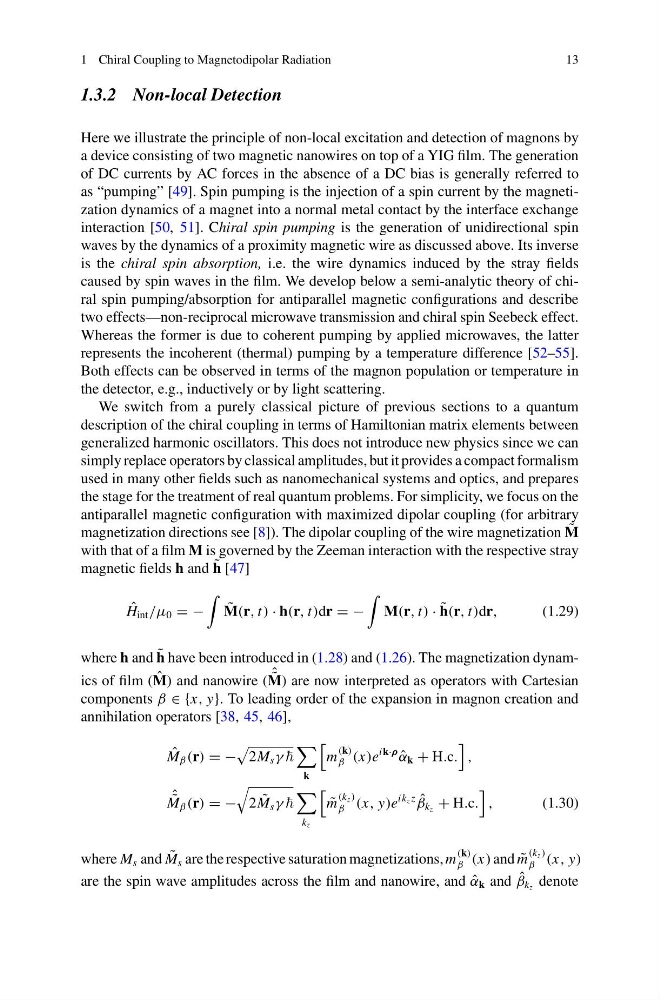
ˆ
H int /μ 0 = −
˜
M(r, t) · h(r, t)dr = −
M(r, t) · ˜
h(r, t)dr,
(1.29)
where h and ˜
h have been introduced in (1.28) and (1.26). The magnetization dynamics of film ( ˆ
M) and nanowire ( ˆ ˜
M) are now interpreted as operators with Cartesian
components β ∈ {x, y}. To leading order of the expansion in magnon creation and
annihilation operators [38, 45, 46],
ˆ
M β (r) = −
2M s γ
k
m
(k)
β (x)e
ik·ρ ρ ρ
ˆ
α k + H.c.
,
ˆ ˜
M β (r) = −
2 ˜
M s γ
k z
˜
m
(k z )
β (x, y)e
ik z z ˆ
β k z + H.c.
,
(1.30)
where M s and ˜
M s are the respective saturation magnetizations, m
(k)
β (x) and ˜
m
(k z )
β (x, y)
are the spin wave amplitudes across the film and nanowire, and ˆ
α k and ˆ
β k z denote
13
1.3.2 Non-local Detection
Here we illustrate the principle of non-local excitation and detection of magnons by
a device consisting of two magnetic nanowires on top of a YIG film. The generation
of DC currents by AC forces in the absence of a DC bias is generally referred to
as “pumping” [49]. Spin pumping is the injection of a spin current by the magnetization dynamics of a magnet into a normal metal contact by the interface exchange
interaction [50, 51]. Chiral spin pumping is the generation of unidirectional spin
waves by the dynamics of a proximity magnetic wire as discussed above. Its inverse
is the chiral spin absorption, i.e. the wire dynamics induced by the stray fields
caused by spin waves in the film. We develop below a semi-analytic theory of chiral spin pumping/absorption for antiparallel magnetic configurations and describe
two effects—non-reciprocal microwave transmission and chiral spin Seebeck effect.
Whereas the former is due to coherent pumping by applied microwaves, the latter
represents the incoherent (thermal) pumping by a temperature difference [52–55].
Both effects can be observed in terms of the magnon population or temperature in
the detector, e.g., inductively or by light scattering.
We switch from a purely classical picture of previous sections to a quantum
description of the chiral coupling in terms of Hamiltonian matrix elements between
generalized harmonic oscillators. This does not introduce new physics since we can
simply replace operators by classical amplitudes, but it provides a compact formalism
used in many other fields such as nanomechanical systems and optics, and prepares
the stage for the treatment of real quantum problems. For simplicity, we focus on the
antiparallel magnetic configuration with maximized dipolar coupling (for arbitrary
magnetization directions see [8]). The dipolar coupling of the wire magnetization ˜
M
with that of a film M is governed by the Zeeman interaction with the respective stray
magnetic fields h and ˜
h [47]
ˆ
H int /μ 0 = −
˜
M(r, t) · h(r, t)dr = −
M(r, t) · ˜
h(r, t)dr,
(1.29)
where h and ˜
h have been introduced in (1.28) and (1.26). The magnetization dynamics of film ( ˆ
M) and nanowire ( ˆ ˜
M) are now interpreted as operators with Cartesian
components β ∈ {x, y}. To leading order of the expansion in magnon creation and
annihilation operators [38, 45, 46],
ˆ
M β (r) = −
2M s γ
k
m
(k)
β (x)e
ik·ρ ρ ρ
ˆ
α k + H.c.
,
ˆ ˜
M β (r) = −
2 ˜
M s γ
k z
˜
m
(k z )
β (x, y)e
ik z z ˆ
β k z + H.c.
,
(1.30)
where M s and ˜
M s are the respective saturation magnetizations, m
(k)
β (x) and ˜
m
(k z )
β (x, y)
are the spin wave amplitudes across the film and nanowire, and ˆ
α k and ˆ
β k z denote