

302
F. Vanderveken et al.
The above set of linear differential equations has wave-like solutions of the form [15,
37]
u(r, t) =
⎡
⎣
u x
u y
u z
⎤
⎦ e
i(ωt+k·r)
.
(12.52)
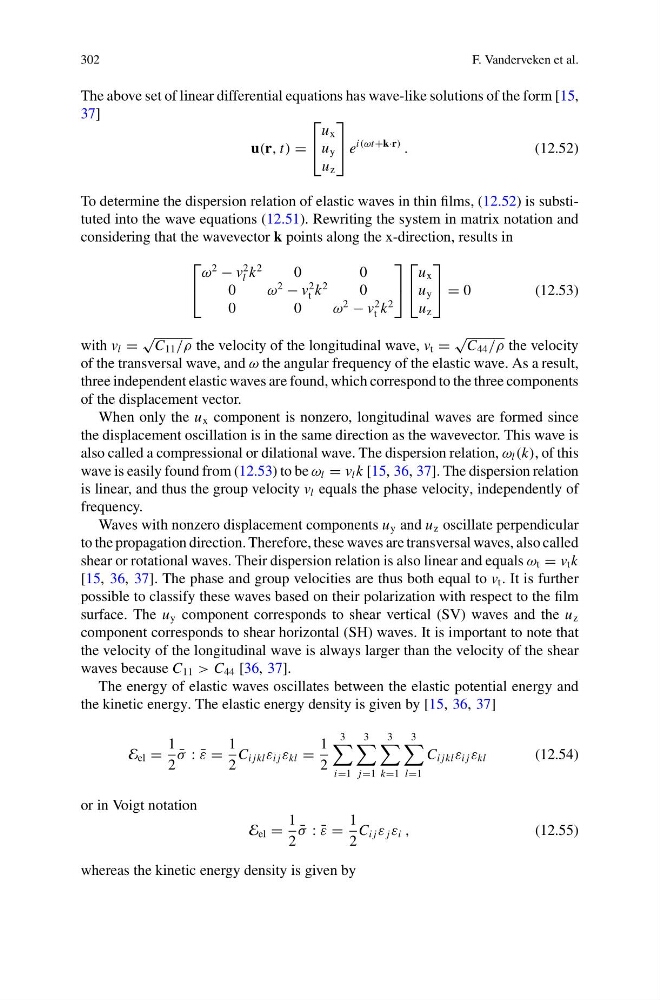
To determine the dispersion relation of elastic waves in thin films, (12.52) is substituted into the wave equations (12.51). Rewriting the system in matrix notation and
considering that the wavevector k points along the x-direction, results in
⎡
⎣
ω
2
− v
2
l k
2
0
0
0
ω
2
− v
2
t k
2
0
0
0
ω
2
− v
2
t k
2
⎤
⎦
⎡
⎣
u x
u y
u z
⎤
⎦ = 0
(12.53)
with v l =
√
C 11 /ρ the velocity of the longitudinal wave, v t =
√
C 44 /ρ the velocity
of the transversal wave, and ω the angular frequency of the elastic wave. As a result,
three independent elastic waves are found, which correspond to the three components
of the displacement vector.
When only the u x component is nonzero, longitudinal waves are formed since
the displacement oscillation is in the same direction as the wavevector. This wave is
also called a compressional or dilational wave. The dispersion relation, ω l (k), of this
wave is easily found from (12.53) to be ω l = v l k [15, 36, 37]. The dispersion relation
is linear, and thus the group velocity v l equals the phase velocity, independently of
frequency.
Waves with nonzero displacement components u y and u z oscillate perpendicular
to the propagation direction. Therefore, these waves are transversal waves, also called
shear or rotational waves. Their dispersion relation is also linear and equals ω t = v t k
[15, 36, 37]. The phase and group velocities are thus both equal to v t . It is further
possible to classify these waves based on their polarization with respect to the film
surface. The u y component corresponds to shear vertical (SV) waves and the u z
component corresponds to shear horizontal (SH) waves. It is important to note that
the velocity of the longitudinal wave is always larger than the velocity of the shear
waves because C 11 > C 44 [36, 37].
The energy of elastic waves oscillates between the elastic potential energy and
the kinetic energy. The elastic energy density is given by [15, 36, 37]
E el =
1
2
¯
σ : ¯
ε =
1
2
C i jkl ε i j ε kl =
1
2
3
i=1
3
j=1
3
k=1
3
l=1
C i jkl ε i j ε kl
(12.54)
or in Voigt notation
E el =
1
2
¯
σ : ¯
ε =
1
2
C i j ε j ε i ,
(12.55)
whereas the kinetic energy density is given by
F. Vanderveken et al.
The above set of linear differential equations has wave-like solutions of the form [15,
37]
u(r, t) =
⎡
⎣
u x
u y
u z
⎤
⎦ e
i(ωt+k·r)
.
(12.52)
To determine the dispersion relation of elastic waves in thin films, (12.52) is substituted into the wave equations (12.51). Rewriting the system in matrix notation and
considering that the wavevector k points along the x-direction, results in
⎡
⎣
ω
2
− v
2
l k
2
0
0
0
ω
2
− v
2
t k
2
0
0
0
ω
2
− v
2
t k
2
⎤
⎦
⎡
⎣
u x
u y
u z
⎤
⎦ = 0
(12.53)
with v l =
√
C 11 /ρ the velocity of the longitudinal wave, v t =
√
C 44 /ρ the velocity
of the transversal wave, and ω the angular frequency of the elastic wave. As a result,
three independent elastic waves are found, which correspond to the three components
of the displacement vector.
When only the u x component is nonzero, longitudinal waves are formed since
the displacement oscillation is in the same direction as the wavevector. This wave is
also called a compressional or dilational wave. The dispersion relation, ω l (k), of this
wave is easily found from (12.53) to be ω l = v l k [15, 36, 37]. The dispersion relation
is linear, and thus the group velocity v l equals the phase velocity, independently of
frequency.
Waves with nonzero displacement components u y and u z oscillate perpendicular
to the propagation direction. Therefore, these waves are transversal waves, also called
shear or rotational waves. Their dispersion relation is also linear and equals ω t = v t k
[15, 36, 37]. The phase and group velocities are thus both equal to v t . It is further
possible to classify these waves based on their polarization with respect to the film
surface. The u y component corresponds to shear vertical (SV) waves and the u z
component corresponds to shear horizontal (SH) waves. It is important to note that
the velocity of the longitudinal wave is always larger than the velocity of the shear
waves because C 11 > C 44 [36, 37].
The energy of elastic waves oscillates between the elastic potential energy and
the kinetic energy. The elastic energy density is given by [15, 36, 37]
E el =
1
2
¯
σ : ¯
ε =
1
2
C i jkl ε i j ε kl =
1
2
3
i=1
3
j=1
3
k=1
3
l=1
C i jkl ε i j ε kl
(12.54)
or in Voigt notation
E el =
1
2
¯
σ : ¯
ε =
1
2
C i j ε j ε i ,
(12.55)
whereas the kinetic energy density is given by