

12 Magnetoelastic Waves in Thin Films
303
E kin =
ρ||v||
2
2
with
v =
∂u
∂t
.
(12.56)
Hence, for an elastic wave, the total energy is E tot = E el + E kin and E el = E kin .
12.4 Magnetoelastic Waves
In the two previous sections, magnetic and elastic waves in thin films were studied. This section connects the two previous sections by introducing magnetoelastic
interactions. In the first part of this section, the magnetoelastic interaction terms are
described, which couple magnetic and elastic waves. In the second part, the properties of these magnetoelastic waves are derived and explained. Magnetoelastic waves
have been studied in detail in bulk materials [8–10], at free surfaces [39–41], and in
infinitesimally thin films [11, 12]. This section reviews the most important aspects
of these magnetoelastic waves together with the corresponding equations. Beyond
this review, we subsequently derive the influence of finite film thickness on the properties of the magnetoelastic waves by taking into account the appropriate dipolar and
exchange fields.
12.4.1 Magnetoelastic Interactions
Magnetoelastic interactions can be separated in two different effects: firstly, the influence of the direction of the magnetization on the internal strain in a ferromagnet,
called the magnetostrictive effect; and secondly, the effect of strain on the magnetization state, called the Villari effect. If both effects are considered simultaneously,
one speaks about magnetoelasticity.
12.4.1.1 Magnetostriction
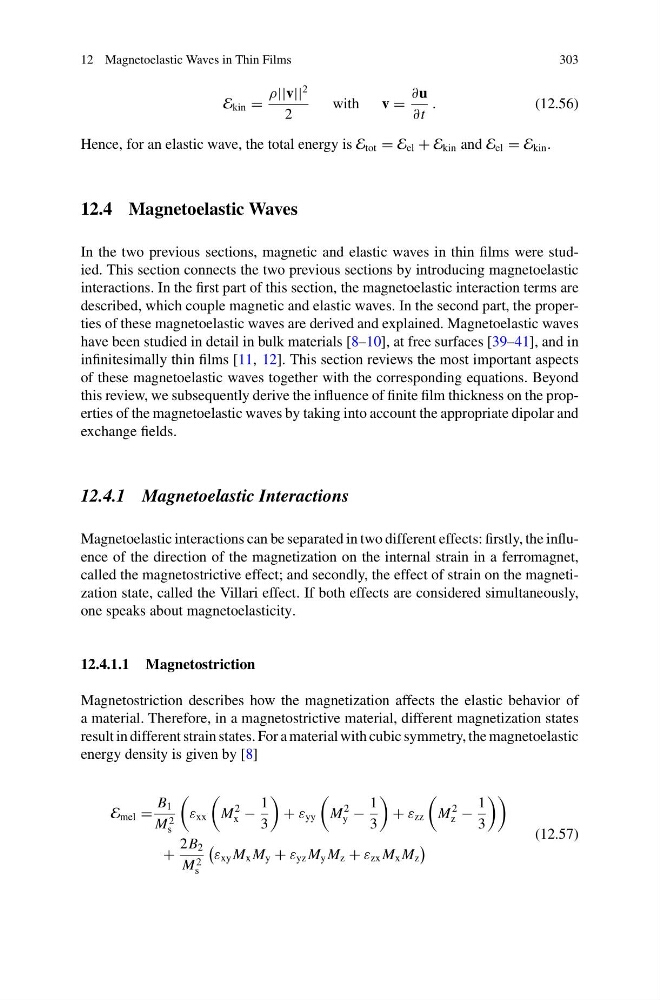
Magnetostriction describes how the magnetization affects the elastic behavior of
a material. Therefore, in a magnetostrictive material, different magnetization states
result in different strain states. For a material with cubic symmetry, the magnetoelastic
energy density is given by [8]
E mel =
B 1
M 2
s
ε xx
M
2
x −
1
3
+ ε yy
M
2
y −
1
3
+ ε zz
M
2
z −
1
3
+
2B 2
M 2
s
ε xy M x M y + ε yz M y M z + ε zx M x M z
(12.57)
303
E kin =
ρ||v||
2
2
with
v =
∂u
∂t
.
(12.56)
Hence, for an elastic wave, the total energy is E tot = E el + E kin and E el = E kin .
12.4 Magnetoelastic Waves
In the two previous sections, magnetic and elastic waves in thin films were studied. This section connects the two previous sections by introducing magnetoelastic
interactions. In the first part of this section, the magnetoelastic interaction terms are
described, which couple magnetic and elastic waves. In the second part, the properties of these magnetoelastic waves are derived and explained. Magnetoelastic waves
have been studied in detail in bulk materials [8–10], at free surfaces [39–41], and in
infinitesimally thin films [11, 12]. This section reviews the most important aspects
of these magnetoelastic waves together with the corresponding equations. Beyond
this review, we subsequently derive the influence of finite film thickness on the properties of the magnetoelastic waves by taking into account the appropriate dipolar and
exchange fields.
12.4.1 Magnetoelastic Interactions
Magnetoelastic interactions can be separated in two different effects: firstly, the influence of the direction of the magnetization on the internal strain in a ferromagnet,
called the magnetostrictive effect; and secondly, the effect of strain on the magnetization state, called the Villari effect. If both effects are considered simultaneously,
one speaks about magnetoelasticity.
12.4.1.1 Magnetostriction
Magnetostriction describes how the magnetization affects the elastic behavior of
a material. Therefore, in a magnetostrictive material, different magnetization states
result in different strain states. For a material with cubic symmetry, the magnetoelastic
energy density is given by [8]
E mel =
B 1
M 2
s
ε xx
M
2
x −
1
3
+ ε yy
M
2
y −
1
3
+ ε zz
M
2
z −
1
3
+
2B 2
M 2
s
ε xy M x M y + ε yz M y M z + ε zx M x M z
(12.57)