

12 Magnetoelastic Waves in Thin Films
301
Note that the above equations do not contain any damping terms and the system
is assumed to be lossless. In practice, materials always possess some degree of
viscoelasticity. In this case, the energy in the elastic wave is lost by different mechanisms such as phonon–phonon scattering due to the anharmonicity of the vibrational
potential or the scattering of phonons by impurities. This can be taken into account
by considering complex stiffness coefficients [37, 38]. However, in the following,
perfect elasticity without loss is assumed for simplicity.
12.3.2 Elastic Waves in Thin Films
In this section, we introduce the properties of elastic waves in an idealized thin film
with free surfaces. This corresponds to an isolated thin film in vacuum in which
the elastodynamics is perfectly confined inside the film. The perfect confinement
is achieved by large acoustical impedance mismatch between the film and vacuum.
Therefore, the model also approximately represents a thin film surrounded by materials with strongly different acoustic impedances, e.g. a film with a free top surface
and a large acoustic impedance mismatch with the supporting substrate. For more
realistic approaches, appropriate stress and velocity boundary conditions need to be
applied at the interfaces. In the next section, when the magnetoelastic interaction is
included, it is demonstrated that the magnetization dynamics also generate elastic
stresses, which further complicates the description at the boundaries. In such cases,
an analytical treatment of the system is difficult and accurate studies require numerical simulations, e.g. by finite element methods. Nonetheless, the treatment of an
idealized system presented here provides analytical insights in the basic elastic (and
magnetoelastic) behavior. This insight will help in the understanding of the magnetoelastic waves in the next section and can be used in the future to interpret numerical
simulations of more realistic systems.
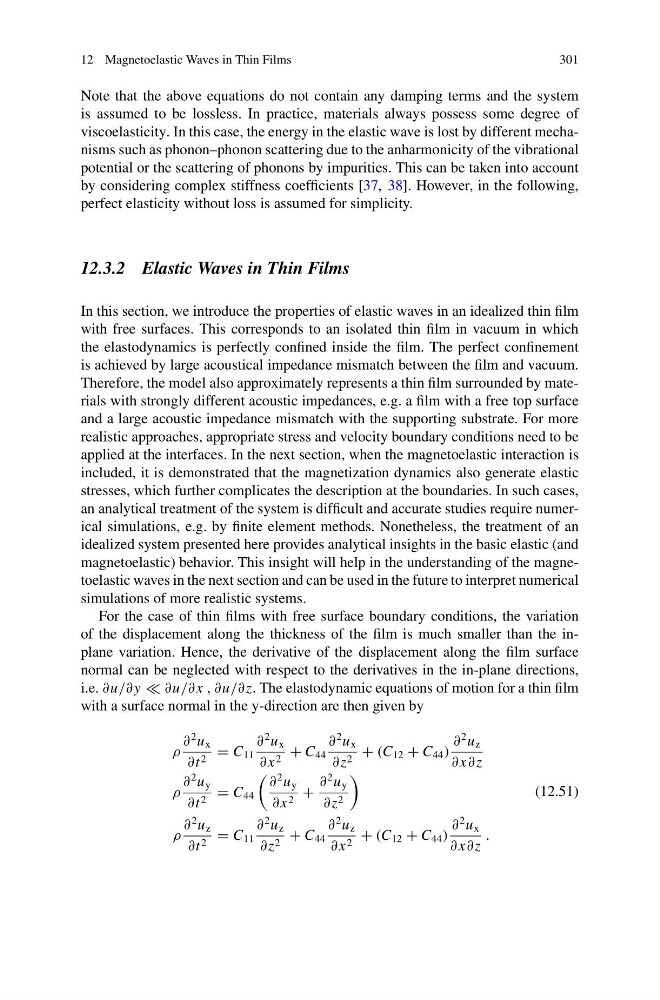
For the case of thin films with free surface boundary conditions, the variation
of the displacement along the thickness of the film is much smaller than the inplane variation. Hence, the derivative of the displacement along the film surface
normal can be neglected with respect to the derivatives in the in-plane directions,
i.e. ∂u/∂ y ∂u/∂ x , ∂u/∂z. The elastodynamic equations of motion for a thin film
with a surface normal in the y-direction are then given by
ρ
∂
2 u x
∂t 2 = C 11
∂
2 u x
∂ x 2 + C 44
∂
2 u x
∂z 2 + (C 12 + C 44 )
∂
2 u z
∂ x∂z
ρ
∂
2 u y
∂t 2 = C 44
∂
2 u y
∂ x 2 +
∂
2 u y
∂z 2
ρ
∂
2 u z
∂t 2 = C 11
∂
2 u z
∂z 2 + C 44
∂
2 u z
∂ x 2 + (C 12 + C 44 )
∂
2 u x
∂ x∂z
.
(12.51)
301
Note that the above equations do not contain any damping terms and the system
is assumed to be lossless. In practice, materials always possess some degree of
viscoelasticity. In this case, the energy in the elastic wave is lost by different mechanisms such as phonon–phonon scattering due to the anharmonicity of the vibrational
potential or the scattering of phonons by impurities. This can be taken into account
by considering complex stiffness coefficients [37, 38]. However, in the following,
perfect elasticity without loss is assumed for simplicity.
12.3.2 Elastic Waves in Thin Films
In this section, we introduce the properties of elastic waves in an idealized thin film
with free surfaces. This corresponds to an isolated thin film in vacuum in which
the elastodynamics is perfectly confined inside the film. The perfect confinement
is achieved by large acoustical impedance mismatch between the film and vacuum.
Therefore, the model also approximately represents a thin film surrounded by materials with strongly different acoustic impedances, e.g. a film with a free top surface
and a large acoustic impedance mismatch with the supporting substrate. For more
realistic approaches, appropriate stress and velocity boundary conditions need to be
applied at the interfaces. In the next section, when the magnetoelastic interaction is
included, it is demonstrated that the magnetization dynamics also generate elastic
stresses, which further complicates the description at the boundaries. In such cases,
an analytical treatment of the system is difficult and accurate studies require numerical simulations, e.g. by finite element methods. Nonetheless, the treatment of an
idealized system presented here provides analytical insights in the basic elastic (and
magnetoelastic) behavior. This insight will help in the understanding of the magnetoelastic waves in the next section and can be used in the future to interpret numerical
simulations of more realistic systems.
For the case of thin films with free surface boundary conditions, the variation
of the displacement along the thickness of the film is much smaller than the inplane variation. Hence, the derivative of the displacement along the film surface
normal can be neglected with respect to the derivatives in the in-plane directions,
i.e. ∂u/∂ y ∂u/∂ x , ∂u/∂z. The elastodynamic equations of motion for a thin film
with a surface normal in the y-direction are then given by
ρ
∂
2 u x
∂t 2 = C 11
∂
2 u x
∂ x 2 + C 44
∂
2 u x
∂z 2 + (C 12 + C 44 )
∂
2 u z
∂ x∂z
ρ
∂
2 u y
∂t 2 = C 44
∂
2 u y
∂ x 2 +
∂
2 u y
∂z 2
ρ
∂
2 u z
∂t 2 = C 11
∂
2 u z
∂z 2 + C 44
∂
2 u z
∂ x 2 + (C 12 + C 44 )
∂
2 u x
∂ x∂z
.
(12.51)