

300
F. Vanderveken et al.
This is called the Voigt notation for Hooke’s law. Important to note is the notation
for the shear strain elements. In some works, this is given by the engineering strains
γ ij = 2ε ij which gives a factor of 2 difference with the real shear strains.
Equation (12.46) indicates that a material with a nonsymmetric (e.g. triclinic)
crystal structure is described by 21 independent stiffness coefficients [36, 37]. In a
crystal system with a certain symmetry, the number of independent stiffness constants
can be greatly reduced. For example, only three independent stiffness constants are
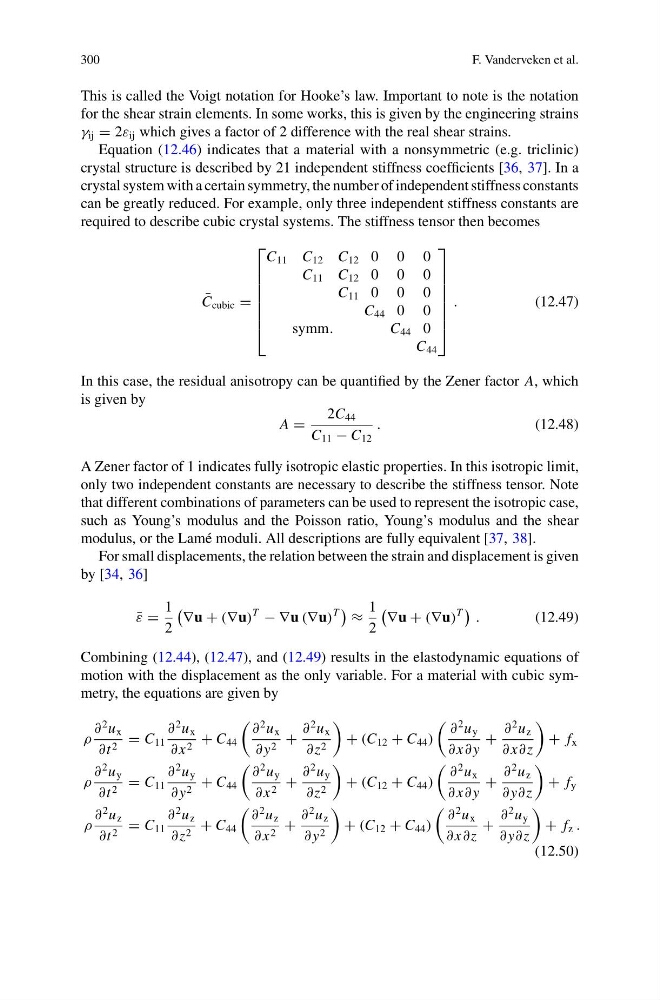
required to describe cubic crystal systems. The stiffness tensor then becomes
¯
C cubic =
⎡
⎢
⎢
⎢
⎢
⎢
⎢
⎣
C 11 C 12 C 12 0 0 0
C 11 C 12 0 0 0
C 11 0 0 0
C 44 0 0
symm.
C 44 0
C 44
⎤
⎥
⎥
⎥
⎥
⎥
⎥
⎦
.
(12.47)
In this case, the residual anisotropy can be quantified by the Zener factor A, which
is given by
A =
2C 44
C 11 − C 12
.
(12.48)
A Zener factor of 1 indicates fully isotropic elastic properties. In this isotropic limit,
only two independent constants are necessary to describe the stiffness tensor. Note
that different combinations of parameters can be used to represent the isotropic case,
such as Young’s modulus and the Poisson ratio, Young’s modulus and the shear
modulus, or the Lamé moduli. All descriptions are fully equivalent [37, 38].
For small displacements, the relation between the strain and displacement is given
by [34, 36]
¯
ε =
1
2
∇u + (∇u)
T
− ∇u (∇u)
T
≈
1
2
∇u + (∇u)
T
.
(12.49)
Combining (12.44), (12.47), and (12.49) results in the elastodynamic equations of
motion with the displacement as the only variable. For a material with cubic symmetry, the equations are given by
ρ
∂
2 u x
∂t 2 = C 11
∂
2 u x
∂ x 2 + C 44
∂
2 u x
∂ y 2 +
∂
2 u x
∂z 2
+ (C 12 + C 44 )
∂
2 u y
∂ x∂ y
+
∂
2 u z
∂ x∂z
+ f x
ρ
∂
2 u y
∂t 2 = C 11
∂
2 u y
∂ y 2 + C 44
∂
2 u y
∂ x 2 +
∂
2 u y
∂z 2
+ (C 12 + C 44 )
∂
2 u x
∂ x∂ y
+
∂
2 u z
∂ y∂z
+ f y
ρ
∂
2 u z
∂t 2 = C 11
∂
2 u z
∂z 2 + C 44
∂
2 u z
∂ x 2 +
∂
2 u z
∂ y 2
+ (C 12 + C 44 )
∂
2 u x
∂ x∂z
+
∂
2 u y
∂ y∂z
+ f z .
(12.50)
F. Vanderveken et al.
This is called the Voigt notation for Hooke’s law. Important to note is the notation
for the shear strain elements. In some works, this is given by the engineering strains
γ ij = 2ε ij which gives a factor of 2 difference with the real shear strains.
Equation (12.46) indicates that a material with a nonsymmetric (e.g. triclinic)
crystal structure is described by 21 independent stiffness coefficients [36, 37]. In a
crystal system with a certain symmetry, the number of independent stiffness constants
can be greatly reduced. For example, only three independent stiffness constants are
required to describe cubic crystal systems. The stiffness tensor then becomes
¯
C cubic =
⎡
⎢
⎢
⎢
⎢
⎢
⎢
⎣
C 11 C 12 C 12 0 0 0
C 11 C 12 0 0 0
C 11 0 0 0
C 44 0 0
symm.
C 44 0
C 44
⎤
⎥
⎥
⎥
⎥
⎥
⎥
⎦
.
(12.47)
In this case, the residual anisotropy can be quantified by the Zener factor A, which
is given by
A =
2C 44
C 11 − C 12
.
(12.48)
A Zener factor of 1 indicates fully isotropic elastic properties. In this isotropic limit,
only two independent constants are necessary to describe the stiffness tensor. Note
that different combinations of parameters can be used to represent the isotropic case,
such as Young’s modulus and the Poisson ratio, Young’s modulus and the shear
modulus, or the Lamé moduli. All descriptions are fully equivalent [37, 38].
For small displacements, the relation between the strain and displacement is given
by [34, 36]
¯
ε =
1
2
∇u + (∇u)
T
− ∇u (∇u)
T
≈
1
2
∇u + (∇u)
T
.
(12.49)
Combining (12.44), (12.47), and (12.49) results in the elastodynamic equations of
motion with the displacement as the only variable. For a material with cubic symmetry, the equations are given by
ρ
∂
2 u x
∂t 2 = C 11
∂
2 u x
∂ x 2 + C 44
∂
2 u x
∂ y 2 +
∂
2 u x
∂z 2
+ (C 12 + C 44 )
∂
2 u y
∂ x∂ y
+
∂
2 u z
∂ x∂z
+ f x
ρ
∂
2 u y
∂t 2 = C 11
∂
2 u y
∂ y 2 + C 44
∂
2 u y
∂ x 2 +
∂
2 u y
∂z 2
+ (C 12 + C 44 )
∂
2 u x
∂ x∂ y
+
∂
2 u z
∂ y∂z
+ f y
ρ
∂
2 u z
∂t 2 = C 11
∂
2 u z
∂z 2 + C 44
∂
2 u z
∂ x 2 +
∂
2 u z
∂ y 2
+ (C 12 + C 44 )
∂
2 u x
∂ x∂z
+
∂
2 u y
∂ y∂z
+ f z .
(12.50)