

12 Magnetoelastic Waves in Thin Films
299
tion of energy stored in the dynamic electric field. As a result, besides the dipolar
and exchange regime, there also exist a regular electromagnetic regime at higher
frequencies, which corresponds to electromagnetic waves with a linear dispersion
relation.
12.3 Elastic Waves
In the previous section, the properties of spin waves in ferromagnetic media, both in
bulk materials and in thin films, have been discussed. In this section, we turn to the
properties of wave-like oscillations of the displacement, i.e. elastic waves. We start
with a short derivation of the fundamental equations of linear elasticity. Then, the
different types of elastic waves and their characteristics are described.
12.3.1 Elastodynamic Equations of Motion
The equation of motion for the displacement u is given by
ρ
d
2 u
dt 2 = ∇ · ¯
σ + f b
(12.44)
with ρ the mass density (kgm
−3 ), ¯
σ the two dimensional stress tensor with components σ ij (Nm
−2 ), and f b the body forces acting on the material (Nm
−3 ). For linear
elastic materials, the stress tensor is related to the strain tensor via Hooke’s law
¯
σ = ¯ ¯
C : ¯
ε
or
σ ij =
3
k=1
3
l=1
C ijkl ε kl .
(12.45)
Here, ¯ ¯
C is the fourth-order stiffness tensor and ¯
ε is the second-order strain tensor.
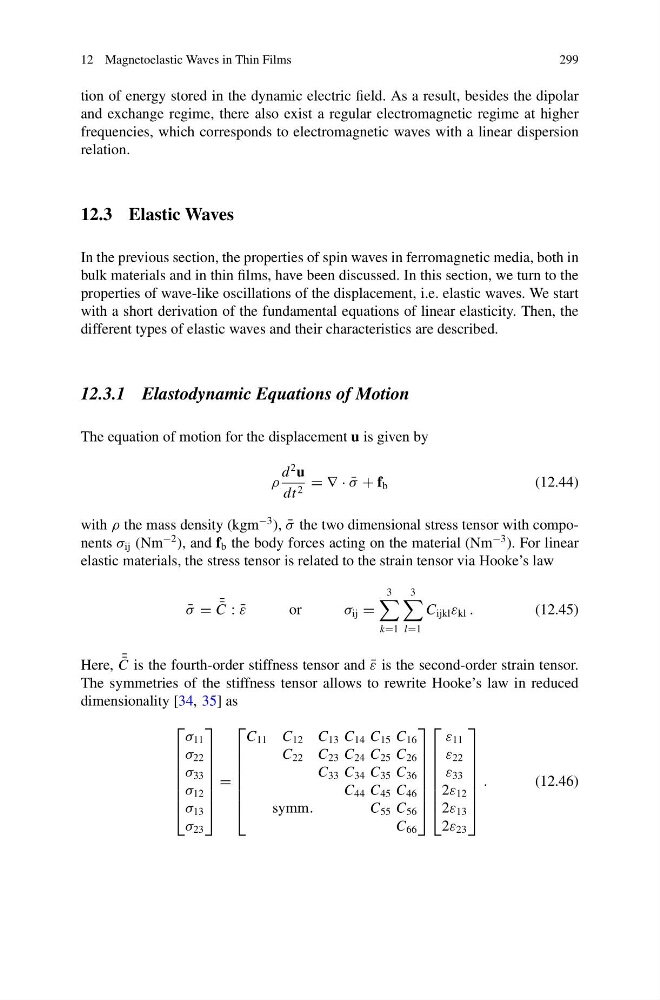
The symmetries of the stiffness tensor allows to rewrite Hooke’s law in reduced
dimensionality [34, 35] as
⎡
⎢
⎢
⎢
⎢
⎢
⎢
⎣
σ 11
σ 22
σ 33
σ 12
σ 13
σ 23
⎤
⎥
⎥
⎥
⎥
⎥
⎥
⎦
=
⎡
⎢
⎢
⎢
⎢
⎢
⎢
⎣
C 11 C 12 C 13 C 14 C 15 C 16
C 22 C 23 C 24 C 25 C 26
C 33 C 34 C 35 C 36
C 44 C 45 C 46
symm.
C 55 C 56
C 66
⎤
⎥
⎥
⎥
⎥
⎥
⎥
⎦
⎡
⎢
⎢
⎢
⎢
⎢
⎢
⎣
ε 11
ε 22
ε 33
2ε 12
2ε 13
2ε 23
⎤
⎥
⎥
⎥
⎥
⎥
⎥
⎦
.
(12.46)
299
tion of energy stored in the dynamic electric field. As a result, besides the dipolar
and exchange regime, there also exist a regular electromagnetic regime at higher
frequencies, which corresponds to electromagnetic waves with a linear dispersion
relation.
12.3 Elastic Waves
In the previous section, the properties of spin waves in ferromagnetic media, both in
bulk materials and in thin films, have been discussed. In this section, we turn to the
properties of wave-like oscillations of the displacement, i.e. elastic waves. We start
with a short derivation of the fundamental equations of linear elasticity. Then, the
different types of elastic waves and their characteristics are described.
12.3.1 Elastodynamic Equations of Motion
The equation of motion for the displacement u is given by
ρ
d
2 u
dt 2 = ∇ · ¯
σ + f b
(12.44)
with ρ the mass density (kgm
−3 ), ¯
σ the two dimensional stress tensor with components σ ij (Nm
−2 ), and f b the body forces acting on the material (Nm
−3 ). For linear
elastic materials, the stress tensor is related to the strain tensor via Hooke’s law
¯
σ = ¯ ¯
C : ¯
ε
or
σ ij =
3
k=1
3
l=1
C ijkl ε kl .
(12.45)
Here, ¯ ¯
C is the fourth-order stiffness tensor and ¯
ε is the second-order strain tensor.
The symmetries of the stiffness tensor allows to rewrite Hooke’s law in reduced
dimensionality [34, 35] as
⎡
⎢
⎢
⎢
⎢
⎢
⎢
⎣
σ 11
σ 22
σ 33
σ 12
σ 13
σ 23
⎤
⎥
⎥
⎥
⎥
⎥
⎥
⎦
=
⎡
⎢
⎢
⎢
⎢
⎢
⎢
⎣
C 11 C 12 C 13 C 14 C 15 C 16
C 22 C 23 C 24 C 25 C 26
C 33 C 34 C 35 C 36
C 44 C 45 C 46
symm.
C 55 C 56
C 66
⎤
⎥
⎥
⎥
⎥
⎥
⎥
⎦
⎡
⎢
⎢
⎢
⎢
⎢
⎢
⎣
ε 11
ε 22
ε 33
2ε 12
2ε 13
2ε 23
⎤
⎥
⎥
⎥
⎥
⎥
⎥
⎦
.
(12.46)