

298
F. Vanderveken et al.
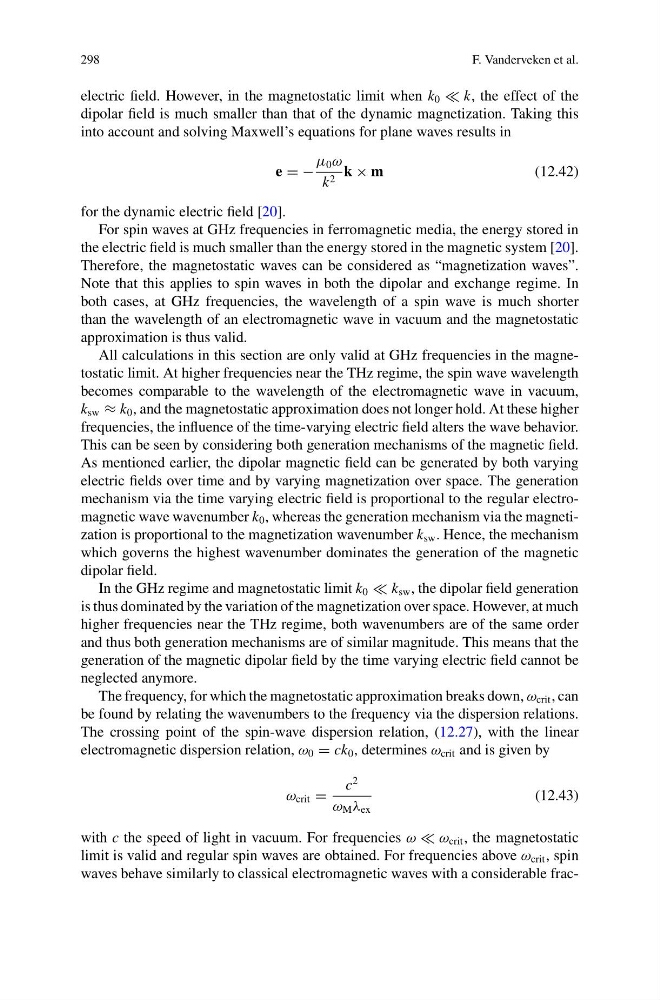
electric field. However, in the magnetostatic limit when k 0 k, the effect of the
dipolar field is much smaller than that of the dynamic magnetization. Taking this
into account and solving Maxwell’s equations for plane waves results in
e = −
μ 0 ω
k 2 k × m
(12.42)
for the dynamic electric field [20].
For spin waves at GHz frequencies in ferromagnetic media, the energy stored in
the electric field is much smaller than the energy stored in the magnetic system [20].
Therefore, the magnetostatic waves can be considered as “magnetization waves”.
Note that this applies to spin waves in both the dipolar and exchange regime. In
both cases, at GHz frequencies, the wavelength of a spin wave is much shorter
than the wavelength of an electromagnetic wave in vacuum and the magnetostatic
approximation is thus valid.
All calculations in this section are only valid at GHz frequencies in the magnetostatic limit. At higher frequencies near the THz regime, the spin wave wavelength
becomes comparable to the wavelength of the electromagnetic wave in vacuum,
k sw ≈ k 0 , and the magnetostatic approximation does not longer hold. At these higher
frequencies, the influence of the time-varying electric field alters the wave behavior.
This can be seen by considering both generation mechanisms of the magnetic field.
As mentioned earlier, the dipolar magnetic field can be generated by both varying
electric fields over time and by varying magnetization over space. The generation
mechanism via the time varying electric field is proportional to the regular electromagnetic wave wavenumber k 0 , whereas the generation mechanism via the magnetization is proportional to the magnetization wavenumber k sw . Hence, the mechanism
which governs the highest wavenumber dominates the generation of the magnetic
dipolar field.
In the GHz regime and magnetostatic limit k 0 k sw , the dipolar field generation
is thus dominated by the variation of the magnetization over space. However, at much
higher frequencies near the THz regime, both wavenumbers are of the same order
and thus both generation mechanisms are of similar magnitude. This means that the
generation of the magnetic dipolar field by the time varying electric field cannot be
neglected anymore.
The frequency, for which the magnetostatic approximation breaks down, ω crit , can
be found by relating the wavenumbers to the frequency via the dispersion relations.
The crossing point of the spin-wave dispersion relation, (12.27), with the linear
electromagnetic dispersion relation, ω 0 = ck 0 , determines ω crit and is given by
ω crit =
c
2
ω M λ ex
(12.43)
with c the speed of light in vacuum. For frequencies ω ω crit , the magnetostatic
limit is valid and regular spin waves are obtained. For frequencies above ω crit , spin
waves behave similarly to classical electromagnetic waves with a considerable frac-
F. Vanderveken et al.
electric field. However, in the magnetostatic limit when k 0 k, the effect of the
dipolar field is much smaller than that of the dynamic magnetization. Taking this
into account and solving Maxwell’s equations for plane waves results in
e = −
μ 0 ω
k 2 k × m
(12.42)
for the dynamic electric field [20].
For spin waves at GHz frequencies in ferromagnetic media, the energy stored in
the electric field is much smaller than the energy stored in the magnetic system [20].
Therefore, the magnetostatic waves can be considered as “magnetization waves”.
Note that this applies to spin waves in both the dipolar and exchange regime. In
both cases, at GHz frequencies, the wavelength of a spin wave is much shorter
than the wavelength of an electromagnetic wave in vacuum and the magnetostatic
approximation is thus valid.
All calculations in this section are only valid at GHz frequencies in the magnetostatic limit. At higher frequencies near the THz regime, the spin wave wavelength
becomes comparable to the wavelength of the electromagnetic wave in vacuum,
k sw ≈ k 0 , and the magnetostatic approximation does not longer hold. At these higher
frequencies, the influence of the time-varying electric field alters the wave behavior.
This can be seen by considering both generation mechanisms of the magnetic field.
As mentioned earlier, the dipolar magnetic field can be generated by both varying
electric fields over time and by varying magnetization over space. The generation
mechanism via the time varying electric field is proportional to the regular electromagnetic wave wavenumber k 0 , whereas the generation mechanism via the magnetization is proportional to the magnetization wavenumber k sw . Hence, the mechanism
which governs the highest wavenumber dominates the generation of the magnetic
dipolar field.
In the GHz regime and magnetostatic limit k 0 k sw , the dipolar field generation
is thus dominated by the variation of the magnetization over space. However, at much
higher frequencies near the THz regime, both wavenumbers are of the same order
and thus both generation mechanisms are of similar magnitude. This means that the
generation of the magnetic dipolar field by the time varying electric field cannot be
neglected anymore.
The frequency, for which the magnetostatic approximation breaks down, ω crit , can
be found by relating the wavenumbers to the frequency via the dispersion relations.
The crossing point of the spin-wave dispersion relation, (12.27), with the linear
electromagnetic dispersion relation, ω 0 = ck 0 , determines ω crit and is given by
ω crit =
c
2
ω M λ ex
(12.43)
with c the speed of light in vacuum. For frequencies ω ω crit , the magnetostatic
limit is valid and regular spin waves are obtained. For frequencies above ω crit , spin
waves behave similarly to classical electromagnetic waves with a considerable frac-