

12 Magnetoelastic Waves in Thin Films
297
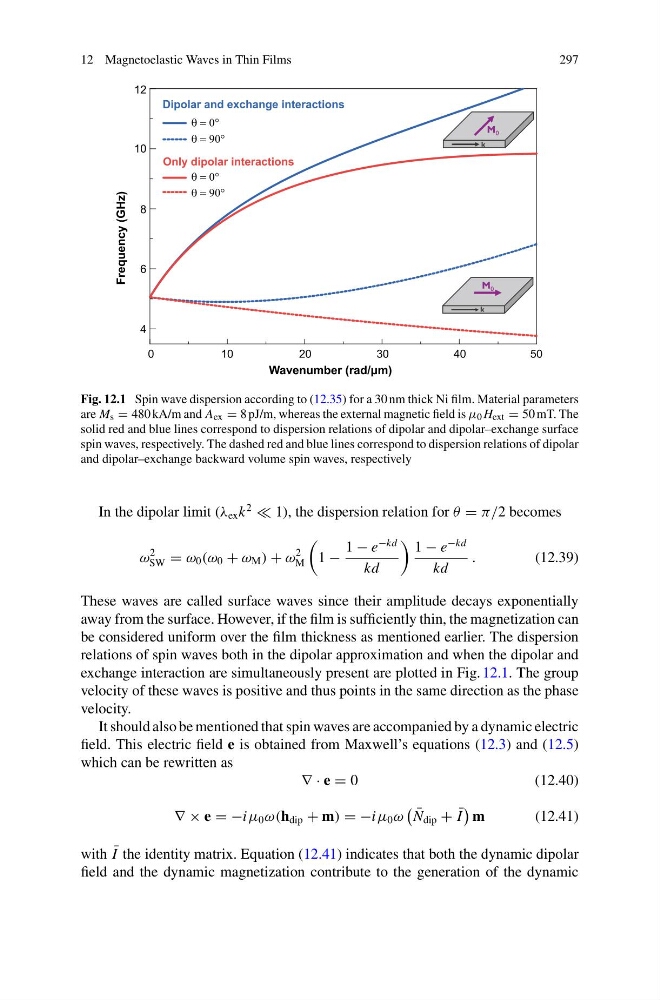
Fig. 12.1 Spin wave dispersion according to (12.35) for a 30 nm thick Ni film. Material parameters
are M s = 480 kA/m and A ex = 8 pJ/m, whereas the external magnetic field is μ 0 H ext = 50 mT. The
solid red and blue lines correspond to dispersion relations of dipolar and dipolar–exchange surface
spin waves, respectively. The dashed red and blue lines correspond to dispersion relations of dipolar
and dipolar–exchange backward volume spin waves, respectively
In the dipolar limit (λ ex k
2
1), the dispersion relation for θ = π/2 becomes
ω
2
SW = ω 0 (ω 0 + ω M ) + ω
2
M
1 −
1 − e
−kd
kd
1 − e
−kd
kd
.
(12.39)
These waves are called surface waves since their amplitude decays exponentially
away from the surface. However, if the film is sufficiently thin, the magnetization can
be considered uniform over the film thickness as mentioned earlier. The dispersion
relations of spin waves both in the dipolar approximation and when the dipolar and
exchange interaction are simultaneously present are plotted in Fig. 12.1. The group
velocity of these waves is positive and thus points in the same direction as the phase
velocity.
It should also be mentioned that spin waves are accompanied by a dynamic electric
field. This electric field e is obtained from Maxwell’s equations (12.3) and (12.5)
which can be rewritten as
∇ · e = 0
(12.40)
∇ × e = −iμ 0 ω(h dip + m) = −iμ 0 ω
¯
N dip + ¯
I
m
(12.41)
with ¯
I the identity matrix. Equation (12.41) indicates that both the dynamic dipolar
field and the dynamic magnetization contribute to the generation of the dynamic
297
Fig. 12.1 Spin wave dispersion according to (12.35) for a 30 nm thick Ni film. Material parameters
are M s = 480 kA/m and A ex = 8 pJ/m, whereas the external magnetic field is μ 0 H ext = 50 mT. The
solid red and blue lines correspond to dispersion relations of dipolar and dipolar–exchange surface
spin waves, respectively. The dashed red and blue lines correspond to dispersion relations of dipolar
and dipolar–exchange backward volume spin waves, respectively
In the dipolar limit (λ ex k
2
1), the dispersion relation for θ = π/2 becomes
ω
2
SW = ω 0 (ω 0 + ω M ) + ω
2
M
1 −
1 − e
−kd
kd
1 − e
−kd
kd
.
(12.39)
These waves are called surface waves since their amplitude decays exponentially
away from the surface. However, if the film is sufficiently thin, the magnetization can
be considered uniform over the film thickness as mentioned earlier. The dispersion
relations of spin waves both in the dipolar approximation and when the dipolar and
exchange interaction are simultaneously present are plotted in Fig. 12.1. The group
velocity of these waves is positive and thus points in the same direction as the phase
velocity.
It should also be mentioned that spin waves are accompanied by a dynamic electric
field. This electric field e is obtained from Maxwell’s equations (12.3) and (12.5)
which can be rewritten as
∇ · e = 0
(12.40)
∇ × e = −iμ 0 ω(h dip + m) = −iμ 0 ω
¯
N dip + ¯
I
m
(12.41)
with ¯
I the identity matrix. Equation (12.41) indicates that both the dynamic dipolar
field and the dynamic magnetization contribute to the generation of the dynamic