

296
F. Vanderveken et al.
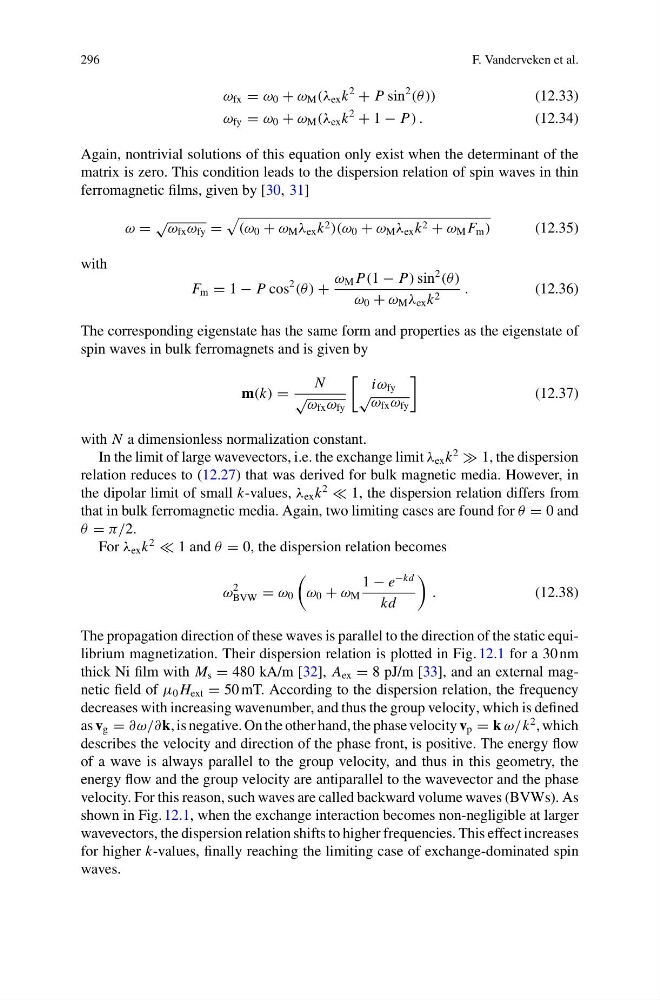
ω fx = ω 0 + ω M (λ ex k
2
+ P sin
2
(θ ))
(12.33)
ω fy = ω 0 + ω M (λ ex k
2
+ 1 − P) .
(12.34)
Again, nontrivial solutions of this equation only exist when the determinant of the
matrix is zero. This condition leads to the dispersion relation of spin waves in thin
ferromagnetic films, given by [30, 31]
ω =
√
ω fx ω fy =
(ω 0 + ω M λ ex k 2 )(ω 0 + ω M λ ex k 2 + ω M F m )
(12.35)
with
F m = 1 − P cos
2
(θ ) +
ω M P(1 − P) sin
2
(θ )
ω 0 + ω M λ ex k 2
.
(12.36)
The corresponding eigenstate has the same form and properties as the eigenstate of
spin waves in bulk ferromagnets and is given by
m(k) =
N
√
ω fx ω fy
iω fy
√ ω fx ω fy
(12.37)
with N a dimensionless normalization constant.
In the limit of large wavevectors, i.e. the exchange limit λ ex k
2
1, the dispersion
relation reduces to (12.27) that was derived for bulk magnetic media. However, in
the dipolar limit of small k-values, λ ex k
2
1, the dispersion relation differs from
that in bulk ferromagnetic media. Again, two limiting cases are found for θ = 0 and
θ = π/2.
For λ ex k
2
1 and θ = 0, the dispersion relation becomes
ω
2
BVW = ω 0
ω 0 + ω M
1 − e
−kd
kd
.
(12.38)
The propagation direction of these waves is parallel to the direction of the static equilibrium magnetization. Their dispersion relation is plotted in Fig. 12.1 for a 30 nm
thick Ni film with M s = 480 kA/m [32], A ex = 8 pJ/m [33], and an external magnetic field of μ 0 H ext = 50 mT. According to the dispersion relation, the frequency
decreases with increasing wavenumber, and thus the group velocity, which is defined
as v g = ∂ω/∂k, is negative. On the other hand, the phase velocity v p = k ω/k
2 , which
describes the velocity and direction of the phase front, is positive. The energy flow
of a wave is always parallel to the group velocity, and thus in this geometry, the
energy flow and the group velocity are antiparallel to the wavevector and the phase
velocity. For this reason, such waves are called backward volume waves (BVWs). As
shown in Fig. 12.1, when the exchange interaction becomes non-negligible at larger
wavevectors, the dispersion relation shifts to higher frequencies. This effect increases
for higher k-values, finally reaching the limiting case of exchange-dominated spin
waves.
F. Vanderveken et al.
ω fx = ω 0 + ω M (λ ex k
2
+ P sin
2
(θ ))
(12.33)
ω fy = ω 0 + ω M (λ ex k
2
+ 1 − P) .
(12.34)
Again, nontrivial solutions of this equation only exist when the determinant of the
matrix is zero. This condition leads to the dispersion relation of spin waves in thin
ferromagnetic films, given by [30, 31]
ω =
√
ω fx ω fy =
(ω 0 + ω M λ ex k 2 )(ω 0 + ω M λ ex k 2 + ω M F m )
(12.35)
with
F m = 1 − P cos
2
(θ ) +
ω M P(1 − P) sin
2
(θ )
ω 0 + ω M λ ex k 2
.
(12.36)
The corresponding eigenstate has the same form and properties as the eigenstate of
spin waves in bulk ferromagnets and is given by
m(k) =
N
√
ω fx ω fy
iω fy
√ ω fx ω fy
(12.37)
with N a dimensionless normalization constant.
In the limit of large wavevectors, i.e. the exchange limit λ ex k
2
1, the dispersion
relation reduces to (12.27) that was derived for bulk magnetic media. However, in
the dipolar limit of small k-values, λ ex k
2
1, the dispersion relation differs from
that in bulk ferromagnetic media. Again, two limiting cases are found for θ = 0 and
θ = π/2.
For λ ex k
2
1 and θ = 0, the dispersion relation becomes
ω
2
BVW = ω 0
ω 0 + ω M
1 − e
−kd
kd
.
(12.38)
The propagation direction of these waves is parallel to the direction of the static equilibrium magnetization. Their dispersion relation is plotted in Fig. 12.1 for a 30 nm
thick Ni film with M s = 480 kA/m [32], A ex = 8 pJ/m [33], and an external magnetic field of μ 0 H ext = 50 mT. According to the dispersion relation, the frequency
decreases with increasing wavenumber, and thus the group velocity, which is defined
as v g = ∂ω/∂k, is negative. On the other hand, the phase velocity v p = k ω/k
2 , which
describes the velocity and direction of the phase front, is positive. The energy flow
of a wave is always parallel to the group velocity, and thus in this geometry, the
energy flow and the group velocity are antiparallel to the wavevector and the phase
velocity. For this reason, such waves are called backward volume waves (BVWs). As
shown in Fig. 12.1, when the exchange interaction becomes non-negligible at larger
wavevectors, the dispersion relation shifts to higher frequencies. This effect increases
for higher k-values, finally reaching the limiting case of exchange-dominated spin
waves.