

12 Magnetoelastic Waves in Thin Films
293
term, the LLG equation becomes
d[M 0 + m(r, t)]
dt
= −γ 0 [(M 0 + m(r, t)) × (H ext + h dip (r, t) + h ex (r, t))]
(12.18)
with γ 0 = γ μ 0 . Terms quadratic in m can be neglected because the perturbation is
assumed to be weak, which results in the linearized LLG equation given by
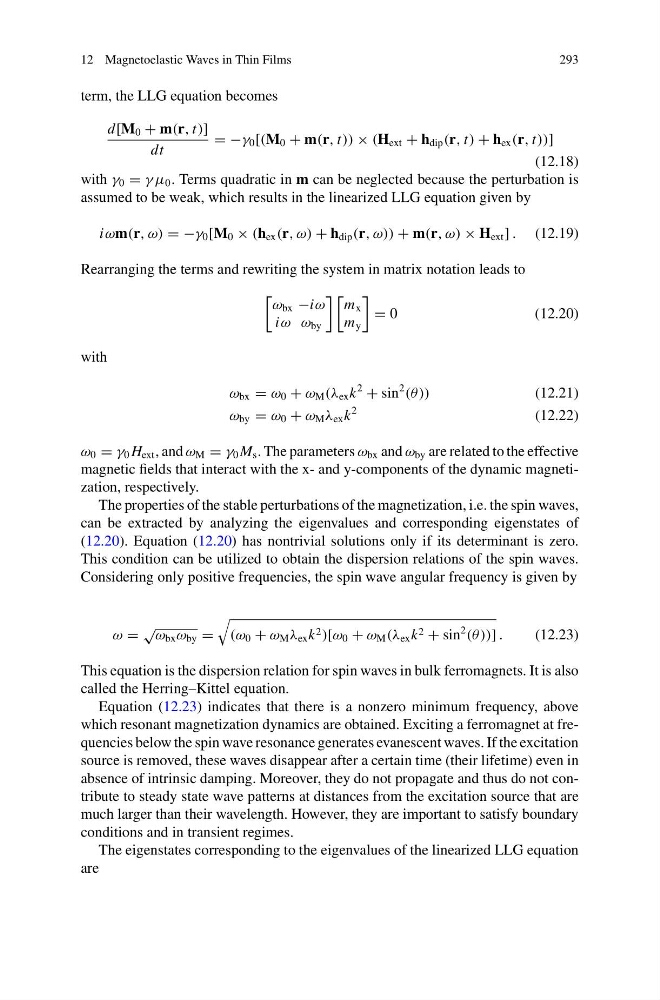
iωm(r, ω) = −γ 0 [M 0 × (h ex (r, ω) + h dip (r, ω)) + m(r, ω) × H ext ] . (12.19)
Rearranging the terms and rewriting the system in matrix notation leads to
ω bx −iω
iω ω by
m x
m y
= 0
(12.20)
with
ω bx = ω 0 + ω M (λ ex k
2
+ sin
2
(θ ))
(12.21)
ω by = ω 0 + ω M λ ex k
2
(12.22)
ω 0 = γ 0 H ext , and ω M = γ 0 M s . The parameters ω bx and ω by are related to the effective
magnetic fields that interact with the x- and y-components of the dynamic magnetization, respectively.
The properties of the stable perturbations of the magnetization, i.e. the spin waves,
can be extracted by analyzing the eigenvalues and corresponding eigenstates of
(12.20). Equation (12.20) has nontrivial solutions only if its determinant is zero.
This condition can be utilized to obtain the dispersion relations of the spin waves.
Considering only positive frequencies, the spin wave angular frequency is given by
ω =
√ ω bx ω by =
(ω 0 + ω M λ ex k 2 )[ω 0 + ω M (λ ex k 2 + sin
2
(θ ))] .
(12.23)
This equation is the dispersion relation for spin waves in bulk ferromagnets. It is also
called the Herring–Kittel equation.
Equation (12.23) indicates that there is a nonzero minimum frequency, above
which resonant magnetization dynamics are obtained. Exciting a ferromagnet at frequencies below the spin wave resonance generates evanescent waves. If the excitation
source is removed, these waves disappear after a certain time (their lifetime) even in
absence of intrinsic damping. Moreover, they do not propagate and thus do not contribute to steady state wave patterns at distances from the excitation source that are
much larger than their wavelength. However, they are important to satisfy boundary
conditions and in transient regimes.
The eigenstates corresponding to the eigenvalues of the linearized LLG equation
are
293
term, the LLG equation becomes
d[M 0 + m(r, t)]
dt
= −γ 0 [(M 0 + m(r, t)) × (H ext + h dip (r, t) + h ex (r, t))]
(12.18)
with γ 0 = γ μ 0 . Terms quadratic in m can be neglected because the perturbation is
assumed to be weak, which results in the linearized LLG equation given by
iωm(r, ω) = −γ 0 [M 0 × (h ex (r, ω) + h dip (r, ω)) + m(r, ω) × H ext ] . (12.19)
Rearranging the terms and rewriting the system in matrix notation leads to
ω bx −iω
iω ω by
m x
m y
= 0
(12.20)
with
ω bx = ω 0 + ω M (λ ex k
2
+ sin
2
(θ ))
(12.21)
ω by = ω 0 + ω M λ ex k
2
(12.22)
ω 0 = γ 0 H ext , and ω M = γ 0 M s . The parameters ω bx and ω by are related to the effective
magnetic fields that interact with the x- and y-components of the dynamic magnetization, respectively.
The properties of the stable perturbations of the magnetization, i.e. the spin waves,
can be extracted by analyzing the eigenvalues and corresponding eigenstates of
(12.20). Equation (12.20) has nontrivial solutions only if its determinant is zero.
This condition can be utilized to obtain the dispersion relations of the spin waves.
Considering only positive frequencies, the spin wave angular frequency is given by
ω =
√ ω bx ω by =
(ω 0 + ω M λ ex k 2 )[ω 0 + ω M (λ ex k 2 + sin
2
(θ ))] .
(12.23)
This equation is the dispersion relation for spin waves in bulk ferromagnets. It is also
called the Herring–Kittel equation.
Equation (12.23) indicates that there is a nonzero minimum frequency, above
which resonant magnetization dynamics are obtained. Exciting a ferromagnet at frequencies below the spin wave resonance generates evanescent waves. If the excitation
source is removed, these waves disappear after a certain time (their lifetime) even in
absence of intrinsic damping. Moreover, they do not propagate and thus do not contribute to steady state wave patterns at distances from the excitation source that are
much larger than their wavelength. However, they are important to satisfy boundary
conditions and in transient regimes.
The eigenstates corresponding to the eigenvalues of the linearized LLG equation
are