

294
F. Vanderveken et al.
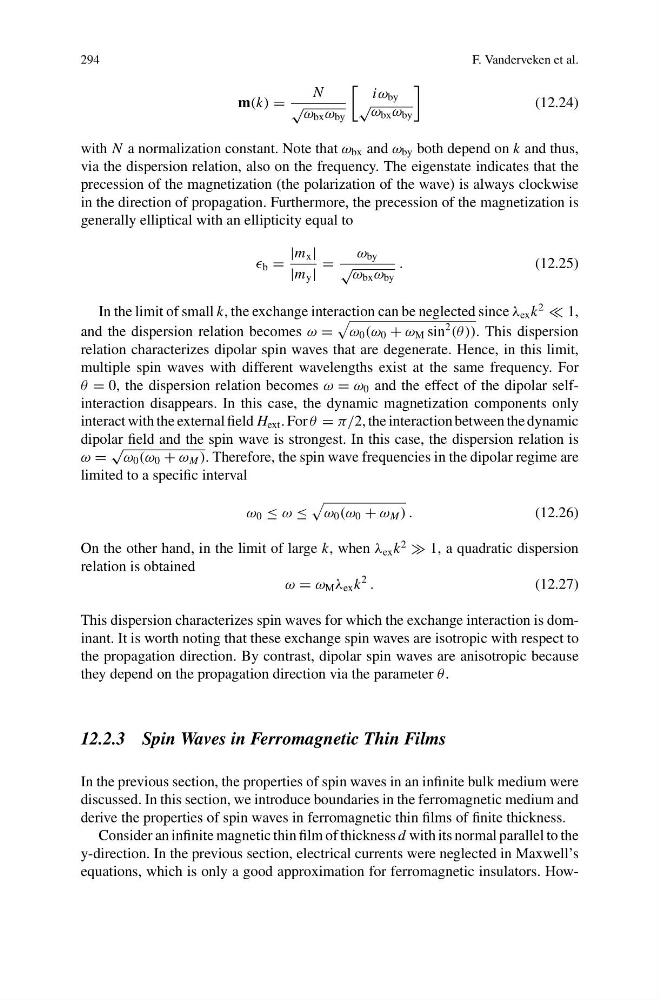
m(k) =
N
√
ω bx ω by
iω by
√ ω bx ω by
(12.24)
with N a normalization constant. Note that ω bx and ω by both depend on k and thus,
via the dispersion relation, also on the frequency. The eigenstate indicates that the
precession of the magnetization (the polarization of the wave) is always clockwise
in the direction of propagation. Furthermore, the precession of the magnetization is
generally elliptical with an ellipticity equal to
b =
|m x |
|m y |
=
ω by
√
ω bx ω by
.
(12.25)
In the limit of small k, the exchange interaction can be neglected since λ ex k
2
1,
and the dispersion relation becomes ω =
ω 0 (ω 0 + ω M sin
2
(θ )). This dispersion
relation characterizes dipolar spin waves that are degenerate. Hence, in this limit,
multiple spin waves with different wavelengths exist at the same frequency. For
θ = 0, the dispersion relation becomes ω = ω 0 and the effect of the dipolar selfinteraction disappears. In this case, the dynamic magnetization components only
interact with the external field H ext . For θ = π/2, the interaction between the dynamic
dipolar field and the spin wave is strongest. In this case, the dispersion relation is
ω =
√ ω 0 (ω 0 + ω M ). Therefore, the spin wave frequencies in the dipolar regime are
limited to a specific interval
ω 0 ≤ ω ≤
ω 0 (ω 0 + ω M ) .
(12.26)
On the other hand, in the limit of large k, when λ ex k
2
1, a quadratic dispersion
relation is obtained
ω = ω M λ ex k
2
.
(12.27)
This dispersion characterizes spin waves for which the exchange interaction is dominant. It is worth noting that these exchange spin waves are isotropic with respect to
the propagation direction. By contrast, dipolar spin waves are anisotropic because
they depend on the propagation direction via the parameter θ .
12.2.3 Spin Waves in Ferromagnetic Thin Films
In the previous section, the properties of spin waves in an infinite bulk medium were
discussed. In this section, we introduce boundaries in the ferromagnetic medium and
derive the properties of spin waves in ferromagnetic thin films of finite thickness.
Consider an infinite magnetic thin film of thickness d with its normal parallel to the
y-direction. In the previous section, electrical currents were neglected in Maxwell’s
equations, which is only a good approximation for ferromagnetic insulators. How-
F. Vanderveken et al.
m(k) =
N
√
ω bx ω by
iω by
√ ω bx ω by
(12.24)
with N a normalization constant. Note that ω bx and ω by both depend on k and thus,
via the dispersion relation, also on the frequency. The eigenstate indicates that the
precession of the magnetization (the polarization of the wave) is always clockwise
in the direction of propagation. Furthermore, the precession of the magnetization is
generally elliptical with an ellipticity equal to
b =
|m x |
|m y |
=
ω by
√
ω bx ω by
.
(12.25)
In the limit of small k, the exchange interaction can be neglected since λ ex k
2
1,
and the dispersion relation becomes ω =
ω 0 (ω 0 + ω M sin
2
(θ )). This dispersion
relation characterizes dipolar spin waves that are degenerate. Hence, in this limit,
multiple spin waves with different wavelengths exist at the same frequency. For
θ = 0, the dispersion relation becomes ω = ω 0 and the effect of the dipolar selfinteraction disappears. In this case, the dynamic magnetization components only
interact with the external field H ext . For θ = π/2, the interaction between the dynamic
dipolar field and the spin wave is strongest. In this case, the dispersion relation is
ω =
√ ω 0 (ω 0 + ω M ). Therefore, the spin wave frequencies in the dipolar regime are
limited to a specific interval
ω 0 ≤ ω ≤
ω 0 (ω 0 + ω M ) .
(12.26)
On the other hand, in the limit of large k, when λ ex k
2
1, a quadratic dispersion
relation is obtained
ω = ω M λ ex k
2
.
(12.27)
This dispersion characterizes spin waves for which the exchange interaction is dominant. It is worth noting that these exchange spin waves are isotropic with respect to
the propagation direction. By contrast, dipolar spin waves are anisotropic because
they depend on the propagation direction via the parameter θ .
12.2.3 Spin Waves in Ferromagnetic Thin Films
In the previous section, the properties of spin waves in an infinite bulk medium were
discussed. In this section, we introduce boundaries in the ferromagnetic medium and
derive the properties of spin waves in ferromagnetic thin films of finite thickness.
Consider an infinite magnetic thin film of thickness d with its normal parallel to the
y-direction. In the previous section, electrical currents were neglected in Maxwell’s
equations, which is only a good approximation for ferromagnetic insulators. How-