

12 Magnetoelastic Waves in Thin Films
291
with V
the volume of the magnetic material and ¯
D(r − r
) the tensorial magnetostatic Green’s function given by [16]
¯
D(r − r
) = −∇ r ∇ r
1
|r − r |
.
(12.10)
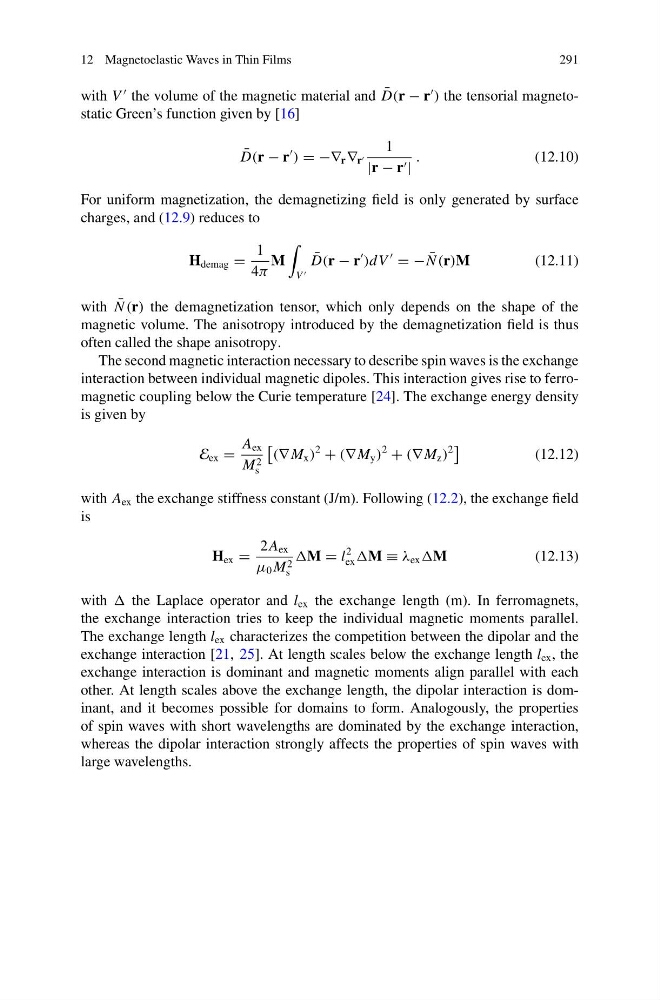
For uniform magnetization, the demagnetizing field is only generated by surface
charges, and (12.9) reduces to
H demag =
1
4π
M
V
¯
D(r − r
)dV
= − ¯
N (r)M
(12.11)
with ¯
N (r) the demagnetization tensor, which only depends on the shape of the
magnetic volume. The anisotropy introduced by the demagnetization field is thus
often called the shape anisotropy.
The second magnetic interaction necessary to describe spin waves is the exchange
interaction between individual magnetic dipoles. This interaction gives rise to ferromagnetic coupling below the Curie temperature [24]. The exchange energy density
is given by
E ex =
A ex
M 2
s
(∇ M x )
2
+ (∇ M y )
2
+ (∇ M z )
2
(12.12)
with A ex the exchange stiffness constant (J/m). Following (12.2), the exchange field
is
H ex =
2 A ex
μ 0 M 2
s
M = l
2
ex M ≡ λ ex M
(12.13)
with the Laplace operator and l ex the exchange length (m). In ferromagnets,
the exchange interaction tries to keep the individual magnetic moments parallel.
The exchange length l ex characterizes the competition between the dipolar and the
exchange interaction [21, 25]. At length scales below the exchange length l ex , the
exchange interaction is dominant and magnetic moments align parallel with each
other. At length scales above the exchange length, the dipolar interaction is dominant, and it becomes possible for domains to form. Analogously, the properties
of spin waves with short wavelengths are dominated by the exchange interaction,
whereas the dipolar interaction strongly affects the properties of spin waves with
large wavelengths.
291
with V
the volume of the magnetic material and ¯
D(r − r
) the tensorial magnetostatic Green’s function given by [16]
¯
D(r − r
) = −∇ r ∇ r
1
|r − r |
.
(12.10)
For uniform magnetization, the demagnetizing field is only generated by surface
charges, and (12.9) reduces to
H demag =
1
4π
M
V
¯
D(r − r
)dV
= − ¯
N (r)M
(12.11)
with ¯
N (r) the demagnetization tensor, which only depends on the shape of the
magnetic volume. The anisotropy introduced by the demagnetization field is thus
often called the shape anisotropy.
The second magnetic interaction necessary to describe spin waves is the exchange
interaction between individual magnetic dipoles. This interaction gives rise to ferromagnetic coupling below the Curie temperature [24]. The exchange energy density
is given by
E ex =
A ex
M 2
s
(∇ M x )
2
+ (∇ M y )
2
+ (∇ M z )
2
(12.12)
with A ex the exchange stiffness constant (J/m). Following (12.2), the exchange field
is
H ex =
2 A ex
μ 0 M 2
s
M = l
2
ex M ≡ λ ex M
(12.13)
with the Laplace operator and l ex the exchange length (m). In ferromagnets,
the exchange interaction tries to keep the individual magnetic moments parallel.
The exchange length l ex characterizes the competition between the dipolar and the
exchange interaction [21, 25]. At length scales below the exchange length l ex , the
exchange interaction is dominant and magnetic moments align parallel with each
other. At length scales above the exchange length, the dipolar interaction is dominant, and it becomes possible for domains to form. Analogously, the properties
of spin waves with short wavelengths are dominated by the exchange interaction,
whereas the dipolar interaction strongly affects the properties of spin waves with
large wavelengths.