

290
F. Vanderveken et al.
The dipolar interaction describes the direct interaction between magnetic dipoles.
Following (12.2), the interaction can be represented by a dipolar magnetic field. This
field is found by solving Maxwell’s equations. For spin waves at GHz frequencies, the
magnetostatic approximation is valid since the wavelengths of such spin waves are
several orders of magnitude shorter than those of electromagnetic waves in vacuum at
the same frequency, i.e. k 0 k sw with k 0 the wavenumber of an electromagnetic wave
in vacuum and k sw the wavenumber of a spin wave. This approximation implies that
the change in electric field over time, ∂E/∂t, has a negligible effect on the generation
of the magnetic field. Assuming further that no free charges and no electrical currents
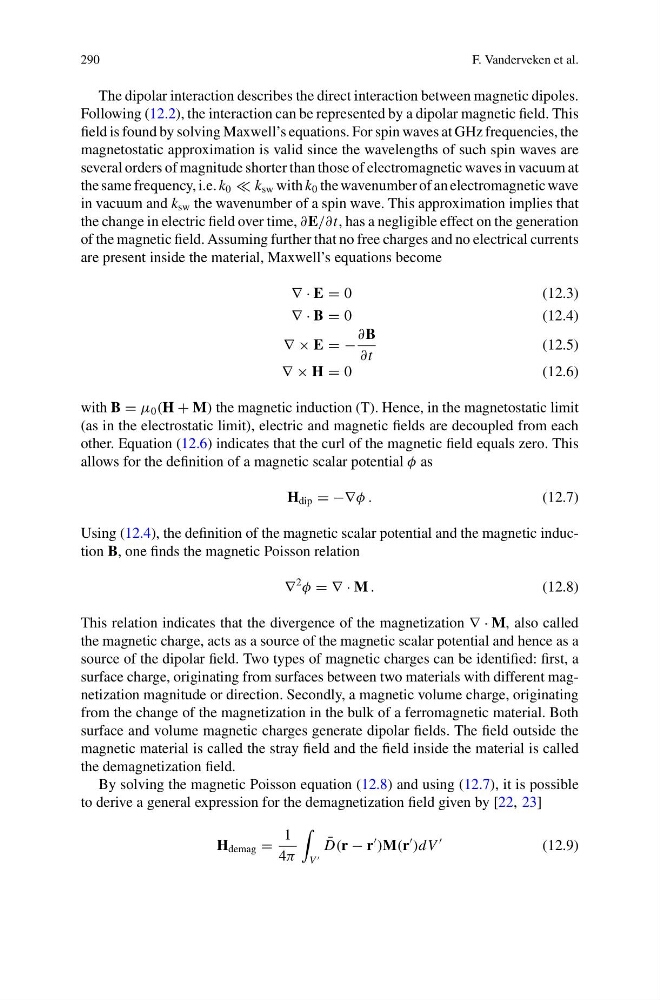
are present inside the material, Maxwell’s equations become
∇ · E = 0
(12.3)
∇ · B = 0
(12.4)
∇ × E = −
∂B
∂t
(12.5)
∇ × H = 0
(12.6)
with B = μ 0 (H + M) the magnetic induction (T). Hence, in the magnetostatic limit
(as in the electrostatic limit), electric and magnetic fields are decoupled from each
other. Equation (12.6) indicates that the curl of the magnetic field equals zero. This
allows for the definition of a magnetic scalar potential φ as
H dip = −∇φ .
(12.7)
Using (12.4), the definition of the magnetic scalar potential and the magnetic induction B, one finds the magnetic Poisson relation
∇
2
φ = ∇ · M .
(12.8)
This relation indicates that the divergence of the magnetization ∇ · M, also called
the magnetic charge, acts as a source of the magnetic scalar potential and hence as a
source of the dipolar field. Two types of magnetic charges can be identified: first, a
surface charge, originating from surfaces between two materials with different magnetization magnitude or direction. Secondly, a magnetic volume charge, originating
from the change of the magnetization in the bulk of a ferromagnetic material. Both
surface and volume magnetic charges generate dipolar fields. The field outside the
magnetic material is called the stray field and the field inside the material is called
the demagnetization field.
By solving the magnetic Poisson equation (12.8) and using (12.7), it is possible
to derive a general expression for the demagnetization field given by [22, 23]
H demag =
1
4π
V
¯
D(r − r
)M(r
)dV
(12.9)
F. Vanderveken et al.
The dipolar interaction describes the direct interaction between magnetic dipoles.
Following (12.2), the interaction can be represented by a dipolar magnetic field. This
field is found by solving Maxwell’s equations. For spin waves at GHz frequencies, the
magnetostatic approximation is valid since the wavelengths of such spin waves are
several orders of magnitude shorter than those of electromagnetic waves in vacuum at
the same frequency, i.e. k 0 k sw with k 0 the wavenumber of an electromagnetic wave
in vacuum and k sw the wavenumber of a spin wave. This approximation implies that
the change in electric field over time, ∂E/∂t, has a negligible effect on the generation
of the magnetic field. Assuming further that no free charges and no electrical currents
are present inside the material, Maxwell’s equations become
∇ · E = 0
(12.3)
∇ · B = 0
(12.4)
∇ × E = −
∂B
∂t
(12.5)
∇ × H = 0
(12.6)
with B = μ 0 (H + M) the magnetic induction (T). Hence, in the magnetostatic limit
(as in the electrostatic limit), electric and magnetic fields are decoupled from each
other. Equation (12.6) indicates that the curl of the magnetic field equals zero. This
allows for the definition of a magnetic scalar potential φ as
H dip = −∇φ .
(12.7)
Using (12.4), the definition of the magnetic scalar potential and the magnetic induction B, one finds the magnetic Poisson relation
∇
2
φ = ∇ · M .
(12.8)
This relation indicates that the divergence of the magnetization ∇ · M, also called
the magnetic charge, acts as a source of the magnetic scalar potential and hence as a
source of the dipolar field. Two types of magnetic charges can be identified: first, a
surface charge, originating from surfaces between two materials with different magnetization magnitude or direction. Secondly, a magnetic volume charge, originating
from the change of the magnetization in the bulk of a ferromagnetic material. Both
surface and volume magnetic charges generate dipolar fields. The field outside the
magnetic material is called the stray field and the field inside the material is called
the demagnetization field.
By solving the magnetic Poisson equation (12.8) and using (12.7), it is possible
to derive a general expression for the demagnetization field given by [22, 23]
H demag =
1
4π
V
¯
D(r − r
)M(r
)dV
(12.9)