

282
M. Sato
ˆ
H eff = ˆ
H mag −
1
2ω
B
2
0
ˆ
S
z
− i E
2
0 [ ˆ
P
x
, ˆ
P
y
] − i E 0 B 0
[ ˆ
P
x
, ˆ
S
x
] + [ ˆ
P
y
, ˆ
S
y
]
.
(11.29)
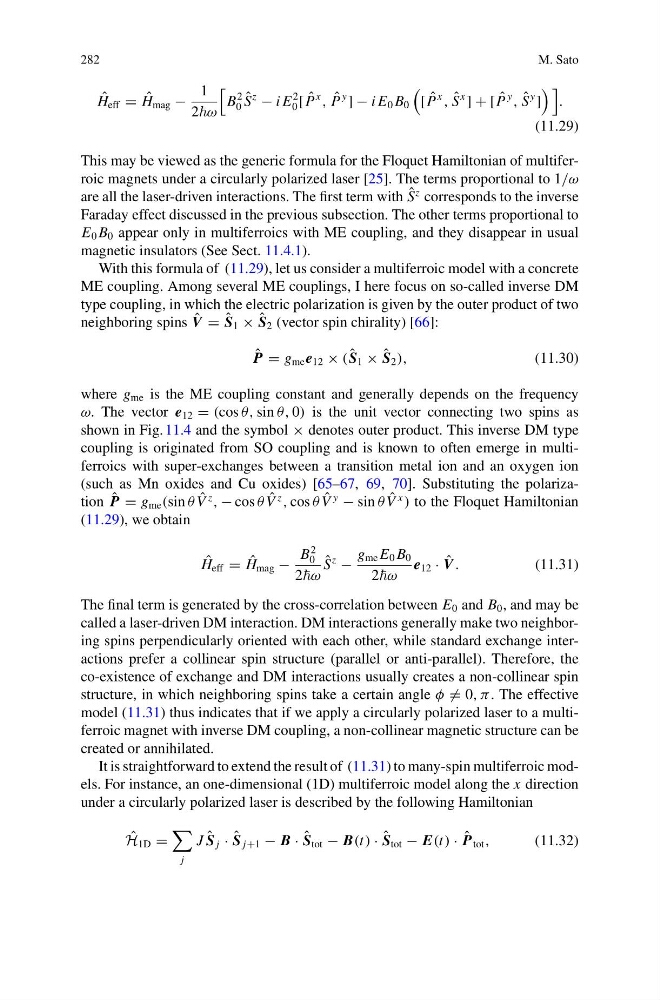
This may be viewed as the generic formula for the Floquet Hamiltonian of multiferroic magnets under a circularly polarized laser [25]. The terms proportional to 1/ω
are all the laser-driven interactions. The first term with ˆ
S
z corresponds to the inverse
Faraday effect discussed in the previous subsection. The other terms proportional to
E 0 B 0 appear only in multiferroics with ME coupling, and they disappear in usual
magnetic insulators (See Sect. 11.4.1).
With this formula of (11.29), let us consider a multiferroic model with a concrete
ME coupling. Among several ME couplings, I here focus on so-called inverse DM
type coupling, in which the electric polarization is given by the outer product of two
neighboring spins ˆ
V = ˆ
S 1 × ˆ
S 2 (vector spin chirality) [66]:
ˆ
P = g me e 12 × ( ˆ
S 1 × ˆ
S 2 ),
(11.30)
where g me is the ME coupling constant and generally depends on the frequency
ω. The vector e 12 = (cos θ, sin θ, 0) is the unit vector connecting two spins as
shown in Fig. 11.4 and the symbol × denotes outer product. This inverse DM type
coupling is originated from SO coupling and is known to often emerge in multiferroics with super-exchanges between a transition metal ion and an oxygen ion
(such as Mn oxides and Cu oxides) [65–67, 69, 70]. Substituting the polarization ˆ
P = g me (sin θ ˆ
V
z
, − cos θ ˆ
V
z
, cos θ ˆ
V
y
− sin θ ˆ
V
x
) to the Floquet Hamiltonian
(11.29), we obtain
ˆ
H eff = ˆ
H mag −
B
2
0
2ω
ˆ
S
z
−
g me E 0 B 0
2ω
e 12 · ˆ
V .
(11.31)
The final term is generated by the cross-correlation between E 0 and B 0 , and may be
called a laser-driven DM interaction. DM interactions generally make two neighboring spins perpendicularly oriented with each other, while standard exchange interactions prefer a collinear spin structure (parallel or anti-parallel). Therefore, the
co-existence of exchange and DM interactions usually creates a non-collinear spin
structure, in which neighboring spins take a certain angle φ = 0, π. The effective
model (11.31) thus indicates that if we apply a circularly polarized laser to a multiferroic magnet with inverse DM coupling, a non-collinear magnetic structure can be
created or annihilated.
It is straightforward to extend the result of (11.31) to many-spin multiferroic models. For instance, an one-dimensional (1D) multiferroic model along the x direction
under a circularly polarized laser is described by the following Hamiltonian
ˆ
H 1D =
j
J ˆ
S j · ˆ
S j+1 − B · ˆ
S tot − B(t) · ˆ
S tot − E(t) · ˆ
P tot ,
(11.32)
M. Sato
ˆ
H eff = ˆ
H mag −
1
2ω
B
2
0
ˆ
S
z
− i E
2
0 [ ˆ
P
x
, ˆ
P
y
] − i E 0 B 0
[ ˆ
P
x
, ˆ
S
x
] + [ ˆ
P
y
, ˆ
S
y
]
.
(11.29)
This may be viewed as the generic formula for the Floquet Hamiltonian of multiferroic magnets under a circularly polarized laser [25]. The terms proportional to 1/ω
are all the laser-driven interactions. The first term with ˆ
S
z corresponds to the inverse
Faraday effect discussed in the previous subsection. The other terms proportional to
E 0 B 0 appear only in multiferroics with ME coupling, and they disappear in usual
magnetic insulators (See Sect. 11.4.1).
With this formula of (11.29), let us consider a multiferroic model with a concrete
ME coupling. Among several ME couplings, I here focus on so-called inverse DM
type coupling, in which the electric polarization is given by the outer product of two
neighboring spins ˆ
V = ˆ
S 1 × ˆ
S 2 (vector spin chirality) [66]:
ˆ
P = g me e 12 × ( ˆ
S 1 × ˆ
S 2 ),
(11.30)
where g me is the ME coupling constant and generally depends on the frequency
ω. The vector e 12 = (cos θ, sin θ, 0) is the unit vector connecting two spins as
shown in Fig. 11.4 and the symbol × denotes outer product. This inverse DM type
coupling is originated from SO coupling and is known to often emerge in multiferroics with super-exchanges between a transition metal ion and an oxygen ion
(such as Mn oxides and Cu oxides) [65–67, 69, 70]. Substituting the polarization ˆ
P = g me (sin θ ˆ
V
z
, − cos θ ˆ
V
z
, cos θ ˆ
V
y
− sin θ ˆ
V
x
) to the Floquet Hamiltonian
(11.29), we obtain
ˆ
H eff = ˆ
H mag −
B
2
0
2ω
ˆ
S
z
−
g me E 0 B 0
2ω
e 12 · ˆ
V .
(11.31)
The final term is generated by the cross-correlation between E 0 and B 0 , and may be
called a laser-driven DM interaction. DM interactions generally make two neighboring spins perpendicularly oriented with each other, while standard exchange interactions prefer a collinear spin structure (parallel or anti-parallel). Therefore, the
co-existence of exchange and DM interactions usually creates a non-collinear spin
structure, in which neighboring spins take a certain angle φ = 0, π. The effective
model (11.31) thus indicates that if we apply a circularly polarized laser to a multiferroic magnet with inverse DM coupling, a non-collinear magnetic structure can be
created or annihilated.
It is straightforward to extend the result of (11.31) to many-spin multiferroic models. For instance, an one-dimensional (1D) multiferroic model along the x direction
under a circularly polarized laser is described by the following Hamiltonian
ˆ
H 1D =
j
J ˆ
S j · ˆ
S j+1 − B · ˆ
S tot − B(t) · ˆ
S tot − E(t) · ˆ
P tot ,
(11.32)