

11 Floquet Theory and Ultrafast Control of Magnetism
283
where S j is the electron spin on jth site, S tot =
j S j is the total spin, and the
polarization is given by ˆ
P tot = g em
j e × ( ˆ
S j × ˆ
S j+1 ) with e = (1, 0, 0) being the
unit vector along the chain (x) direction. The first term is the 1D exchange interaction
between neighboring spins and the second is the static Zeeman interaction. The third
and fourth terms are generated by applied laser fields B(t) and E(t). After some
algebra, we arrive at the Floquet Hamiltonian
ˆ
H eff =
j
J ˆ
S j · ˆ
S j+1 − B · ˆ
S tot −
B
2
0
2ω
ˆ
S
z
tot −
g me E 0 B 0
2ω
j
( ˆ
S j × ˆ
S j+1 )
x
.
(11.33)
The final term is the laser-driven uniform DM interaction which prefers a spiral spin
structure. A finite spin chirality V
x
tot =
j ( ˆ
S j × ˆ
S j+1 )
x
is shown [25] to be created when we numerically solve the Schrødinger equation for the driven multiferroic
model (11.32). This is owing to the competition between exchange and laser-driven
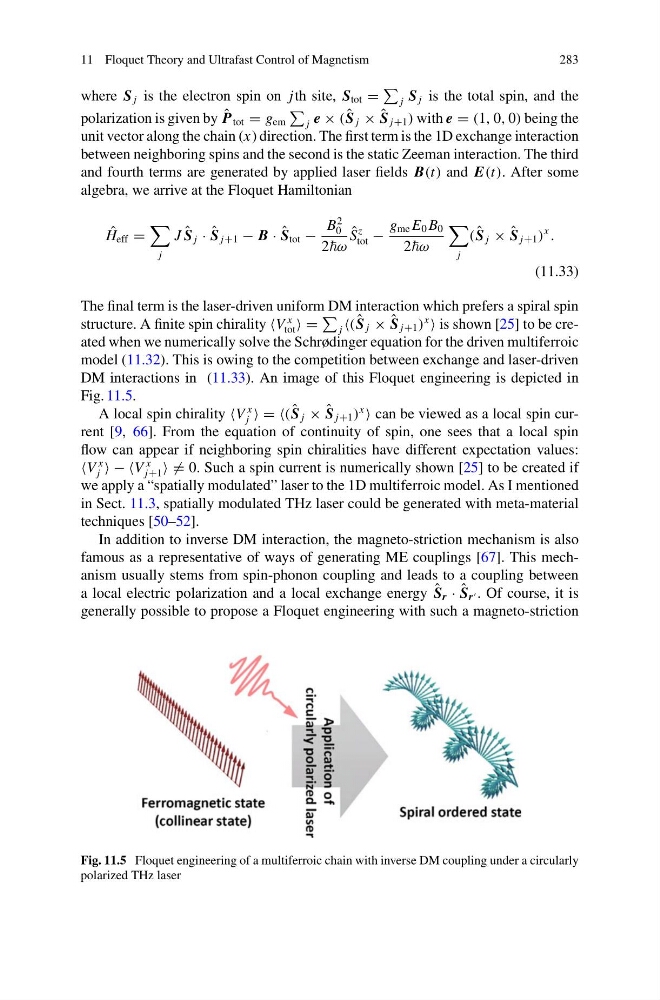
DM interactions in (11.33). An image of this Floquet engineering is depicted in
Fig. 11.5.
A local spin chirality V
x
j = =( ˆ
S j × ˆ
S j+1 )
x
can be viewed as a local spin current [9, 66]. From the equation of continuity of spin, one sees that a local spin
flow can appear if neighboring spin chiralities have different expectation values:
V
x
j − −V
x
j+1 = 0. Such a spin current is numerically shown [25] to be created if
we apply a “spatially modulated” laser to the 1D multiferroic model. As I mentioned
in Sect. 11.3, spatially modulated THz laser could be generated with meta-material
techniques [50–52].
In addition to inverse DM interaction, the magneto-striction mechanism is also
famous as a representative of ways of generating ME couplings [67]. This mechanism usually stems from spin-phonon coupling and leads to a coupling between
a local electric polarization and a local exchange energy ˆ
S r · ˆ
S r . Of course, it is
generally possible to propose a Floquet engineering with such a magneto-striction
Fig. 11.5 Floquet engineering of a multiferroic chain with inverse DM coupling under a circularly
polarized THz laser
283
where S j is the electron spin on jth site, S tot =
j S j is the total spin, and the
polarization is given by ˆ
P tot = g em
j e × ( ˆ
S j × ˆ
S j+1 ) with e = (1, 0, 0) being the
unit vector along the chain (x) direction. The first term is the 1D exchange interaction
between neighboring spins and the second is the static Zeeman interaction. The third
and fourth terms are generated by applied laser fields B(t) and E(t). After some
algebra, we arrive at the Floquet Hamiltonian
ˆ
H eff =
j
J ˆ
S j · ˆ
S j+1 − B · ˆ
S tot −
B
2
0
2ω
ˆ
S
z
tot −
g me E 0 B 0
2ω
j
( ˆ
S j × ˆ
S j+1 )
x
.
(11.33)
The final term is the laser-driven uniform DM interaction which prefers a spiral spin
structure. A finite spin chirality V
x
tot =
j ( ˆ
S j × ˆ
S j+1 )
x
is shown [25] to be created when we numerically solve the Schrødinger equation for the driven multiferroic
model (11.32). This is owing to the competition between exchange and laser-driven
DM interactions in (11.33). An image of this Floquet engineering is depicted in
Fig. 11.5.
A local spin chirality V
x
j = =( ˆ
S j × ˆ
S j+1 )
x
can be viewed as a local spin current [9, 66]. From the equation of continuity of spin, one sees that a local spin
flow can appear if neighboring spin chiralities have different expectation values:
V
x
j − −V
x
j+1 = 0. Such a spin current is numerically shown [25] to be created if
we apply a “spatially modulated” laser to the 1D multiferroic model. As I mentioned
in Sect. 11.3, spatially modulated THz laser could be generated with meta-material
techniques [50–52].
In addition to inverse DM interaction, the magneto-striction mechanism is also
famous as a representative of ways of generating ME couplings [67]. This mechanism usually stems from spin-phonon coupling and leads to a coupling between
a local electric polarization and a local exchange energy ˆ
S r · ˆ
S r . Of course, it is
generally possible to propose a Floquet engineering with such a magneto-striction
Fig. 11.5 Floquet engineering of a multiferroic chain with inverse DM coupling under a circularly
polarized THz laser