

11 Floquet Theory and Ultrafast Control of Magnetism
281
11.4.2 Ultrafast Control of Spin Chirality and Spin Current
in Multiferroic Magnets
In this subsection, we consider another type of magnetic insulators, a class of multiferroic magnets [66, 67]. Multiferroics stands for the system with cross-correlated multiple ferro-type orders in the broad sense. Particularly, in the last decade, researchers
have actively studied a class of multiferroic magnetic insulators with a strong coupling (called magneto-electric (ME) coupling) between magnetic moments and electric polarization. Therefore, recently the word “multiferroics” have been used as this
sort of magnets in a limited sense. In this subsection, I will use terminology “multiferroics” according to this convention. In such multiferroic magnets, there are several
types of ME couplings and the electric polarization may be almost always approximated by a function of electron spins.
When we theoretically analyze the essential aspects of the Floquet engineering for
multiferroics [25], it is enough to consider a simple two-spin multiferroic magnetic
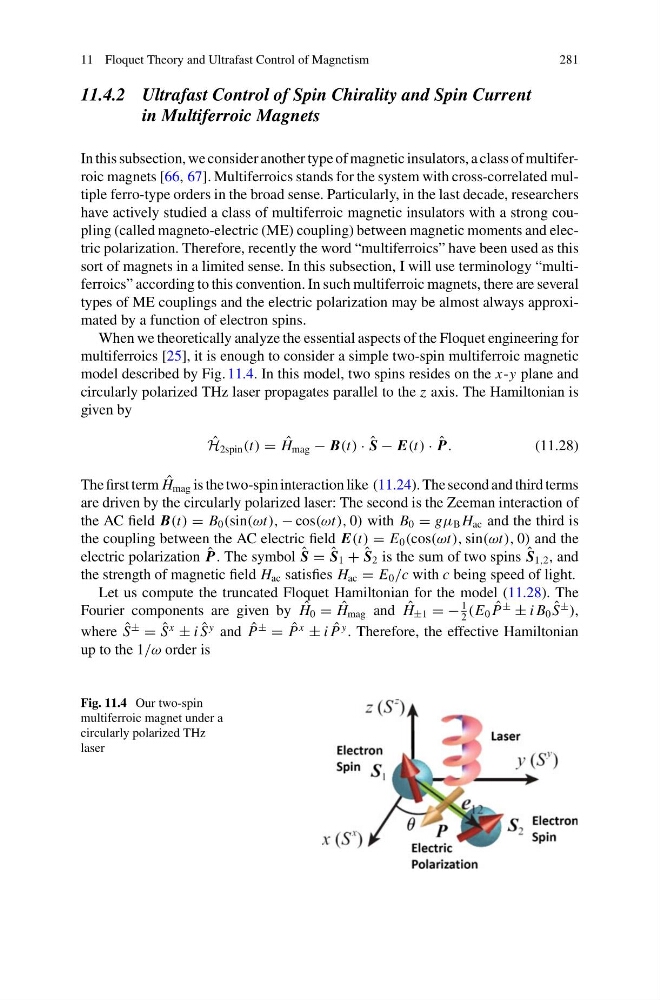
model described by Fig. 11.4. In this model, two spins resides on the x-y plane and
circularly polarized THz laser propagates parallel to the z axis. The Hamiltonian is
given by
ˆ
H 2spin (t) = ˆ
H mag − B(t) · ˆ
S − E(t) · ˆ
P.
(11.28)
The first term ˆ
H mag is the two-spin interaction like (11.24). The second and third terms
are driven by the circularly polarized laser: The second is the Zeeman interaction of
the AC field B(t) = B 0 (sin(ωt), − cos(ωt), 0) with B 0 = gμ B H ac and the third is
the coupling between the AC electric field E(t) = E 0 (cos(ωt), sin(ωt), 0) and the
electric polarization ˆ
P. The symbol ˆ
S = ˆ
S 1 + ˆ
S 2 is the sum of two spins ˆ
S 1,2 , and
the strength of magnetic field H ac satisfies H ac = E 0 /c with c being speed of light.
Let us compute the truncated Floquet Hamiltonian for the model (11.28). The
Fourier components are given by ˆ
H 0 = ˆ
H mag and ˆ
H ±1 = −
1
2
(E 0 ˆ
P
±
± i B 0 ˆ
S
±
),
where ˆ
S
±
= ˆ
S
x
± i ˆ
S
y and ˆ
P
±
= ˆ
P
x
± i ˆ
P
y . Therefore, the effective Hamiltonian
up to the 1/ω order is
Fig. 11.4 Our two-spin
multiferroic magnet under a
circularly polarized THz
laser
281
11.4.2 Ultrafast Control of Spin Chirality and Spin Current
in Multiferroic Magnets
In this subsection, we consider another type of magnetic insulators, a class of multiferroic magnets [66, 67]. Multiferroics stands for the system with cross-correlated multiple ferro-type orders in the broad sense. Particularly, in the last decade, researchers
have actively studied a class of multiferroic magnetic insulators with a strong coupling (called magneto-electric (ME) coupling) between magnetic moments and electric polarization. Therefore, recently the word “multiferroics” have been used as this
sort of magnets in a limited sense. In this subsection, I will use terminology “multiferroics” according to this convention. In such multiferroic magnets, there are several
types of ME couplings and the electric polarization may be almost always approximated by a function of electron spins.
When we theoretically analyze the essential aspects of the Floquet engineering for
multiferroics [25], it is enough to consider a simple two-spin multiferroic magnetic
model described by Fig. 11.4. In this model, two spins resides on the x-y plane and
circularly polarized THz laser propagates parallel to the z axis. The Hamiltonian is
given by
ˆ
H 2spin (t) = ˆ
H mag − B(t) · ˆ
S − E(t) · ˆ
P.
(11.28)
The first term ˆ
H mag is the two-spin interaction like (11.24). The second and third terms
are driven by the circularly polarized laser: The second is the Zeeman interaction of
the AC field B(t) = B 0 (sin(ωt), − cos(ωt), 0) with B 0 = gμ B H ac and the third is
the coupling between the AC electric field E(t) = E 0 (cos(ωt), sin(ωt), 0) and the
electric polarization ˆ
P. The symbol ˆ
S = ˆ
S 1 + ˆ
S 2 is the sum of two spins ˆ
S 1,2 , and
the strength of magnetic field H ac satisfies H ac = E 0 /c with c being speed of light.
Let us compute the truncated Floquet Hamiltonian for the model (11.28). The
Fourier components are given by ˆ
H 0 = ˆ
H mag and ˆ
H ±1 = −
1
2
(E 0 ˆ
P
±
± i B 0 ˆ
S
±
),
where ˆ
S
±
= ˆ
S
x
± i ˆ
S
y and ˆ
P
±
= ˆ
P
x
± i ˆ
P
y . Therefore, the effective Hamiltonian
up to the 1/ω order is
Fig. 11.4 Our two-spin
multiferroic magnet under a
circularly polarized THz
laser