

278
M. Sato
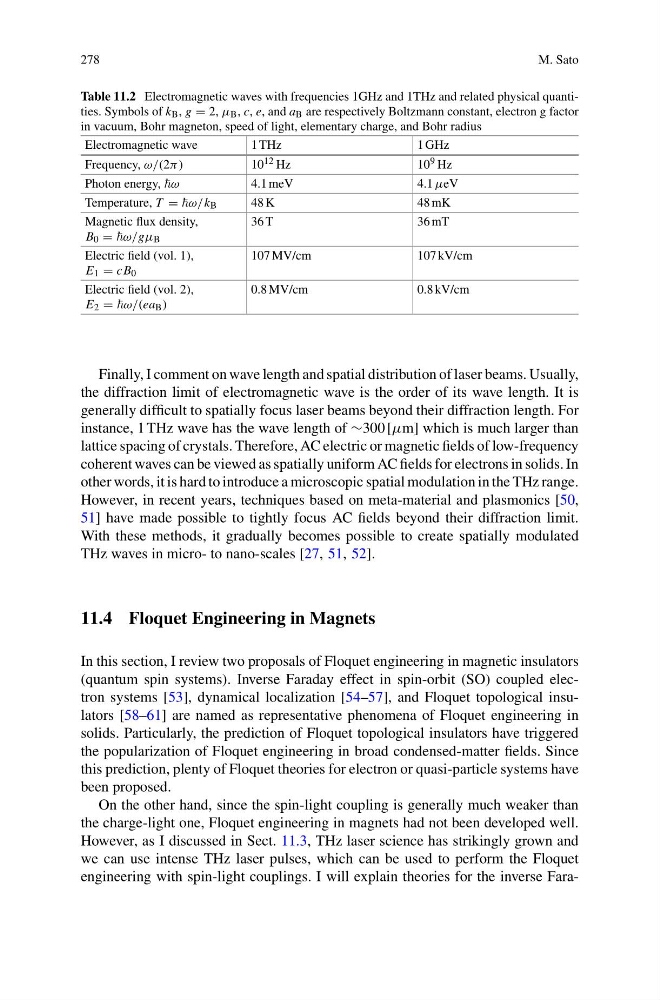
Table 11.2 Electromagnetic waves with frequencies 1GHz and 1THz and related physical quantities. Symbols of k B , g = 2, μ B , c, e, and a B are respectively Boltzmann constant, electron g factor
in vacuum, Bohr magneton, speed of light, elementary charge, and Bohr radius
Electromagnetic wave
1 THz
1 GHz
Frequency, ω/(2π)
10 12 Hz
10 9 Hz
Photon energy, ω
4.1 meV
4.1 μeV
Temperature, T = ω/k B
48 K
48 mK
Magnetic flux density,
B 0 = ω/gμ B
36 T
36 mT
Electric field (vol. 1),
E 1 = cB 0
107 MV/cm
107 kV/cm
Electric field (vol. 2),
E 2 = ω/(ea B )
0.8 MV/cm
0.8 kV/cm
Finally, I comment on wave length and spatial distribution of laser beams. Usually,
the diffraction limit of electromagnetic wave is the order of its wave length. It is
generally difficult to spatially focus laser beams beyond their diffraction length. For
instance, 1 THz wave has the wave length of ∼300 [μm] which is much larger than
lattice spacing of crystals. Therefore, AC electric or magnetic fields of low-frequency
coherent waves can be viewed as spatially uniform AC fields for electrons in solids. In
other words, it is hard to introduce a microscopic spatial modulation in the THz range.
However, in recent years, techniques based on meta-material and plasmonics [50,
51] have made possible to tightly focus AC fields beyond their diffraction limit.
With these methods, it gradually becomes possible to create spatially modulated
THz waves in micro- to nano-scales [27, 51, 52].
11.4 Floquet Engineering in Magnets
In this section, I review two proposals of Floquet engineering in magnetic insulators
(quantum spin systems). Inverse Faraday effect in spin-orbit (SO) coupled electron systems [53], dynamical localization [54–57], and Floquet topological insulators [58–61] are named as representative phenomena of Floquet engineering in
solids. Particularly, the prediction of Floquet topological insulators have triggered
the popularization of Floquet engineering in broad condensed-matter fields. Since
this prediction, plenty of Floquet theories for electron or quasi-particle systems have
been proposed.
On the other hand, since the spin-light coupling is generally much weaker than
the charge-light one, Floquet engineering in magnets had not been developed well.
However, as I discussed in Sect. 11.3, THz laser science has strikingly grown and
we can use intense THz laser pulses, which can be used to perform the Floquet
engineering with spin-light couplings. I will explain theories for the inverse Fara-
M. Sato
Table 11.2 Electromagnetic waves with frequencies 1GHz and 1THz and related physical quantities. Symbols of k B , g = 2, μ B , c, e, and a B are respectively Boltzmann constant, electron g factor
in vacuum, Bohr magneton, speed of light, elementary charge, and Bohr radius
Electromagnetic wave
1 THz
1 GHz
Frequency, ω/(2π)
10 12 Hz
10 9 Hz
Photon energy, ω
4.1 meV
4.1 μeV
Temperature, T = ω/k B
48 K
48 mK
Magnetic flux density,
B 0 = ω/gμ B
36 T
36 mT
Electric field (vol. 1),
E 1 = cB 0
107 MV/cm
107 kV/cm
Electric field (vol. 2),
E 2 = ω/(ea B )
0.8 MV/cm
0.8 kV/cm
Finally, I comment on wave length and spatial distribution of laser beams. Usually,
the diffraction limit of electromagnetic wave is the order of its wave length. It is
generally difficult to spatially focus laser beams beyond their diffraction length. For
instance, 1 THz wave has the wave length of ∼300 [μm] which is much larger than
lattice spacing of crystals. Therefore, AC electric or magnetic fields of low-frequency
coherent waves can be viewed as spatially uniform AC fields for electrons in solids. In
other words, it is hard to introduce a microscopic spatial modulation in the THz range.
However, in recent years, techniques based on meta-material and plasmonics [50,
51] have made possible to tightly focus AC fields beyond their diffraction limit.
With these methods, it gradually becomes possible to create spatially modulated
THz waves in micro- to nano-scales [27, 51, 52].
11.4 Floquet Engineering in Magnets
In this section, I review two proposals of Floquet engineering in magnetic insulators
(quantum spin systems). Inverse Faraday effect in spin-orbit (SO) coupled electron systems [53], dynamical localization [54–57], and Floquet topological insulators [58–61] are named as representative phenomena of Floquet engineering in
solids. Particularly, the prediction of Floquet topological insulators have triggered
the popularization of Floquet engineering in broad condensed-matter fields. Since
this prediction, plenty of Floquet theories for electron or quasi-particle systems have
been proposed.
On the other hand, since the spin-light coupling is generally much weaker than
the charge-light one, Floquet engineering in magnets had not been developed well.
However, as I discussed in Sect. 11.3, THz laser science has strikingly grown and
we can use intense THz laser pulses, which can be used to perform the Floquet
engineering with spin-light couplings. I will explain theories for the inverse Fara-