

11 Floquet Theory and Ultrafast Control of Magnetism
279
day effect (ultrafast control of magnetization) with THz laser and ultrafast control
of Dzyaloshinskii-Moriya (DM) interaction [62–64] in a class of multiferroic systems [65–67], respectively, in Sects. 11.4.1 and 11.4.2.
11.4.1 Inverse Faraday Effect by THz Laser
In this subsection, I consider a wide class of standard magnetic insulators (quantum
spin systems) [24, 68]. As I discussed in Sect. 11.3, magnetic excitations are distributed from 1 GHz to 10 THz, and thereby THz laser or wave are suitable for their
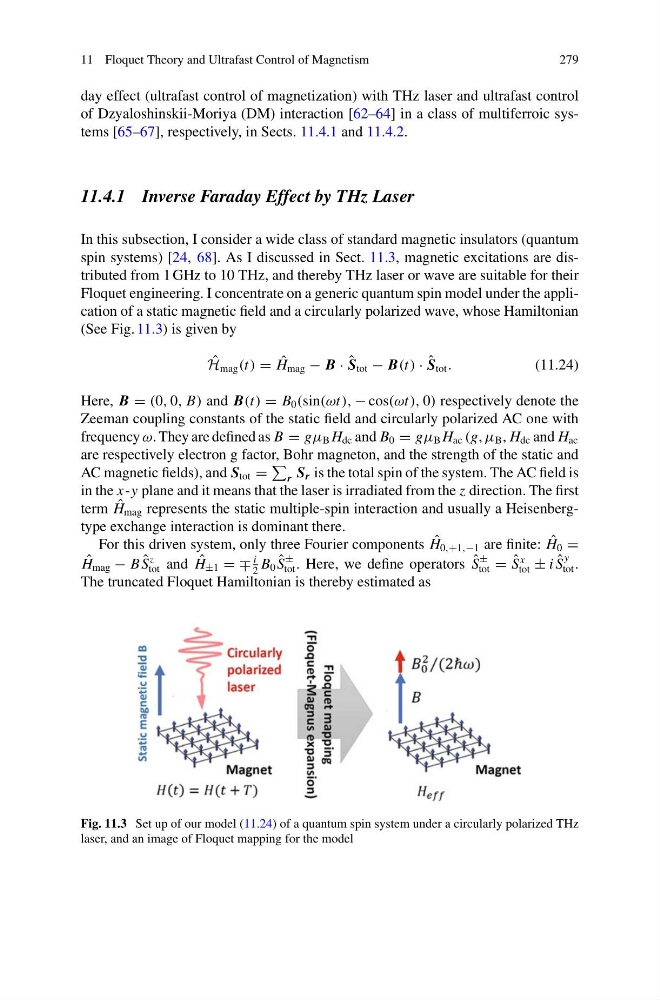
Floquet engineering. I concentrate on a generic quantum spin model under the application of a static magnetic field and a circularly polarized wave, whose Hamiltonian
(See Fig. 11.3) is given by
ˆ
H mag (t) = ˆ
H mag − B · ˆ
S tot − B(t) · ˆ
S tot .
(11.24)
Here, B = (0, 0, B) and B(t) = B 0 (sin(ωt), − cos(ωt), 0) respectively denote the
Zeeman coupling constants of the static field and circularly polarized AC one with
frequency ω. They are defined as B = gμ B H dc and B 0 = gμ B H ac (g, μ B , H dc and H ac
are respectively electron g factor, Bohr magneton, and the strength of the static and
AC magnetic fields), and S tot =
r S r is the total spin of the system. The AC field is
in the x-y plane and it means that the laser is irradiated from the z direction. The first
term ˆ
H mag represents the static multiple-spin interaction and usually a Heisenbergtype exchange interaction is dominant there.
For this driven system, only three Fourier components ˆ
H 0,+1,−1 are finite: ˆ
H 0 =
ˆ
H mag − B ˆ
S
z
tot and ˆ
H ±1 = ∓
i
2
B 0 ˆ
S
±
tot . Here, we define operators ˆ
S
±
tot = ˆ
S
x
tot ± i ˆ
S
y
tot .
The truncated Floquet Hamiltonian is thereby estimated as
Fig. 11.3 Set up of our model (11.24) of a quantum spin system under a circularly polarized THz
laser, and an image of Floquet mapping for the model
279
day effect (ultrafast control of magnetization) with THz laser and ultrafast control
of Dzyaloshinskii-Moriya (DM) interaction [62–64] in a class of multiferroic systems [65–67], respectively, in Sects. 11.4.1 and 11.4.2.
11.4.1 Inverse Faraday Effect by THz Laser
In this subsection, I consider a wide class of standard magnetic insulators (quantum
spin systems) [24, 68]. As I discussed in Sect. 11.3, magnetic excitations are distributed from 1 GHz to 10 THz, and thereby THz laser or wave are suitable for their
Floquet engineering. I concentrate on a generic quantum spin model under the application of a static magnetic field and a circularly polarized wave, whose Hamiltonian
(See Fig. 11.3) is given by
ˆ
H mag (t) = ˆ
H mag − B · ˆ
S tot − B(t) · ˆ
S tot .
(11.24)
Here, B = (0, 0, B) and B(t) = B 0 (sin(ωt), − cos(ωt), 0) respectively denote the
Zeeman coupling constants of the static field and circularly polarized AC one with
frequency ω. They are defined as B = gμ B H dc and B 0 = gμ B H ac (g, μ B , H dc and H ac
are respectively electron g factor, Bohr magneton, and the strength of the static and
AC magnetic fields), and S tot =
r S r is the total spin of the system. The AC field is
in the x-y plane and it means that the laser is irradiated from the z direction. The first
term ˆ
H mag represents the static multiple-spin interaction and usually a Heisenbergtype exchange interaction is dominant there.
For this driven system, only three Fourier components ˆ
H 0,+1,−1 are finite: ˆ
H 0 =
ˆ
H mag − B ˆ
S
z
tot and ˆ
H ±1 = ∓
i
2
B 0 ˆ
S
±
tot . Here, we define operators ˆ
S
±
tot = ˆ
S
x
tot ± i ˆ
S
y
tot .
The truncated Floquet Hamiltonian is thereby estimated as
Fig. 11.3 Set up of our model (11.24) of a quantum spin system under a circularly polarized THz
laser, and an image of Floquet mapping for the model