

11 Floquet Theory and Ultrafast Control of Magnetism
277
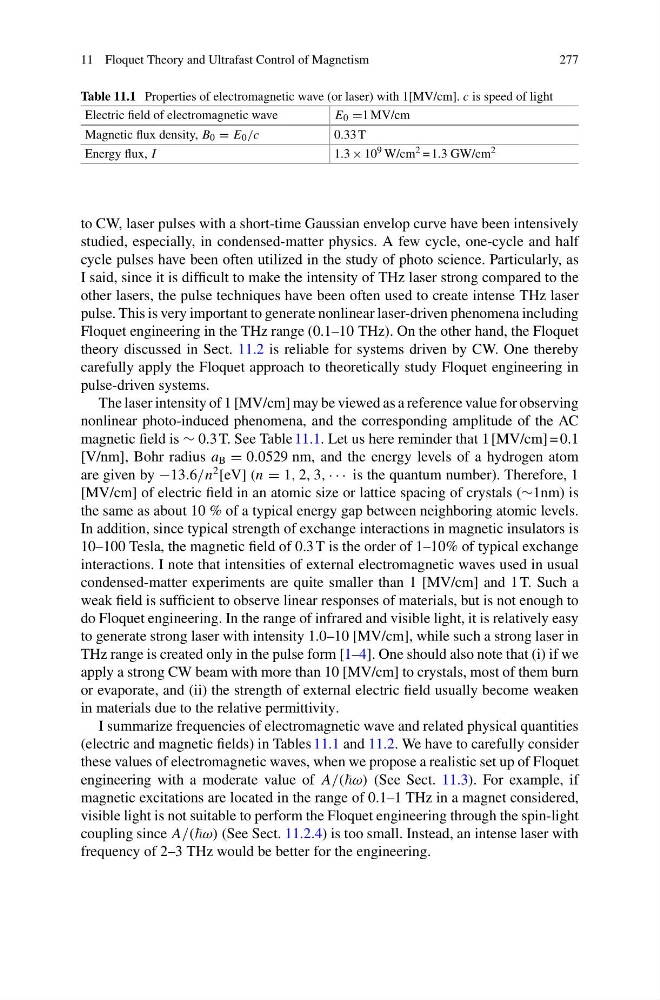
Table 11.1 Properties of electromagnetic wave (or laser) with 1[MV/cm]. c is speed of light
Electric field of electromagnetic wave
E 0 =1 MV/cm
Magnetic flux density, B 0 = E 0 /c
0.33 T
Energy flux, I
1.3 × 10 9 W/cm 2 = 1.3 GW/cm 2
to CW, laser pulses with a short-time Gaussian envelop curve have been intensively
studied, especially, in condensed-matter physics. A few cycle, one-cycle and half
cycle pulses have been often utilized in the study of photo science. Particularly, as
I said, since it is difficult to make the intensity of THz laser strong compared to the
other lasers, the pulse techniques have been often used to create intense THz laser
pulse. This is very important to generate nonlinear laser-driven phenomena including
Floquet engineering in the THz range (0.1–10 THz). On the other hand, the Floquet
theory discussed in Sect. 11.2 is reliable for systems driven by CW. One thereby
carefully apply the Floquet approach to theoretically study Floquet engineering in
pulse-driven systems.
The laser intensity of 1 [MV/cm] may be viewed as a reference value for observing
nonlinear photo-induced phenomena, and the corresponding amplitude of the AC
magnetic field is ∼ 0.3 T. See Table 11.1. Let us here reminder that 1 [MV/cm] = 0.1
[V/nm], Bohr radius a B = 0.0529 nm, and the energy levels of a hydrogen atom
are given by −13.6/n
2 [eV] (n = 1, 2, 3, · · · is the quantum number). Therefore, 1
[MV/cm] of electric field in an atomic size or lattice spacing of crystals (∼1nm) is
the same as about 10 % of a typical energy gap between neighboring atomic levels.
In addition, since typical strength of exchange interactions in magnetic insulators is
10–100 Tesla, the magnetic field of 0.3 T is the order of 1–10% of typical exchange
interactions. I note that intensities of external electromagnetic waves used in usual
condensed-matter experiments are quite smaller than 1 [MV/cm] and 1 T. Such a
weak field is sufficient to observe linear responses of materials, but is not enough to
do Floquet engineering. In the range of infrared and visible light, it is relatively easy
to generate strong laser with intensity 1.0–10 [MV/cm], while such a strong laser in
THz range is created only in the pulse form [1–4]. One should also note that (i) if we
apply a strong CW beam with more than 10 [MV/cm] to crystals, most of them burn
or evaporate, and (ii) the strength of external electric field usually become weaken
in materials due to the relative permittivity.
I summarize frequencies of electromagnetic wave and related physical quantities
(electric and magnetic fields) in Tables 11.1 and 11.2. We have to carefully consider
these values of electromagnetic waves, when we propose a realistic set up of Floquet
engineering with a moderate value of A/(ω) (See Sect. 11.3). For example, if
magnetic excitations are located in the range of 0.1–1 THz in a magnet considered,
visible light is not suitable to perform the Floquet engineering through the spin-light
coupling since A/(ω) (See Sect. 11.2.4) is too small. Instead, an intense laser with
frequency of 2–3 THz would be better for the engineering.
277
Table 11.1 Properties of electromagnetic wave (or laser) with 1[MV/cm]. c is speed of light
Electric field of electromagnetic wave
E 0 =1 MV/cm
Magnetic flux density, B 0 = E 0 /c
0.33 T
Energy flux, I
1.3 × 10 9 W/cm 2 = 1.3 GW/cm 2
to CW, laser pulses with a short-time Gaussian envelop curve have been intensively
studied, especially, in condensed-matter physics. A few cycle, one-cycle and half
cycle pulses have been often utilized in the study of photo science. Particularly, as
I said, since it is difficult to make the intensity of THz laser strong compared to the
other lasers, the pulse techniques have been often used to create intense THz laser
pulse. This is very important to generate nonlinear laser-driven phenomena including
Floquet engineering in the THz range (0.1–10 THz). On the other hand, the Floquet
theory discussed in Sect. 11.2 is reliable for systems driven by CW. One thereby
carefully apply the Floquet approach to theoretically study Floquet engineering in
pulse-driven systems.
The laser intensity of 1 [MV/cm] may be viewed as a reference value for observing
nonlinear photo-induced phenomena, and the corresponding amplitude of the AC
magnetic field is ∼ 0.3 T. See Table 11.1. Let us here reminder that 1 [MV/cm] = 0.1
[V/nm], Bohr radius a B = 0.0529 nm, and the energy levels of a hydrogen atom
are given by −13.6/n
2 [eV] (n = 1, 2, 3, · · · is the quantum number). Therefore, 1
[MV/cm] of electric field in an atomic size or lattice spacing of crystals (∼1nm) is
the same as about 10 % of a typical energy gap between neighboring atomic levels.
In addition, since typical strength of exchange interactions in magnetic insulators is
10–100 Tesla, the magnetic field of 0.3 T is the order of 1–10% of typical exchange
interactions. I note that intensities of external electromagnetic waves used in usual
condensed-matter experiments are quite smaller than 1 [MV/cm] and 1 T. Such a
weak field is sufficient to observe linear responses of materials, but is not enough to
do Floquet engineering. In the range of infrared and visible light, it is relatively easy
to generate strong laser with intensity 1.0–10 [MV/cm], while such a strong laser in
THz range is created only in the pulse form [1–4]. One should also note that (i) if we
apply a strong CW beam with more than 10 [MV/cm] to crystals, most of them burn
or evaporate, and (ii) the strength of external electric field usually become weaken
in materials due to the relative permittivity.
I summarize frequencies of electromagnetic wave and related physical quantities
(electric and magnetic fields) in Tables 11.1 and 11.2. We have to carefully consider
these values of electromagnetic waves, when we propose a realistic set up of Floquet
engineering with a moderate value of A/(ω) (See Sect. 11.3). For example, if
magnetic excitations are located in the range of 0.1–1 THz in a magnet considered,
visible light is not suitable to perform the Floquet engineering through the spin-light
coupling since A/(ω) (See Sect. 11.2.4) is too small. Instead, an intense laser with
frequency of 2–3 THz would be better for the engineering.