

1 Chiral Coupling to Magnetodipolar Radiation
5
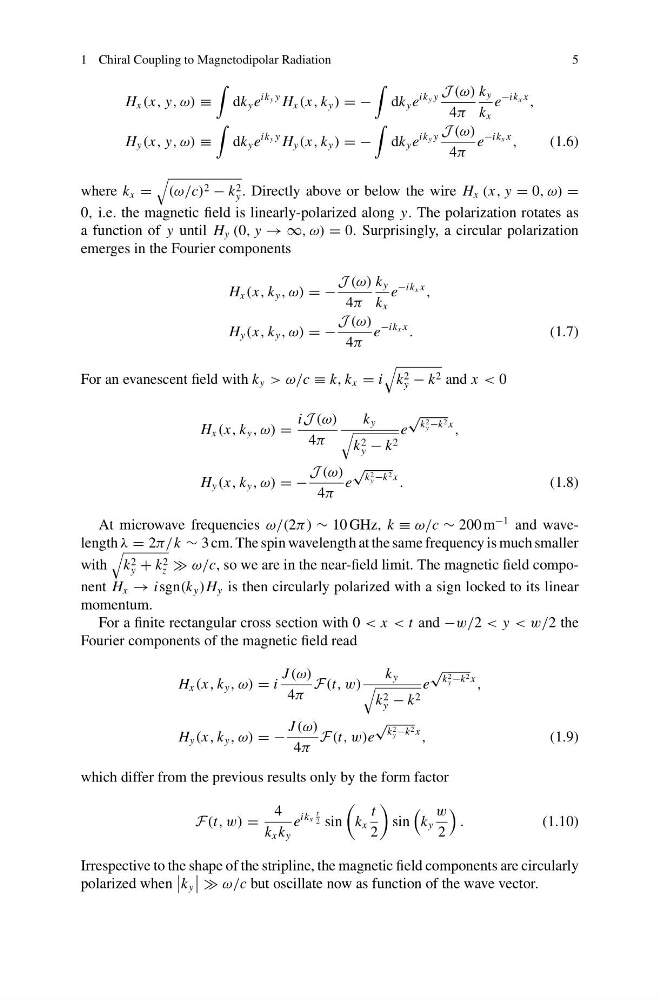
H x (x, y, ω) ≡
dk y e
ik y y H x (x, k y ) = −
dk y e
ik y y J (ω)
4π
k y
k x
e
−ik x x
,
H y (x, y, ω) ≡
dk y e
ik y y H y (x, k y ) = −
dk y e
ik y y J (ω)
4π
e
−ik x x
,
(1.6)
where k x =
(ω/c) 2 − k 2
y . Directly above or below the wire H x (x, y = 0, ω) =
0, i.e. the magnetic field is linearly-polarized along y. The polarization rotates as
a function of y until H y (0, y → ∞, ω) = 0. Surprisingly, a circular polarization
emerges in the Fourier components
H x (x, k y , ω) = −
J (ω)
4π
k y
k x
e
−ik x x
,
H y (x, k y , ω) = −
J (ω)
4π
e
−ik x x
.
(1.7)
For an evanescent field with k y > ω/c ≡ k, k x = i
k 2
y − k 2 and x < 0
H x (x, k y , ω) =
iJ (ω)
4π
k y
k 2
y − k 2
e
√
k 2
y −k 2 x ,
H y (x, k y , ω) = −
J (ω)
4π
e
√
k 2
y −k 2 x .
(1.8)
At microwave frequencies ω/(2π) ∼ 10 GHz, k ≡ ω/c ∼ 200 m
−1 and wavelength λ = 2π/k ∼ 3 cm. The spin wavelength at the same frequency is much smaller
with
k 2
y + k 2
z ω/c, so we are in the near-field limit. The magnetic field component H x → isgn(k y )H y is then circularly polarized with a sign locked to its linear
momentum.
For a finite rectangular cross section with 0 < x < t and −w/2 < y < w/2 the
Fourier components of the magnetic field read
H x (x, k y , ω) = i
J (ω)
4π
F(t, w)
k y
k 2
y − k 2
e
√
k 2
y −k 2 x ,
H y (x, k y , ω) = −
J (ω)
4π
F(t, w)e
√
k 2
y −k 2 x ,
(1.9)
which differ from the previous results only by the form factor
F(t, w) =
4
k x k y
e
ik x
t
2 sin
k x
t
2
sin
k y
w
2
.
(1.10)
Irrespective to the shape of the stripline, the magnetic field components are circularly
polarized when
k y
ω/c but oscillate now as function of the wave vector.
5
H x (x, y, ω) ≡
dk y e
ik y y H x (x, k y ) = −
dk y e
ik y y J (ω)
4π
k y
k x
e
−ik x x
,
H y (x, y, ω) ≡
dk y e
ik y y H y (x, k y ) = −
dk y e
ik y y J (ω)
4π
e
−ik x x
,
(1.6)
where k x =
(ω/c) 2 − k 2
y . Directly above or below the wire H x (x, y = 0, ω) =
0, i.e. the magnetic field is linearly-polarized along y. The polarization rotates as
a function of y until H y (0, y → ∞, ω) = 0. Surprisingly, a circular polarization
emerges in the Fourier components
H x (x, k y , ω) = −
J (ω)
4π
k y
k x
e
−ik x x
,
H y (x, k y , ω) = −
J (ω)
4π
e
−ik x x
.
(1.7)
For an evanescent field with k y > ω/c ≡ k, k x = i
k 2
y − k 2 and x < 0
H x (x, k y , ω) =
iJ (ω)
4π
k y
k 2
y − k 2
e
√
k 2
y −k 2 x ,
H y (x, k y , ω) = −
J (ω)
4π
e
√
k 2
y −k 2 x .
(1.8)
At microwave frequencies ω/(2π) ∼ 10 GHz, k ≡ ω/c ∼ 200 m
−1 and wavelength λ = 2π/k ∼ 3 cm. The spin wavelength at the same frequency is much smaller
with
k 2
y + k 2
z ω/c, so we are in the near-field limit. The magnetic field component H x → isgn(k y )H y is then circularly polarized with a sign locked to its linear
momentum.
For a finite rectangular cross section with 0 < x < t and −w/2 < y < w/2 the
Fourier components of the magnetic field read
H x (x, k y , ω) = i
J (ω)
4π
F(t, w)
k y
k 2
y − k 2
e
√
k 2
y −k 2 x ,
H y (x, k y , ω) = −
J (ω)
4π
F(t, w)e
√
k 2
y −k 2 x ,
(1.9)
which differ from the previous results only by the form factor
F(t, w) =
4
k x k y
e
ik x
t
2 sin
k x
t
2
sin
k y
w
2
.
(1.10)
Irrespective to the shape of the stripline, the magnetic field components are circularly
polarized when
k y
ω/c but oscillate now as function of the wave vector.