

6
T. Yu and G. E. W. Bauer
1.2.2 Chiral Excitation of Spin Waves
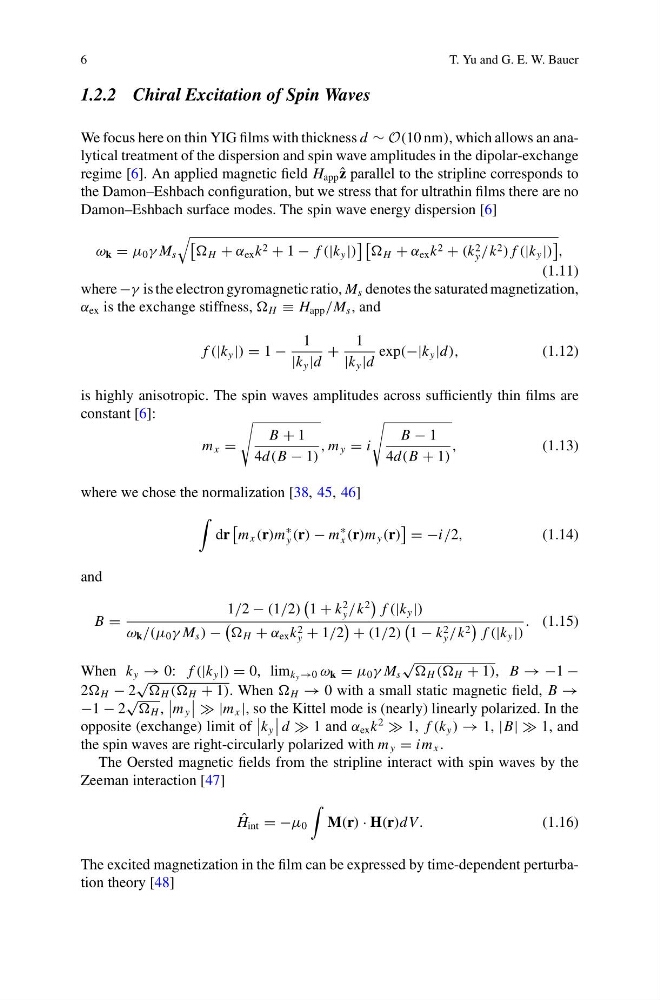
We focus here on thin YIG films with thickness d ∼ O(10 nm), which allows an analytical treatment of the dispersion and spin wave amplitudes in the dipolar-exchange
regime [6]. An applied magnetic field H app ˆ
z parallel to the stripline corresponds to
the Damon–Eshbach configuration, but we stress that for ultrathin films there are no
Damon–Eshbach surface modes. The spin wave energy dispersion [6]
ω k = μ 0 γ M s
H + α ex k 2 + 1 − f (|k y |)
H + α ex k 2 + (k 2
y /k 2 ) f (|k y |)
,
(1.11)
where −γ is the electron gyromagnetic ratio, M s denotes the saturated magnetization,
α ex is the exchange stiffness, H ≡ H app /M s , and
f (|k y |) = 1 −
1
|k y |d
+
1
|k y |d
exp(−|k y |d),
(1.12)
is highly anisotropic. The spin waves amplitudes across sufficiently thin films are
constant [6]:
m x =
B + 1
4d(B − 1)
, m y = i
B − 1
4d(B + 1)
,
(1.13)
where we chose the normalization [38, 45, 46]
dr
m x (r)m
∗
y (r) − m
∗
x (r)m y (r)
= −i/2,
(1.14)
and
B =
1/2 − (1/2)
1 + k
2
y /k
2
f (|k y |)
ω k /(μ 0 γ M s ) −
H + α ex k 2
y + 1/2
+ (1/2)
1 − k 2
y /k 2
f (|k y |)
. (1.15)
When k y → 0: f (|k y |) = 0, lim k y →0 ω k = μ 0 γ M s
√
H (( H + 1), B → −1 −
2 H − 2
√
H (( H + 1). When H → 0 with a small static magnetic field, B →
−1 − 2
√ H ,
m y
|m x |, so the Kittel mode is (nearly) linearly polarized. In the
opposite (exchange) limit of
k y
d 1 and α ex k
2
1, f (k y ) → 1, |B| 1, and
the spin waves are right-circularly polarized with m y = im x .
The Oersted magnetic fields from the stripline interact with spin waves by the
Zeeman interaction [47]
ˆ
H int = −μ 0
M(r) · H(r)dV.
(1.16)
The excited magnetization in the film can be expressed by time-dependent perturbation theory [48]
T. Yu and G. E. W. Bauer
1.2.2 Chiral Excitation of Spin Waves
We focus here on thin YIG films with thickness d ∼ O(10 nm), which allows an analytical treatment of the dispersion and spin wave amplitudes in the dipolar-exchange
regime [6]. An applied magnetic field H app ˆ
z parallel to the stripline corresponds to
the Damon–Eshbach configuration, but we stress that for ultrathin films there are no
Damon–Eshbach surface modes. The spin wave energy dispersion [6]
ω k = μ 0 γ M s
H + α ex k 2 + 1 − f (|k y |)
H + α ex k 2 + (k 2
y /k 2 ) f (|k y |)
,
(1.11)
where −γ is the electron gyromagnetic ratio, M s denotes the saturated magnetization,
α ex is the exchange stiffness, H ≡ H app /M s , and
f (|k y |) = 1 −
1
|k y |d
+
1
|k y |d
exp(−|k y |d),
(1.12)
is highly anisotropic. The spin waves amplitudes across sufficiently thin films are
constant [6]:
m x =
B + 1
4d(B − 1)
, m y = i
B − 1
4d(B + 1)
,
(1.13)
where we chose the normalization [38, 45, 46]
dr
m x (r)m
∗
y (r) − m
∗
x (r)m y (r)
= −i/2,
(1.14)
and
B =
1/2 − (1/2)
1 + k
2
y /k
2
f (|k y |)
ω k /(μ 0 γ M s ) −
H + α ex k 2
y + 1/2
+ (1/2)
1 − k 2
y /k 2
f (|k y |)
. (1.15)
When k y → 0: f (|k y |) = 0, lim k y →0 ω k = μ 0 γ M s
√
H (( H + 1), B → −1 −
2 H − 2
√
H (( H + 1). When H → 0 with a small static magnetic field, B →
−1 − 2
√ H ,
m y
|m x |, so the Kittel mode is (nearly) linearly polarized. In the
opposite (exchange) limit of
k y
d 1 and α ex k
2
1, f (k y ) → 1, |B| 1, and
the spin waves are right-circularly polarized with m y = im x .
The Oersted magnetic fields from the stripline interact with spin waves by the
Zeeman interaction [47]
ˆ
H int = −μ 0
M(r) · H(r)dV.
(1.16)
The excited magnetization in the film can be expressed by time-dependent perturbation theory [48]