

4
T. Yu and G. E. W. Bauer
A(r, ω) =
μ 0
4π
dr
J(r
, ω)
e
ik|r−r
|
|r − r |
,
(1.2)
where k = ω/c. The current in the stripline is uniform over the cross section of
width w and thickness t as well as length L c/ω. In the long wavelength limit and
square cross section J(r, ω) δ(x)δ(y)J (ω)ˆ z, where J is the total electric current,
leading to
A(r, ω) =
μ 0
4π
J (ω)ˆ z
∞
−∞
dz
e
ik
√
x 2 +y 2 +z
x 2 + y 2 + z
,
(1.3)
which does not depend on z. Substituting the Weyl identity [41]
e
ik
√
x 2 +y 2 +z 2
x 2 + y 2 + z 2
=
i
2π
dk y dk z
e
ik x |x|+ik y y+ik z z
k x
,
(1.4)
where k =
k 2
x + k 2
y + k 2
z and k x = |a| + i|b| is complex, into (1.3) yields
A(x, y, ω) =
iμ 0
4π
J (ω)ˆ z
dk y
e
ik x |x|+ik y y
k x
.
(1.5)
The magnetic field H(r) = ∇ × A(r)/μ 0 =
∂ y A z , −∂ x A z , 0
/μ 0 is transverse to
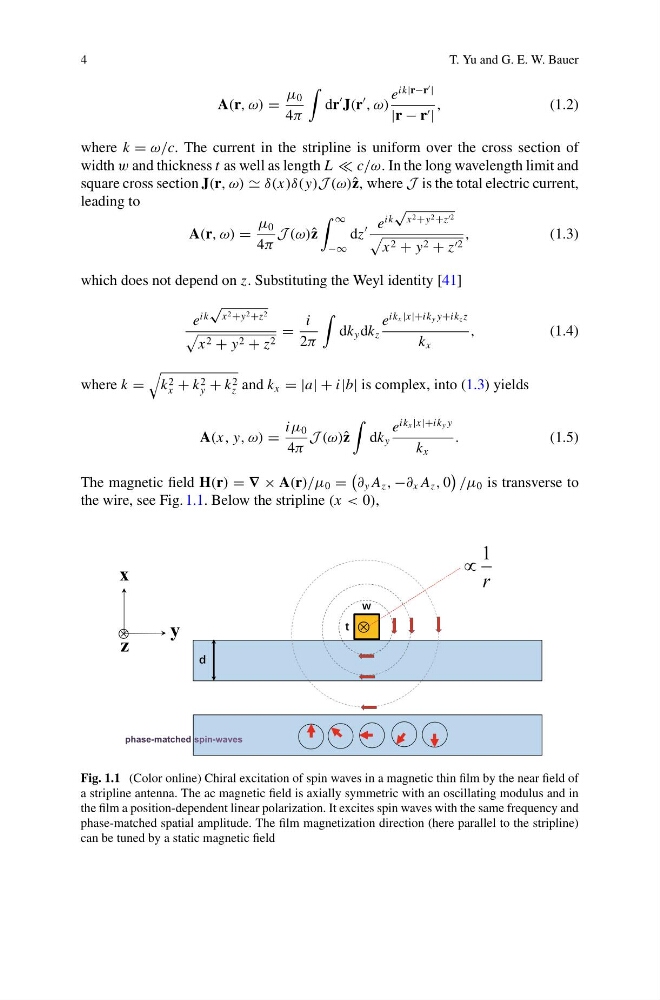
the wire, see Fig. 1.1. Below the stripline (x < 0),
r
1
x
y
z
phase-matched spin-waves
Fig. 1.1 (Color online) Chiral excitation of spin waves in a magnetic thin film by the near field of
a stripline antenna. The ac magnetic field is axially symmetric with an oscillating modulus and in
the film a position-dependent linear polarization. It excites spin waves with the same frequency and
phase-matched spatial amplitude. The film magnetization direction (here parallel to the stripline)
can be tuned by a static magnetic field
T. Yu and G. E. W. Bauer
A(r, ω) =
μ 0
4π
dr
J(r
, ω)
e
ik|r−r
|
|r − r |
,
(1.2)
where k = ω/c. The current in the stripline is uniform over the cross section of
width w and thickness t as well as length L c/ω. In the long wavelength limit and
square cross section J(r, ω) δ(x)δ(y)J (ω)ˆ z, where J is the total electric current,
leading to
A(r, ω) =
μ 0
4π
J (ω)ˆ z
∞
−∞
dz
e
ik
√
x 2 +y 2 +z
x 2 + y 2 + z
,
(1.3)
which does not depend on z. Substituting the Weyl identity [41]
e
ik
√
x 2 +y 2 +z 2
x 2 + y 2 + z 2
=
i
2π
dk y dk z
e
ik x |x|+ik y y+ik z z
k x
,
(1.4)
where k =
k 2
x + k 2
y + k 2
z and k x = |a| + i|b| is complex, into (1.3) yields
A(x, y, ω) =
iμ 0
4π
J (ω)ˆ z
dk y
e
ik x |x|+ik y y
k x
.
(1.5)
The magnetic field H(r) = ∇ × A(r)/μ 0 =
∂ y A z , −∂ x A z , 0
/μ 0 is transverse to
the wire, see Fig. 1.1. Below the stripline (x < 0),
r
1
x
y
z
phase-matched spin-waves
Fig. 1.1 (Color online) Chiral excitation of spin waves in a magnetic thin film by the near field of
a stripline antenna. The ac magnetic field is axially symmetric with an oscillating modulus and in
the film a position-dependent linear polarization. It excites spin waves with the same frequency and
phase-matched spatial amplitude. The film magnetization direction (here parallel to the stripline)
can be tuned by a static magnetic field