

232
I. Proskurin and R. L. Stamps
where ˜
H k = U
†
k H k U k is the Hamiltonian in the transformed basis, and
ˆ
A =
k ˜
χ
†
k A k ˜
χ k with
A k = −iσ z U
−1
k
∂U k
∂ k
(9.85)
being the connection associated with the transformation U k .
Among the various representations, there is one specific basis, where the Hamiltonian in (9.80) becomes diagonal. This basis is reached by choosing tanh 2θ k =
|B k |/A k and φ k = arg B k , which gives
ˆ
H =
k
ε k
α
†
k α k + β
†
−k β −k
,
(9.86)
where ε k =
A
2
k − |B k | 2 is the magnon energy dispersion. To find the expression
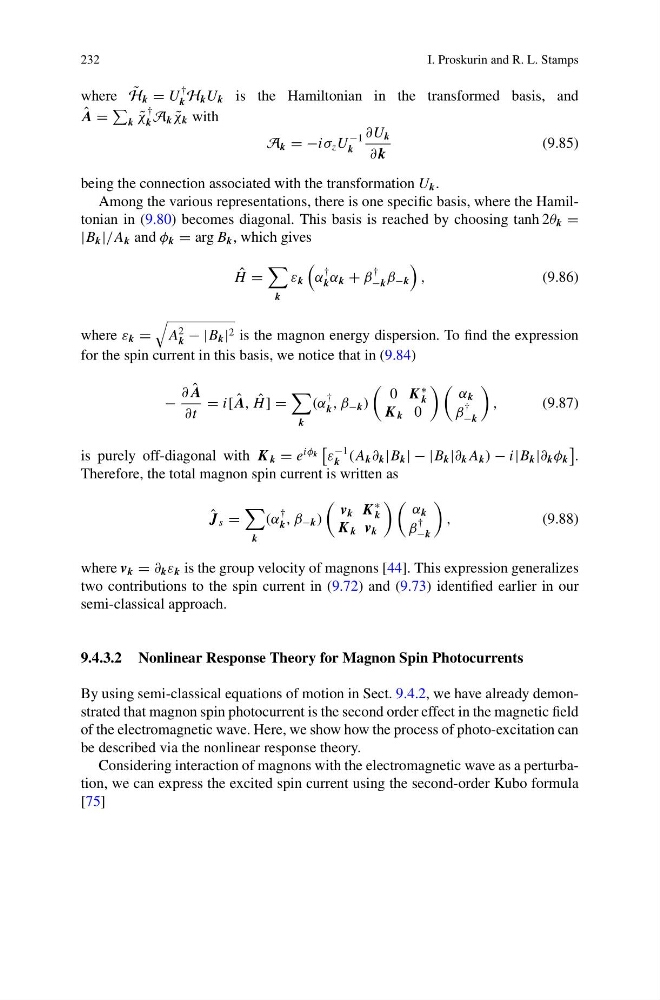
for the spin current in this basis, we notice that in (9.84)
−
∂ ˆ
A
∂t
= i[ ˆ
A, ˆ
H ] =
k
(α
†
k , β −k )
0 K
∗
k
K k 0
α k
β
†
−k
,
(9.87)
is purely off-diagonal with K k = e
iφ k
ε
−1
k (A k ∂ k |B k | − |B k |∂ k A k ) − i|B k |∂ k φ k
.
Therefore, the total magnon spin current is written as
ˆ
J s =
k
(α
†
k , β −k )
v k K
∗
k
K k v k
α k
β
†
−k
,
(9.88)
where v k = ∂ k ε k is the group velocity of magnons [44]. This expression generalizes
two contributions to the spin current in (9.72) and (9.73) identified earlier in our
semi-classical approach.
9.4.3.2 Nonlinear Response Theory for Magnon Spin Photocurrents
By using semi-classical equations of motion in Sect. 9.4.2, we have already demonstrated that magnon spin photocurrent is the second order effect in the magnetic field
of the electromagnetic wave. Here, we show how the process of photo-excitation can
be described via the nonlinear response theory.
Considering interaction of magnons with the electromagnetic wave as a perturbation, we can express the excited spin current using the second-order Kubo formula
[75]
I. Proskurin and R. L. Stamps
where ˜
H k = U
†
k H k U k is the Hamiltonian in the transformed basis, and
ˆ
A =
k ˜
χ
†
k A k ˜
χ k with
A k = −iσ z U
−1
k
∂U k
∂ k
(9.85)
being the connection associated with the transformation U k .
Among the various representations, there is one specific basis, where the Hamiltonian in (9.80) becomes diagonal. This basis is reached by choosing tanh 2θ k =
|B k |/A k and φ k = arg B k , which gives
ˆ
H =
k
ε k
α
†
k α k + β
†
−k β −k
,
(9.86)
where ε k =
A
2
k − |B k | 2 is the magnon energy dispersion. To find the expression
for the spin current in this basis, we notice that in (9.84)
−
∂ ˆ
A
∂t
= i[ ˆ
A, ˆ
H ] =
k
(α
†
k , β −k )
0 K
∗
k
K k 0
α k
β
†
−k
,
(9.87)
is purely off-diagonal with K k = e
iφ k
ε
−1
k (A k ∂ k |B k | − |B k |∂ k A k ) − i|B k |∂ k φ k
.
Therefore, the total magnon spin current is written as
ˆ
J s =
k
(α
†
k , β −k )
v k K
∗
k
K k v k
α k
β
†
−k
,
(9.88)
where v k = ∂ k ε k is the group velocity of magnons [44]. This expression generalizes
two contributions to the spin current in (9.72) and (9.73) identified earlier in our
semi-classical approach.
9.4.3.2 Nonlinear Response Theory for Magnon Spin Photocurrents
By using semi-classical equations of motion in Sect. 9.4.2, we have already demonstrated that magnon spin photocurrent is the second order effect in the magnetic field
of the electromagnetic wave. Here, we show how the process of photo-excitation can
be described via the nonlinear response theory.
Considering interaction of magnons with the electromagnetic wave as a perturbation, we can express the excited spin current using the second-order Kubo formula
[75]