

9 Symmetry Approach to Chiral Optomagnonics in Antiferromagnetic Insulators
213
U 2 =
1
√
2
1 −i
−i 1
.
(9.15)
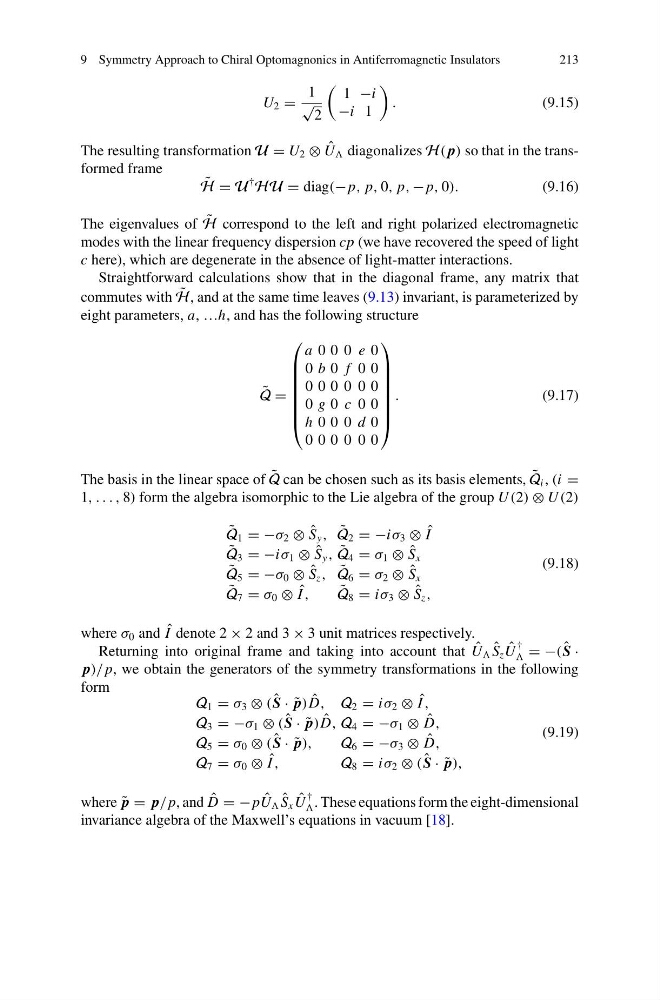
The resulting transformation U = U 2 ⊗ ˆ
U diagonalizes H( p) so that in the transformed frame
˜
H = U
†
HU = diag(− p, p, 0, p, − p, 0).
(9.16)
The eigenvalues of ˜
H correspond to the left and right polarized electromagnetic
modes with the linear frequency dispersion cp (we have recovered the speed of light
c here), which are degenerate in the absence of light-matter interactions.
Straightforward calculations show that in the diagonal frame, any matrix that
commutes with ˜
H, and at the same time leaves (9.13) invariant, is parameterized by
eight parameters, a, …h, and has the following structure
˜
Q =
⎛
⎜
⎜
⎜
⎜
⎜
⎜
⎝
a 0 0 0 e 0
0 b 0 f 0 0
0 0 0 0 0 0
0 g 0 c 0 0
h 0 0 0 d 0
0 0 0 0 0 0
⎞
⎟
⎟
⎟
⎟
⎟
⎟
⎠
.
(9.17)
The basis in the linear space of ˜
Q can be chosen such as its basis elements, ˜
Q i , (i =
1, . . . , 8) form the algebra isomorphic to the Lie algebra of the group U (2) ⊗ U (2)
˜
Q 1 = −σ 2 ⊗ ˆ
S y , ˜
Q 2 = −iσ 3 ⊗ ˆ
I
˜
Q 3 = −iσ 1 ⊗ ˆ
S y , ˜
Q 4 = σ 1 ⊗ ˆ
S x
˜
Q 5 = −σ 0 ⊗ ˆ
S z , ˜
Q 6 = σ 2 ⊗ ˆ
S x
˜
Q 7 = σ 0 ⊗ ˆ
I ,
˜
Q 8 = iσ 3 ⊗ ˆ
S z ,
(9.18)
where σ 0 and ˆ
I denote 2 × 2 and 3 × 3 unit matrices respectively.
Returning into original frame and taking into account that ˆ
U ˆ
S z ˆ
U
†
= −( ˆ
S ·
p)/ p, we obtain the generators of the symmetry transformations in the following
form
Q 1 = σ 3 ⊗ ( ˆ
S · ˜
p) ˆ
D, Q 2 = iσ 2 ⊗ ˆ
I ,
Q 3 = −σ 1 ⊗ ( ˆ
S · ˜
p) ˆ
D, Q 4 = −σ 1 ⊗ ˆ
D,
Q 5 = σ 0 ⊗ ( ˆ
S · ˜
p),
Q 6 = −σ 3 ⊗ ˆ
D,
Q 7 = σ 0 ⊗ ˆ
I ,
Q 8 = iσ 2 ⊗ ( ˆ
S · ˜
p),
(9.19)
where ˜
p = p/ p, and ˆ
D = −p ˆ
U ˆ
S x ˆ
U
†
. These equations form the eight-dimensional
invariance algebra of the Maxwell’s equations in vacuum [18].
213
U 2 =
1
√
2
1 −i
−i 1
.
(9.15)
The resulting transformation U = U 2 ⊗ ˆ
U diagonalizes H( p) so that in the transformed frame
˜
H = U
†
HU = diag(− p, p, 0, p, − p, 0).
(9.16)
The eigenvalues of ˜
H correspond to the left and right polarized electromagnetic
modes with the linear frequency dispersion cp (we have recovered the speed of light
c here), which are degenerate in the absence of light-matter interactions.
Straightforward calculations show that in the diagonal frame, any matrix that
commutes with ˜
H, and at the same time leaves (9.13) invariant, is parameterized by
eight parameters, a, …h, and has the following structure
˜
Q =
⎛
⎜
⎜
⎜
⎜
⎜
⎜
⎝
a 0 0 0 e 0
0 b 0 f 0 0
0 0 0 0 0 0
0 g 0 c 0 0
h 0 0 0 d 0
0 0 0 0 0 0
⎞
⎟
⎟
⎟
⎟
⎟
⎟
⎠
.
(9.17)
The basis in the linear space of ˜
Q can be chosen such as its basis elements, ˜
Q i , (i =
1, . . . , 8) form the algebra isomorphic to the Lie algebra of the group U (2) ⊗ U (2)
˜
Q 1 = −σ 2 ⊗ ˆ
S y , ˜
Q 2 = −iσ 3 ⊗ ˆ
I
˜
Q 3 = −iσ 1 ⊗ ˆ
S y , ˜
Q 4 = σ 1 ⊗ ˆ
S x
˜
Q 5 = −σ 0 ⊗ ˆ
S z , ˜
Q 6 = σ 2 ⊗ ˆ
S x
˜
Q 7 = σ 0 ⊗ ˆ
I ,
˜
Q 8 = iσ 3 ⊗ ˆ
S z ,
(9.18)
where σ 0 and ˆ
I denote 2 × 2 and 3 × 3 unit matrices respectively.
Returning into original frame and taking into account that ˆ
U ˆ
S z ˆ
U
†
= −( ˆ
S ·
p)/ p, we obtain the generators of the symmetry transformations in the following
form
Q 1 = σ 3 ⊗ ( ˆ
S · ˜
p) ˆ
D, Q 2 = iσ 2 ⊗ ˆ
I ,
Q 3 = −σ 1 ⊗ ( ˆ
S · ˜
p) ˆ
D, Q 4 = −σ 1 ⊗ ˆ
D,
Q 5 = σ 0 ⊗ ( ˆ
S · ˜
p),
Q 6 = −σ 3 ⊗ ˆ
D,
Q 7 = σ 0 ⊗ ˆ
I ,
Q 8 = iσ 2 ⊗ ( ˆ
S · ˜
p),
(9.19)
where ˜
p = p/ p, and ˆ
D = −p ˆ
U ˆ
S x ˆ
U
†
. These equations form the eight-dimensional
invariance algebra of the Maxwell’s equations in vacuum [18].