

214
I. Proskurin and R. L. Stamps
9.2.1.2 Nongeometric Symmetries
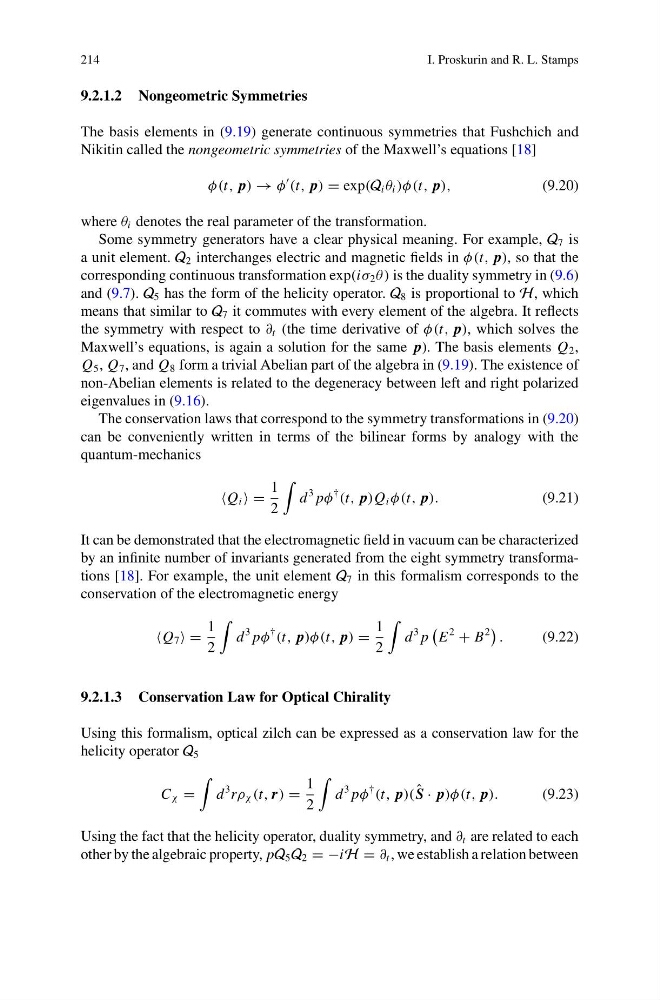
The basis elements in (9.19) generate continuous symmetries that Fushchich and
Nikitin called the nongeometric symmetries of the Maxwell’s equations [18]
φ(t, p) → φ
(t, p) = exp(Q i θ i )φ(t, p),
(9.20)
where θ i denotes the real parameter of the transformation.
Some symmetry generators have a clear physical meaning. For example, Q 7 is
a unit element. Q 2 interchanges electric and magnetic fields in φ(t, p), so that the
corresponding continuous transformation exp(iσ 2 θ) is the duality symmetry in (9.6)
and (9.7). Q 5 has the form of the helicity operator. Q 8 is proportional to H, which
means that similar to Q 7 it commutes with every element of the algebra. It reflects
the symmetry with respect to ∂ t (the time derivative of φ(t, p), which solves the
Maxwell’s equations, is again a solution for the same p). The basis elements Q 2 ,
Q 5 , Q 7 , and Q 8 form a trivial Abelian part of the algebra in (9.19). The existence of
non-Abelian elements is related to the degeneracy between left and right polarized
eigenvalues in (9.16).
The conservation laws that correspond to the symmetry transformations in (9.20)
can be conveniently written in terms of the bilinear forms by analogy with the
quantum-mechanics
Q i =
1
2
d
3 pφ
†
(t, p)Q i φ(t, p).
(9.21)
It can be demonstrated that the electromagnetic field in vacuum can be characterized
by an infinite number of invariants generated from the eight symmetry transformations [18]. For example, the unit element Q 7 in this formalism corresponds to the
conservation of the electromagnetic energy
Q 7 =
1
2
d
3 pφ
†
(t, p)φ(t, p) =
1
2
d
3 p
E
2
+ B
2
.
(9.22)
9.2.1.3 Conservation Law for Optical Chirality
Using this formalism, optical zilch can be expressed as a conservation law for the
helicity operator Q 5
C χ =
d
3 rρ χ (t, r) =
1
2
d
3 pφ
†
(t, p)( ˆ
S · p)φ(t, p).
(9.23)
Using the fact that the helicity operator, duality symmetry, and ∂ t are related to each
other by the algebraic property, pQ 5 Q 2 = −iH = ∂ t , we establish a relation between
I. Proskurin and R. L. Stamps
9.2.1.2 Nongeometric Symmetries
The basis elements in (9.19) generate continuous symmetries that Fushchich and
Nikitin called the nongeometric symmetries of the Maxwell’s equations [18]
φ(t, p) → φ
(t, p) = exp(Q i θ i )φ(t, p),
(9.20)
where θ i denotes the real parameter of the transformation.
Some symmetry generators have a clear physical meaning. For example, Q 7 is
a unit element. Q 2 interchanges electric and magnetic fields in φ(t, p), so that the
corresponding continuous transformation exp(iσ 2 θ) is the duality symmetry in (9.6)
and (9.7). Q 5 has the form of the helicity operator. Q 8 is proportional to H, which
means that similar to Q 7 it commutes with every element of the algebra. It reflects
the symmetry with respect to ∂ t (the time derivative of φ(t, p), which solves the
Maxwell’s equations, is again a solution for the same p). The basis elements Q 2 ,
Q 5 , Q 7 , and Q 8 form a trivial Abelian part of the algebra in (9.19). The existence of
non-Abelian elements is related to the degeneracy between left and right polarized
eigenvalues in (9.16).
The conservation laws that correspond to the symmetry transformations in (9.20)
can be conveniently written in terms of the bilinear forms by analogy with the
quantum-mechanics
Q i =
1
2
d
3 pφ
†
(t, p)Q i φ(t, p).
(9.21)
It can be demonstrated that the electromagnetic field in vacuum can be characterized
by an infinite number of invariants generated from the eight symmetry transformations [18]. For example, the unit element Q 7 in this formalism corresponds to the
conservation of the electromagnetic energy
Q 7 =
1
2
d
3 pφ
†
(t, p)φ(t, p) =
1
2
d
3 p
E
2
+ B
2
.
(9.22)
9.2.1.3 Conservation Law for Optical Chirality
Using this formalism, optical zilch can be expressed as a conservation law for the
helicity operator Q 5
C χ =
d
3 rρ χ (t, r) =
1
2
d
3 pφ
†
(t, p)( ˆ
S · p)φ(t, p).
(9.23)
Using the fact that the helicity operator, duality symmetry, and ∂ t are related to each
other by the algebraic property, pQ 5 Q 2 = −iH = ∂ t , we establish a relation between