

8 Microwave-Driven Dynamics of Magnetic Skyrmions …
187
H ex
x
y
z
H z
H x
Ferromag.
Skyrmion Crystal
Helical
x
y
z
(b)
(a)
0.0168
0.0567
H z /J
(d) =30
(c)
Bloch-type
Neel-type
=0
=30
=30
-1
1
m iz
(e)
(f)
x
y
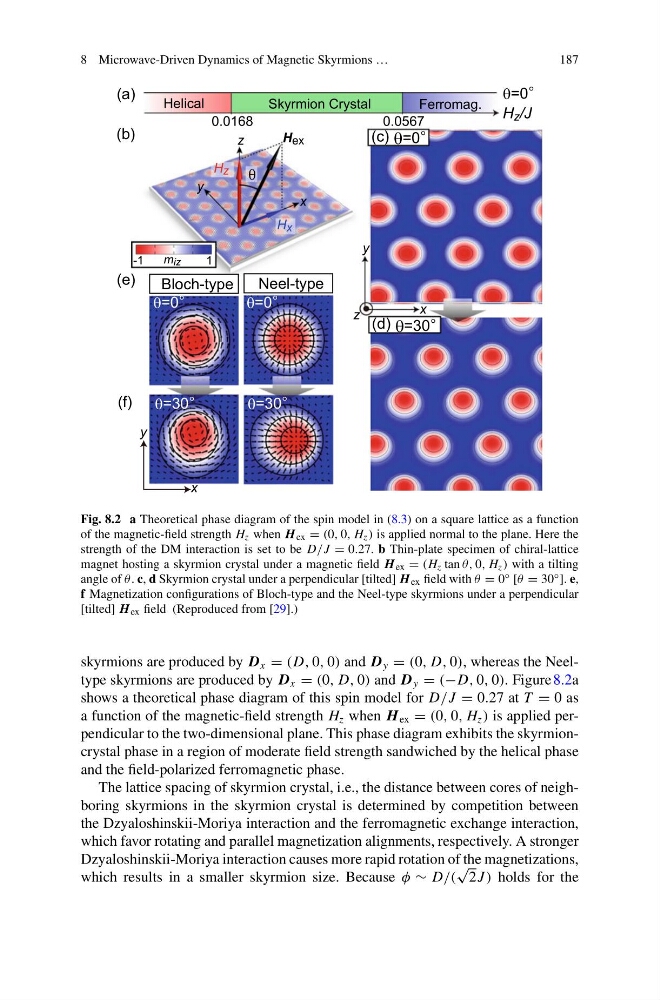
Fig. 8.2 a Theoretical phase diagram of the spin model in (8.3) on a square lattice as a function
of the magnetic-field strength H z when H ex = (0, 0, H z ) is applied normal to the plane. Here the
strength of the DM interaction is set to be D/J = 0.27. b Thin-plate specimen of chiral-lattice
magnet hosting a skyrmion crystal under a magnetic field H ex = (H z tan θ, 0, H z ) with a tilting
angle of θ. c, d Skyrmion crystal under a perpendicular [tilted] H ex field with θ = 0 ◦ [θ = 30 ◦ ]. e,
f Magnetization configurations of Bloch-type and the Neel-type skyrmions under a perpendicular
[tilted] H ex field (Reproduced from [29].)
skyrmions are produced by D x = (D, 0, 0) and D y = (0, D, 0), whereas the Neeltype skyrmions are produced by D x = (0, D, 0) and D y = (−D, 0, 0). Figure 8.2a
shows a theoretical phase diagram of this spin model for D/J = 0.27 at T = 0 as
a function of the magnetic-field strength H z when H ex = (0, 0, H z ) is applied perpendicular to the two-dimensional plane. This phase diagram exhibits the skyrmioncrystal phase in a region of moderate field strength sandwiched by the helical phase
and the field-polarized ferromagnetic phase.
The lattice spacing of skyrmion crystal, i.e., the distance between cores of neighboring skyrmions in the skyrmion crystal is determined by competition between
the Dzyaloshinskii-Moriya interaction and the ferromagnetic exchange interaction,
which favor rotating and parallel magnetization alignments, respectively. A stronger
Dzyaloshinskii-Moriya interaction causes more rapid rotation of the magnetizations,
which results in a smaller skyrmion size. Because φ ∼ D/(
√
2J ) holds for the
187
H ex
x
y
z
H z
H x
Ferromag.
Skyrmion Crystal
Helical
x
y
z
(b)
(a)
0.0168
0.0567
H z /J
(d) =30
(c)
Bloch-type
Neel-type
=0
=30
=30
-1
1
m iz
(e)
(f)
x
y
Fig. 8.2 a Theoretical phase diagram of the spin model in (8.3) on a square lattice as a function
of the magnetic-field strength H z when H ex = (0, 0, H z ) is applied normal to the plane. Here the
strength of the DM interaction is set to be D/J = 0.27. b Thin-plate specimen of chiral-lattice
magnet hosting a skyrmion crystal under a magnetic field H ex = (H z tan θ, 0, H z ) with a tilting
angle of θ. c, d Skyrmion crystal under a perpendicular [tilted] H ex field with θ = 0 ◦ [θ = 30 ◦ ]. e,
f Magnetization configurations of Bloch-type and the Neel-type skyrmions under a perpendicular
[tilted] H ex field (Reproduced from [29].)
skyrmions are produced by D x = (D, 0, 0) and D y = (0, D, 0), whereas the Neeltype skyrmions are produced by D x = (0, D, 0) and D y = (−D, 0, 0). Figure 8.2a
shows a theoretical phase diagram of this spin model for D/J = 0.27 at T = 0 as
a function of the magnetic-field strength H z when H ex = (0, 0, H z ) is applied perpendicular to the two-dimensional plane. This phase diagram exhibits the skyrmioncrystal phase in a region of moderate field strength sandwiched by the helical phase
and the field-polarized ferromagnetic phase.
The lattice spacing of skyrmion crystal, i.e., the distance between cores of neighboring skyrmions in the skyrmion crystal is determined by competition between
the Dzyaloshinskii-Moriya interaction and the ferromagnetic exchange interaction,
which favor rotating and parallel magnetization alignments, respectively. A stronger
Dzyaloshinskii-Moriya interaction causes more rapid rotation of the magnetizations,
which results in a smaller skyrmion size. Because φ ∼ D/(
√
2J ) holds for the