

188
M. Mochizuki
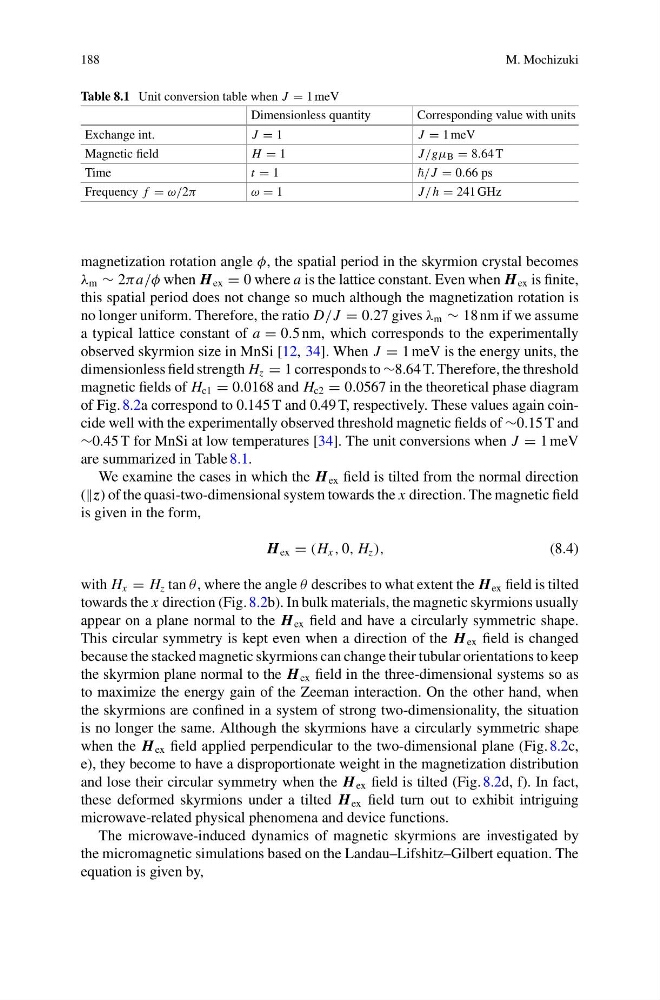
Table 8.1 Unit conversion table when J = 1 meV
Dimensionless quantity
Corresponding value with units
Exchange int.
J = 1
J = 1 meV
Magnetic field
H = 1
J/gμ B = 8.64 T
Time
t = 1
/J = 0.66 ps
Frequency f = ω/2π
ω = 1
J/ h = 241 GHz
magnetization rotation angle φ, the spatial period in the skyrmion crystal becomes
λ m ∼ 2πa/φ when H ex = 0 where a is the lattice constant. Even when H ex is finite,
this spatial period does not change so much although the magnetization rotation is
no longer uniform. Therefore, the ratio D/J = 0.27 gives λ m ∼ 18 nm if we assume
a typical lattice constant of a = 0.5 nm, which corresponds to the experimentally
observed skyrmion size in MnSi [12, 34]. When J = 1 meV is the energy units, the
dimensionless field strength H z = 1 corresponds to ∼8.64 T. Therefore, the threshold
magnetic fields of H c1 = 0.0168 and H c2 = 0.0567 in the theoretical phase diagram
of Fig. 8.2a correspond to 0.145 T and 0.49 T, respectively. These values again coincide well with the experimentally observed threshold magnetic fields of ∼0.15 T and
∼0.45 T for MnSi at low temperatures [34]. The unit conversions when J = 1 meV
are summarized in Table 8.1.
We examine the cases in which the H ex field is tilted from the normal direction
(z) of the quasi-two-dimensional system towards the x direction. The magnetic field
is given in the form,
H ex = (H x , 0, H z ),
(8.4)
with H x = H z tan θ , where the angle θ describes to what extent the H ex field is tilted
towards the x direction (Fig. 8.2b). In bulk materials, the magnetic skyrmions usually
appear on a plane normal to the H ex field and have a circularly symmetric shape.
This circular symmetry is kept even when a direction of the H ex field is changed
because the stacked magnetic skyrmions can change their tubular orientations to keep
the skyrmion plane normal to the H ex field in the three-dimensional systems so as
to maximize the energy gain of the Zeeman interaction. On the other hand, when
the skyrmions are confined in a system of strong two-dimensionality, the situation
is no longer the same. Although the skyrmions have a circularly symmetric shape
when the H ex field applied perpendicular to the two-dimensional plane (Fig. 8.2c,
e), they become to have a disproportionate weight in the magnetization distribution
and lose their circular symmetry when the H ex field is tilted (Fig. 8.2d, f). In fact,
these deformed skyrmions under a tilted H ex field turn out to exhibit intriguing
microwave-related physical phenomena and device functions.
The microwave-induced dynamics of magnetic skyrmions are investigated by
the micromagnetic simulations based on the Landau–Lifshitz–Gilbert equation. The
equation is given by,
M. Mochizuki
Table 8.1 Unit conversion table when J = 1 meV
Dimensionless quantity
Corresponding value with units
Exchange int.
J = 1
J = 1 meV
Magnetic field
H = 1
J/gμ B = 8.64 T
Time
t = 1
/J = 0.66 ps
Frequency f = ω/2π
ω = 1
J/ h = 241 GHz
magnetization rotation angle φ, the spatial period in the skyrmion crystal becomes
λ m ∼ 2πa/φ when H ex = 0 where a is the lattice constant. Even when H ex is finite,
this spatial period does not change so much although the magnetization rotation is
no longer uniform. Therefore, the ratio D/J = 0.27 gives λ m ∼ 18 nm if we assume
a typical lattice constant of a = 0.5 nm, which corresponds to the experimentally
observed skyrmion size in MnSi [12, 34]. When J = 1 meV is the energy units, the
dimensionless field strength H z = 1 corresponds to ∼8.64 T. Therefore, the threshold
magnetic fields of H c1 = 0.0168 and H c2 = 0.0567 in the theoretical phase diagram
of Fig. 8.2a correspond to 0.145 T and 0.49 T, respectively. These values again coincide well with the experimentally observed threshold magnetic fields of ∼0.15 T and
∼0.45 T for MnSi at low temperatures [34]. The unit conversions when J = 1 meV
are summarized in Table 8.1.
We examine the cases in which the H ex field is tilted from the normal direction
(z) of the quasi-two-dimensional system towards the x direction. The magnetic field
is given in the form,
H ex = (H x , 0, H z ),
(8.4)
with H x = H z tan θ , where the angle θ describes to what extent the H ex field is tilted
towards the x direction (Fig. 8.2b). In bulk materials, the magnetic skyrmions usually
appear on a plane normal to the H ex field and have a circularly symmetric shape.
This circular symmetry is kept even when a direction of the H ex field is changed
because the stacked magnetic skyrmions can change their tubular orientations to keep
the skyrmion plane normal to the H ex field in the three-dimensional systems so as
to maximize the energy gain of the Zeeman interaction. On the other hand, when
the skyrmions are confined in a system of strong two-dimensionality, the situation
is no longer the same. Although the skyrmions have a circularly symmetric shape
when the H ex field applied perpendicular to the two-dimensional plane (Fig. 8.2c,
e), they become to have a disproportionate weight in the magnetization distribution
and lose their circular symmetry when the H ex field is tilted (Fig. 8.2d, f). In fact,
these deformed skyrmions under a tilted H ex field turn out to exhibit intriguing
microwave-related physical phenomena and device functions.
The microwave-induced dynamics of magnetic skyrmions are investigated by
the micromagnetic simulations based on the Landau–Lifshitz–Gilbert equation. The
equation is given by,