

186
M. Mochizuki
IoT era. Future electronic devices sustaining the IoT society such as sensor, logic, and
storage devices are demanded to keep working normally with a little energy supply
in harsh environments such as weather-beaten places, extremely hot or cold areas,
places suffered from continuous mechanical shocks and vibrations, and outer spaces
exposed by cosmic rays. Therefore, the devices should have the resistance against
thermal assitations, the durability against radioactive rays, and the sustainability with
conserved electric power. From this viewpoint, the magnetic skyrmions have high
potentials as building blocks of the next-generation magnetic devices because they
have not only the topologically protected stability but also the nanoscale ultrasmall
size and the operability with ultralow energy consumption.
Aiming at the technical applications, magnetic skyrmions have attracted a great
deal of interest recently as a target of the spintronics research, and several intriguing
phenomena and useful devices functions have been discovered or proposed successively. In particular, the dynamical magnetoelectric phenomena and the microwave
devices functions associated with their peculiar microwave-active spin-wave modes
[27] are important examples [6, 7]. In this chapter, we discuss recent theoretical
studys on the microwave-induced physical phenomena and device functions of magnetic skyrmions by particularly focusing on theoretical proposals of the microwavedriven translational motion [28–30] and the efficient conversion of microwaves to DC
electric voltages [31] expected in the spin-wave excitations of magnetic skyrmions
in a quasi-two-dimensional magnet under a tilted external magnetic field.
8.2 Spin Model of the Skyrmion-Hosting Magnets
In this chapter, we deal with magnetic skyrmions confined in a quasi-two-dimensional
thin-plate magnet with broken spatial inversion symmetry. The simplest spin model
for such quasi-two-dimensional skyrmion-hosting magnets is given in a continuum
form as [32],
H 0 =
d r
J
2a
(∇m)
2
+
D
a 2 m · (∇ × m) −
1
a 3 H · m
(8.2)
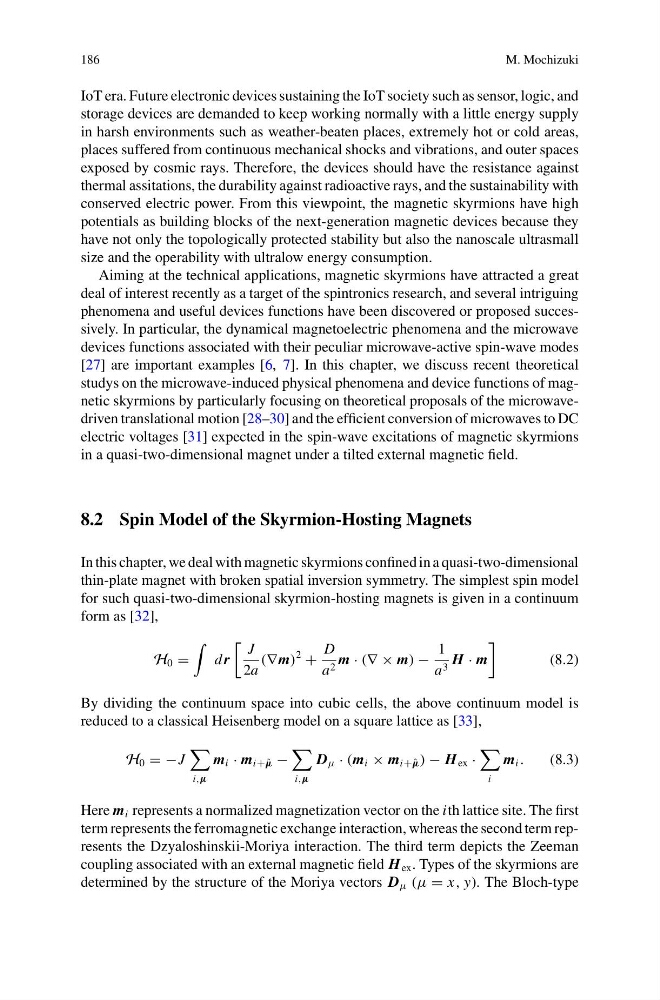
By dividing the continuum space into cubic cells, the above continuum model is
reduced to a classical Heisenberg model on a square lattice as [33],
H 0 = −J
i,μ
m i · m i+ ˆ
μ −
i,μ
D μ · (m i × m i+ ˆ
μ ) − H ex ·
i
m i .
(8.3)
Here m i represents a normalized magnetization vector on the ith lattice site. The first
term represents the ferromagnetic exchange interaction, whereas the second term represents the Dzyaloshinskii-Moriya interaction. The third term depicts the Zeeman
coupling associated with an external magnetic field H ex . Types of the skyrmions are
determined by the structure of the Moriya vectors D μ (μ = x, y). The Bloch-type
M. Mochizuki
IoT era. Future electronic devices sustaining the IoT society such as sensor, logic, and
storage devices are demanded to keep working normally with a little energy supply
in harsh environments such as weather-beaten places, extremely hot or cold areas,
places suffered from continuous mechanical shocks and vibrations, and outer spaces
exposed by cosmic rays. Therefore, the devices should have the resistance against
thermal assitations, the durability against radioactive rays, and the sustainability with
conserved electric power. From this viewpoint, the magnetic skyrmions have high
potentials as building blocks of the next-generation magnetic devices because they
have not only the topologically protected stability but also the nanoscale ultrasmall
size and the operability with ultralow energy consumption.
Aiming at the technical applications, magnetic skyrmions have attracted a great
deal of interest recently as a target of the spintronics research, and several intriguing
phenomena and useful devices functions have been discovered or proposed successively. In particular, the dynamical magnetoelectric phenomena and the microwave
devices functions associated with their peculiar microwave-active spin-wave modes
[27] are important examples [6, 7]. In this chapter, we discuss recent theoretical
studys on the microwave-induced physical phenomena and device functions of magnetic skyrmions by particularly focusing on theoretical proposals of the microwavedriven translational motion [28–30] and the efficient conversion of microwaves to DC
electric voltages [31] expected in the spin-wave excitations of magnetic skyrmions
in a quasi-two-dimensional magnet under a tilted external magnetic field.
8.2 Spin Model of the Skyrmion-Hosting Magnets
In this chapter, we deal with magnetic skyrmions confined in a quasi-two-dimensional
thin-plate magnet with broken spatial inversion symmetry. The simplest spin model
for such quasi-two-dimensional skyrmion-hosting magnets is given in a continuum
form as [32],
H 0 =
d r
J
2a
(∇m)
2
+
D
a 2 m · (∇ × m) −
1
a 3 H · m
(8.2)
By dividing the continuum space into cubic cells, the above continuum model is
reduced to a classical Heisenberg model on a square lattice as [33],
H 0 = −J
i,μ
m i · m i+ ˆ
μ −
i,μ
D μ · (m i × m i+ ˆ
μ ) − H ex ·
i
m i .
(8.3)
Here m i represents a normalized magnetization vector on the ith lattice site. The first
term represents the ferromagnetic exchange interaction, whereas the second term represents the Dzyaloshinskii-Moriya interaction. The third term depicts the Zeeman
coupling associated with an external magnetic field H ex . Types of the skyrmions are
determined by the structure of the Moriya vectors D μ (μ = x, y). The Bloch-type