

164
J. Masell and K. Everschor-Sitte
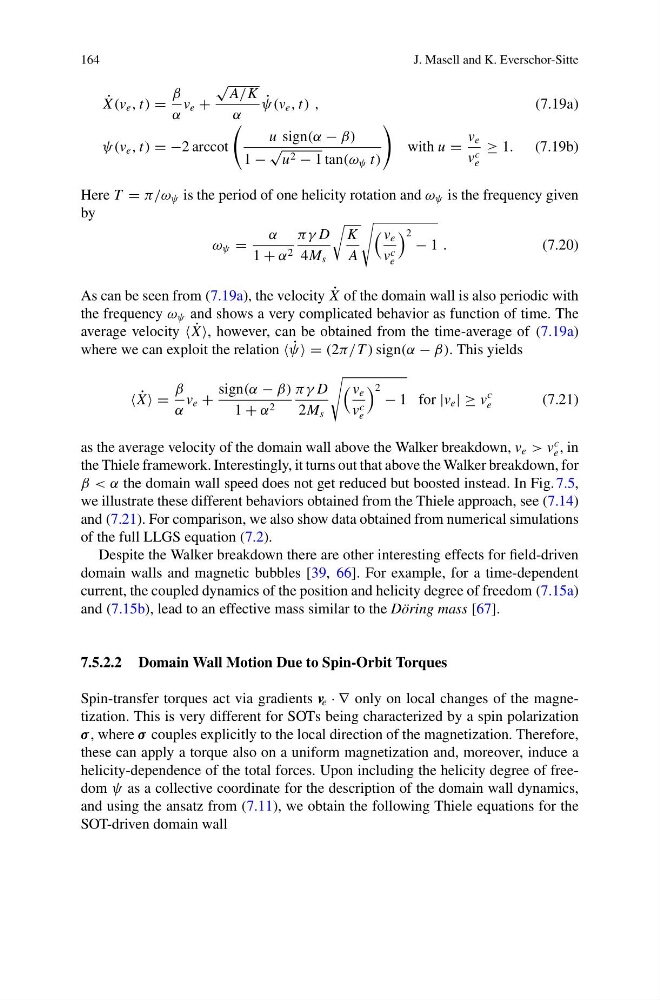
˙
X (v e , t) =
β
α
v e +
√
A/K
α
˙
ψ(v e , t) ,
(7.19a)
ψ(v e , t) = −2 arccot
u sign(α − β)
1 −
√
u 2 − 1 tan(ω ψ t)
with u =
v e
v c
e
≥ 1. (7.19b)
Here T = π/ω ψ is the period of one helicity rotation and ω ψ is the frequency given
by
ω ψ =
α
1 + α 2
πγ D
4M s
K
A
v e
v c
e
2 − 1 .
(7.20)
As can be seen from (7.19a), the velocity ˙
X of the domain wall is also periodic with
the frequency ω ψ and shows a very complicated behavior as function of time. The
average velocity ˙
X , however, can be obtained from the time-average of (7.19a)
where we can exploit the relation ˙
ψ = (2π/T ) sign(α − β). This yields
˙
X =
β
α
v e +
sign(α − β)
1 + α 2
πγ D
2M s
v e
v c
e
2 − 1 for |v e | ≥ v
c
e
(7.21)
as the average velocity of the domain wall above the Walker breakdown, v e > v
c
e , in
the Thiele framework. Interestingly, it turns out that above the Walker breakdown, for
β < α the domain wall speed does not get reduced but boosted instead. In Fig. 7.5,
we illustrate these different behaviors obtained from the Thiele approach, see (7.14)
and (7.21). For comparison, we also show data obtained from numerical simulations
of the full LLGS equation (7.2).
Despite the Walker breakdown there are other interesting effects for field-driven
domain walls and magnetic bubbles [39, 66]. For example, for a time-dependent
current, the coupled dynamics of the position and helicity degree of freedom (7.15a)
and (7.15b), lead to an effective mass similar to the Döring mass [67].
7.5.2.2 Domain Wall Motion Due to Spin-Orbit Torques
Spin-transfer torques act via gradients v e · ∇ only on local changes of the magnetization. This is very different for SOTs being characterized by a spin polarization
σ , where σ couples explicitly to the local direction of the magnetization. Therefore,
these can apply a torque also on a uniform magnetization and, moreover, induce a
helicity-dependence of the total forces. Upon including the helicity degree of freedom ψ as a collective coordinate for the description of the domain wall dynamics,
and using the ansatz from (7.11), we obtain the following Thiele equations for the
SOT-driven domain wall
J. Masell and K. Everschor-Sitte
˙
X (v e , t) =
β
α
v e +
√
A/K
α
˙
ψ(v e , t) ,
(7.19a)
ψ(v e , t) = −2 arccot
u sign(α − β)
1 −
√
u 2 − 1 tan(ω ψ t)
with u =
v e
v c
e
≥ 1. (7.19b)
Here T = π/ω ψ is the period of one helicity rotation and ω ψ is the frequency given
by
ω ψ =
α
1 + α 2
πγ D
4M s
K
A
v e
v c
e
2 − 1 .
(7.20)
As can be seen from (7.19a), the velocity ˙
X of the domain wall is also periodic with
the frequency ω ψ and shows a very complicated behavior as function of time. The
average velocity ˙
X , however, can be obtained from the time-average of (7.19a)
where we can exploit the relation ˙
ψ = (2π/T ) sign(α − β). This yields
˙
X =
β
α
v e +
sign(α − β)
1 + α 2
πγ D
2M s
v e
v c
e
2 − 1 for |v e | ≥ v
c
e
(7.21)
as the average velocity of the domain wall above the Walker breakdown, v e > v
c
e , in
the Thiele framework. Interestingly, it turns out that above the Walker breakdown, for
β < α the domain wall speed does not get reduced but boosted instead. In Fig. 7.5,
we illustrate these different behaviors obtained from the Thiele approach, see (7.14)
and (7.21). For comparison, we also show data obtained from numerical simulations
of the full LLGS equation (7.2).
Despite the Walker breakdown there are other interesting effects for field-driven
domain walls and magnetic bubbles [39, 66]. For example, for a time-dependent
current, the coupled dynamics of the position and helicity degree of freedom (7.15a)
and (7.15b), lead to an effective mass similar to the Döring mass [67].
7.5.2.2 Domain Wall Motion Due to Spin-Orbit Torques
Spin-transfer torques act via gradients v e · ∇ only on local changes of the magnetization. This is very different for SOTs being characterized by a spin polarization
σ , where σ couples explicitly to the local direction of the magnetization. Therefore,
these can apply a torque also on a uniform magnetization and, moreover, induce a
helicity-dependence of the total forces. Upon including the helicity degree of freedom ψ as a collective coordinate for the description of the domain wall dynamics,
and using the ansatz from (7.11), we obtain the following Thiele equations for the
SOT-driven domain wall