

7 Current-Induced Dynamics of Chiral Magnetic Structures
165
G X ψ ˙
ψ + τ FL σ · G
SOT
X (ψ) + αD X X ˙
X + τ DL σ · D
SOT
X (ψ) = 0 ,
(7.22a)
G ψ X ˙
X + τ FL σ · G
SOT
ψ (ψ) + αD ψψ ˙
ψ + τ DL σ · D
SOT
ψ (ψ) = F ψ (X, ψ) . (7.22b)
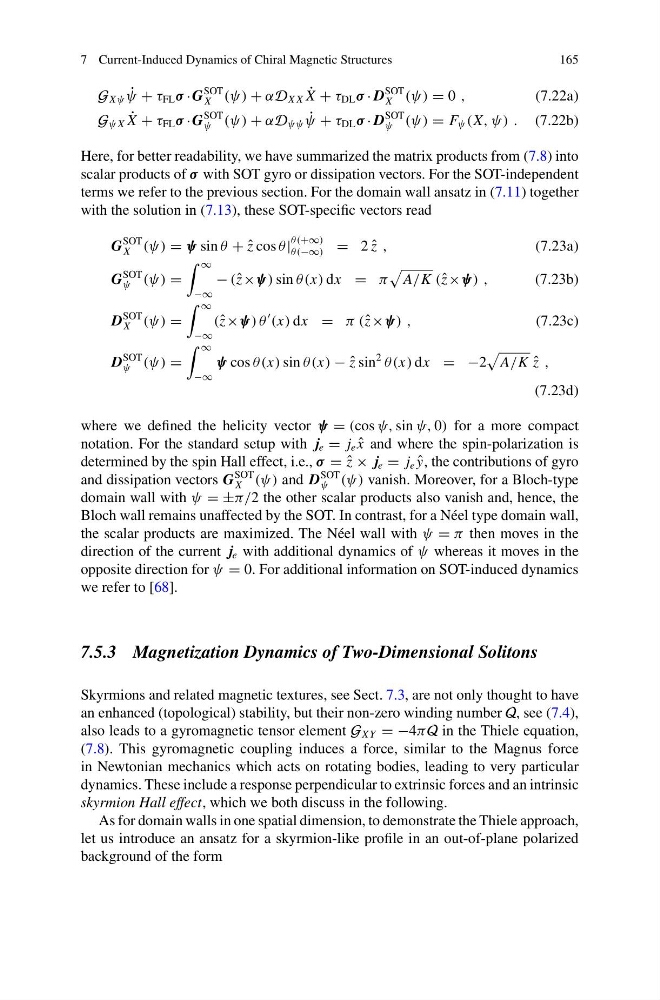
Here, for better readability, we have summarized the matrix products from (7.8) into
scalar products of σ with SOT gyro or dissipation vectors. For the SOT-independent
terms we refer to the previous section. For the domain wall ansatz in (7.11) together
with the solution in (7.13), these SOT-specific vectors read
G
SOT
X (ψ) = ψ sin θ + ˆ
z cos θ |
θ(+∞)
θ(−∞) = 2 ˆ
z ,
(7.23a)
G
SOT
ψ (ψ) =
∞
−∞
− (ˆ z ×ψ) sin θ(x) dx = π
A/K (ˆ z ×ψ) ,
(7.23b)
D
SOT
X (ψ) =
∞
−∞
(ˆ z ×ψ) θ
(x) dx = π (ˆ z ×ψ) ,
(7.23c)
D
SOT
ψ (ψ) =
∞
−∞
ψ cos θ(x) sin θ(x) − ˆ
z sin
2
θ(x) dx = −2
A/K ˆ
z ,
(7.23d)
where we defined the helicity vector ψ = (cos ψ, sin ψ, 0) for a more compact
notation. For the standard setup with j e = j e ˆ
x and where the spin-polarization is
determined by the spin Hall effect, i.e., σ = ˆ
z × j e = j e ˆ
y, the contributions of gyro
and dissipation vectors G
SOT
X (ψ) and D
SOT
ψ (ψ) vanish. Moreover, for a Bloch-type
domain wall with ψ = ±π/2 the other scalar products also vanish and, hence, the
Bloch wall remains unaffected by the SOT. In contrast, for a Néel type domain wall,
the scalar products are maximized. The Néel wall with ψ = π then moves in the
direction of the current j e with additional dynamics of ψ whereas it moves in the
opposite direction for ψ = 0. For additional information on SOT-induced dynamics
we refer to [68].
7.5.3 Magnetization Dynamics of Two-Dimensional Solitons
Skyrmions and related magnetic textures, see Sect. 7.3, are not only thought to have
an enhanced (topological) stability, but their non-zero winding number Q, see (7.4),
also leads to a gyromagnetic tensor element G XY = −4π Q in the Thiele equation,
(7.8). This gyromagnetic coupling induces a force, similar to the Magnus force
in Newtonian mechanics which acts on rotating bodies, leading to very particular
dynamics. These include a response perpendicular to extrinsic forces and an intrinsic
skyrmion Hall effect, which we both discuss in the following.
As for domain walls in one spatial dimension, to demonstrate the Thiele approach,
let us introduce an ansatz for a skyrmion-like profile in an out-of-plane polarized
background of the form
165
G X ψ ˙
ψ + τ FL σ · G
SOT
X (ψ) + αD X X ˙
X + τ DL σ · D
SOT
X (ψ) = 0 ,
(7.22a)
G ψ X ˙
X + τ FL σ · G
SOT
ψ (ψ) + αD ψψ ˙
ψ + τ DL σ · D
SOT
ψ (ψ) = F ψ (X, ψ) . (7.22b)
Here, for better readability, we have summarized the matrix products from (7.8) into
scalar products of σ with SOT gyro or dissipation vectors. For the SOT-independent
terms we refer to the previous section. For the domain wall ansatz in (7.11) together
with the solution in (7.13), these SOT-specific vectors read
G
SOT
X (ψ) = ψ sin θ + ˆ
z cos θ |
θ(+∞)
θ(−∞) = 2 ˆ
z ,
(7.23a)
G
SOT
ψ (ψ) =
∞
−∞
− (ˆ z ×ψ) sin θ(x) dx = π
A/K (ˆ z ×ψ) ,
(7.23b)
D
SOT
X (ψ) =
∞
−∞
(ˆ z ×ψ) θ
(x) dx = π (ˆ z ×ψ) ,
(7.23c)
D
SOT
ψ (ψ) =
∞
−∞
ψ cos θ(x) sin θ(x) − ˆ
z sin
2
θ(x) dx = −2
A/K ˆ
z ,
(7.23d)
where we defined the helicity vector ψ = (cos ψ, sin ψ, 0) for a more compact
notation. For the standard setup with j e = j e ˆ
x and where the spin-polarization is
determined by the spin Hall effect, i.e., σ = ˆ
z × j e = j e ˆ
y, the contributions of gyro
and dissipation vectors G
SOT
X (ψ) and D
SOT
ψ (ψ) vanish. Moreover, for a Bloch-type
domain wall with ψ = ±π/2 the other scalar products also vanish and, hence, the
Bloch wall remains unaffected by the SOT. In contrast, for a Néel type domain wall,
the scalar products are maximized. The Néel wall with ψ = π then moves in the
direction of the current j e with additional dynamics of ψ whereas it moves in the
opposite direction for ψ = 0. For additional information on SOT-induced dynamics
we refer to [68].
7.5.3 Magnetization Dynamics of Two-Dimensional Solitons
Skyrmions and related magnetic textures, see Sect. 7.3, are not only thought to have
an enhanced (topological) stability, but their non-zero winding number Q, see (7.4),
also leads to a gyromagnetic tensor element G XY = −4π Q in the Thiele equation,
(7.8). This gyromagnetic coupling induces a force, similar to the Magnus force
in Newtonian mechanics which acts on rotating bodies, leading to very particular
dynamics. These include a response perpendicular to extrinsic forces and an intrinsic
skyrmion Hall effect, which we both discuss in the following.
As for domain walls in one spatial dimension, to demonstrate the Thiele approach,
let us introduce an ansatz for a skyrmion-like profile in an out-of-plane polarized
background of the form