

6 Magnetoelectricity of Chiral Micromagnetic Structures
141
a)
b)
c)
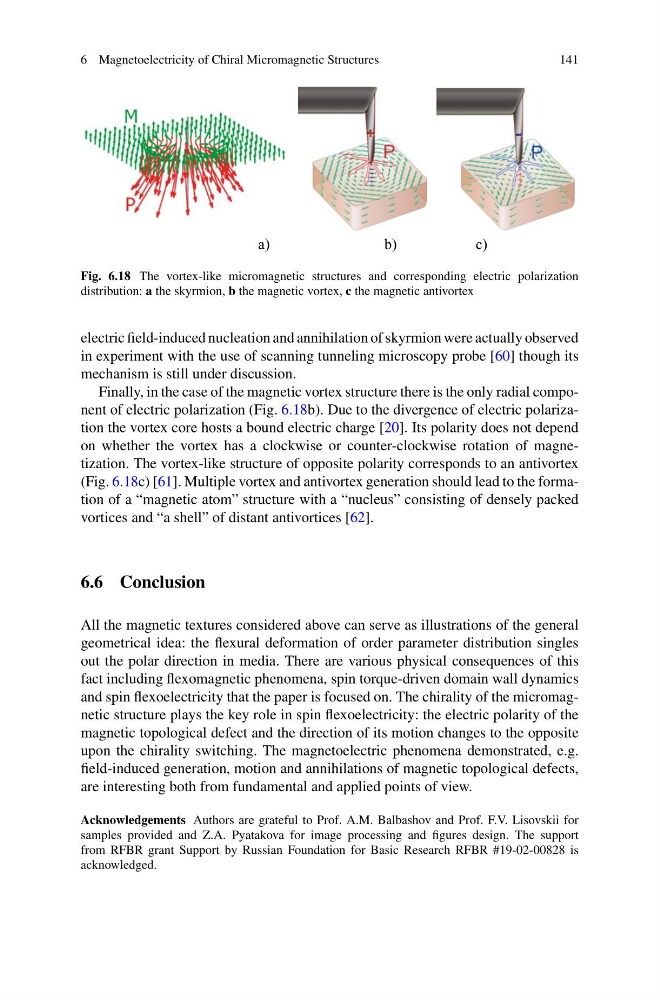
Fig. 6.18 The vortex-like micromagnetic structures and corresponding electric polarization
distribution: a the skyrmion, b the magnetic vortex, c the magnetic antivortex
electric field-induced nucleation and annihilation of skyrmion were actually observed
in experiment with the use of scanning tunneling microscopy probe [60] though its
mechanism is still under discussion.
Finally, in the case of the magnetic vortex structure there is the only radial component of electric polarization (Fig. 6.18b). Due to the divergence of electric polarization the vortex core hosts a bound electric charge [20]. Its polarity does not depend
on whether the vortex has a clockwise or counter-clockwise rotation of magnetization. The vortex-like structure of opposite polarity corresponds to an antivortex
(Fig. 6.18c) [61]. Multiple vortex and antivortex generation should lead to the formation of a “magnetic atom” structure with a “nucleus” consisting of densely packed
vortices and “a shell” of distant antivortices [62].
6.6 Conclusion
All the magnetic textures considered above can serve as illustrations of the general
geometrical idea: the flexural deformation of order parameter distribution singles
out the polar direction in media. There are various physical consequences of this
fact including flexomagnetic phenomena, spin torque-driven domain wall dynamics
and spin flexoelectricity that the paper is focused on. The chirality of the micromagnetic structure plays the key role in spin flexoelectricity: the electric polarity of the
magnetic topological defect and the direction of its motion changes to the opposite
upon the chirality switching. The magnetoelectric phenomena demonstrated, e.g.
field-induced generation, motion and annihilations of magnetic topological defects,
are interesting both from fundamental and applied points of view.
Acknowledgements Authors are grateful to Prof. A.M. Balbashov and Prof. F.V. Lisovskii for
samples provided and Z.A. Pyatakova for image processing and figures design. The support
from RFBR grant Support by Russian Foundation for Basic Research RFBR #19-02-00828 is
acknowledged.
141
a)
b)
c)
Fig. 6.18 The vortex-like micromagnetic structures and corresponding electric polarization
distribution: a the skyrmion, b the magnetic vortex, c the magnetic antivortex
electric field-induced nucleation and annihilation of skyrmion were actually observed
in experiment with the use of scanning tunneling microscopy probe [60] though its
mechanism is still under discussion.
Finally, in the case of the magnetic vortex structure there is the only radial component of electric polarization (Fig. 6.18b). Due to the divergence of electric polarization the vortex core hosts a bound electric charge [20]. Its polarity does not depend
on whether the vortex has a clockwise or counter-clockwise rotation of magnetization. The vortex-like structure of opposite polarity corresponds to an antivortex
(Fig. 6.18c) [61]. Multiple vortex and antivortex generation should lead to the formation of a “magnetic atom” structure with a “nucleus” consisting of densely packed
vortices and “a shell” of distant antivortices [62].
6.6 Conclusion
All the magnetic textures considered above can serve as illustrations of the general
geometrical idea: the flexural deformation of order parameter distribution singles
out the polar direction in media. There are various physical consequences of this
fact including flexomagnetic phenomena, spin torque-driven domain wall dynamics
and spin flexoelectricity that the paper is focused on. The chirality of the micromagnetic structure plays the key role in spin flexoelectricity: the electric polarity of the
magnetic topological defect and the direction of its motion changes to the opposite
upon the chirality switching. The magnetoelectric phenomena demonstrated, e.g.
field-induced generation, motion and annihilations of magnetic topological defects,
are interesting both from fundamental and applied points of view.
Acknowledgements Authors are grateful to Prof. A.M. Balbashov and Prof. F.V. Lisovskii for
samples provided and Z.A. Pyatakova for image processing and figures design. The support
from RFBR grant Support by Russian Foundation for Basic Research RFBR #19-02-00828 is
acknowledged.