

140
A. P. Pyatakov et al.
a)
b)
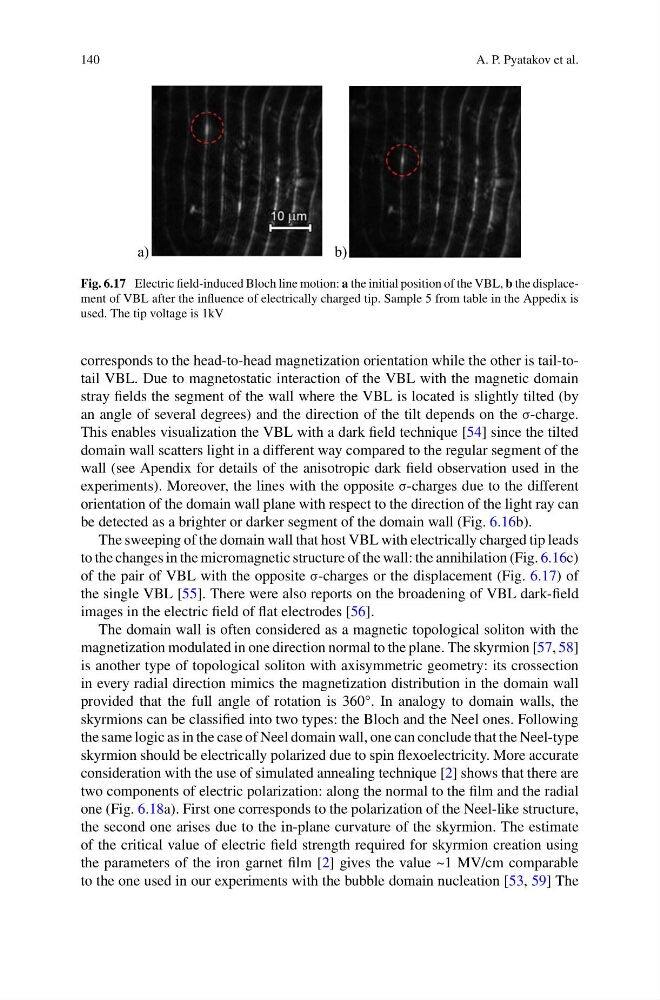
Fig. 6.17 Electric field-induced Bloch line motion: a the initial position of the VBL, b the displacement of VBL after the influence of electrically charged tip. Sample 5 from table in the Appedix is
used. The tip voltage is 1kV
corresponds to the head-to-head magnetization orientation while the other is tail-totail VBL. Due to magnetostatic interaction of the VBL with the magnetic domain
stray fields the segment of the wall where the VBL is located is slightly tilted (by
an angle of several degrees) and the direction of the tilt depends on the σ-charge.
This enables visualization the VBL with a dark field technique [54] since the tilted
domain wall scatters light in a different way compared to the regular segment of the
wall (see Apendix for details of the anisotropic dark field observation used in the
experiments). Moreover, the lines with the opposite σ-charges due to the different
orientation of the domain wall plane with respect to the direction of the light ray can
be detected as a brighter or darker segment of the domain wall (Fig. 6.16b).
The sweeping of the domain wall that host VBL with electrically charged tip leads
to the changes in the micromagnetic structure of the wall: the annihilation (Fig. 6.16c)
of the pair of VBL with the opposite σ-charges or the displacement (Fig. 6.17) of
the single VBL [55]. There were also reports on the broadening of VBL dark-field
images in the electric field of flat electrodes [56].
The domain wall is often considered as a magnetic topological soliton with the
magnetization modulated in one direction normal to the plane. The skyrmion [57, 58]
is another type of topological soliton with axisymmetric geometry: its crossection
in every radial direction mimics the magnetization distribution in the domain wall
provided that the full angle of rotation is 360°. In analogy to domain walls, the
skyrmions can be classified into two types: the Bloch and the Neel ones. Following
the same logic as in the case of Neel domain wall, one can conclude that the Neel-type
skyrmion should be electrically polarized due to spin flexoelectricity. More accurate
consideration with the use of simulated annealing technique [2] shows that there are
two components of electric polarization: along the normal to the film and the radial
one (Fig. 6.18a). First one corresponds to the polarization of the Neel-like structure,
the second one arises due to the in-plane curvature of the skyrmion. The estimate
of the critical value of electric field strength required for skyrmion creation using
the parameters of the iron garnet film [2] gives the value ~1 MV/cm comparable
to the one used in our experiments with the bubble domain nucleation [53, 59] The
A. P. Pyatakov et al.
a)
b)
Fig. 6.17 Electric field-induced Bloch line motion: a the initial position of the VBL, b the displacement of VBL after the influence of electrically charged tip. Sample 5 from table in the Appedix is
used. The tip voltage is 1kV
corresponds to the head-to-head magnetization orientation while the other is tail-totail VBL. Due to magnetostatic interaction of the VBL with the magnetic domain
stray fields the segment of the wall where the VBL is located is slightly tilted (by
an angle of several degrees) and the direction of the tilt depends on the σ-charge.
This enables visualization the VBL with a dark field technique [54] since the tilted
domain wall scatters light in a different way compared to the regular segment of the
wall (see Apendix for details of the anisotropic dark field observation used in the
experiments). Moreover, the lines with the opposite σ-charges due to the different
orientation of the domain wall plane with respect to the direction of the light ray can
be detected as a brighter or darker segment of the domain wall (Fig. 6.16b).
The sweeping of the domain wall that host VBL with electrically charged tip leads
to the changes in the micromagnetic structure of the wall: the annihilation (Fig. 6.16c)
of the pair of VBL with the opposite σ-charges or the displacement (Fig. 6.17) of
the single VBL [55]. There were also reports on the broadening of VBL dark-field
images in the electric field of flat electrodes [56].
The domain wall is often considered as a magnetic topological soliton with the
magnetization modulated in one direction normal to the plane. The skyrmion [57, 58]
is another type of topological soliton with axisymmetric geometry: its crossection
in every radial direction mimics the magnetization distribution in the domain wall
provided that the full angle of rotation is 360°. In analogy to domain walls, the
skyrmions can be classified into two types: the Bloch and the Neel ones. Following
the same logic as in the case of Neel domain wall, one can conclude that the Neel-type
skyrmion should be electrically polarized due to spin flexoelectricity. More accurate
consideration with the use of simulated annealing technique [2] shows that there are
two components of electric polarization: along the normal to the film and the radial
one (Fig. 6.18a). First one corresponds to the polarization of the Neel-like structure,
the second one arises due to the in-plane curvature of the skyrmion. The estimate
of the critical value of electric field strength required for skyrmion creation using
the parameters of the iron garnet film [2] gives the value ~1 MV/cm comparable
to the one used in our experiments with the bubble domain nucleation [53, 59] The