

6 Magnetoelectricity of Chiral Micromagnetic Structures
137
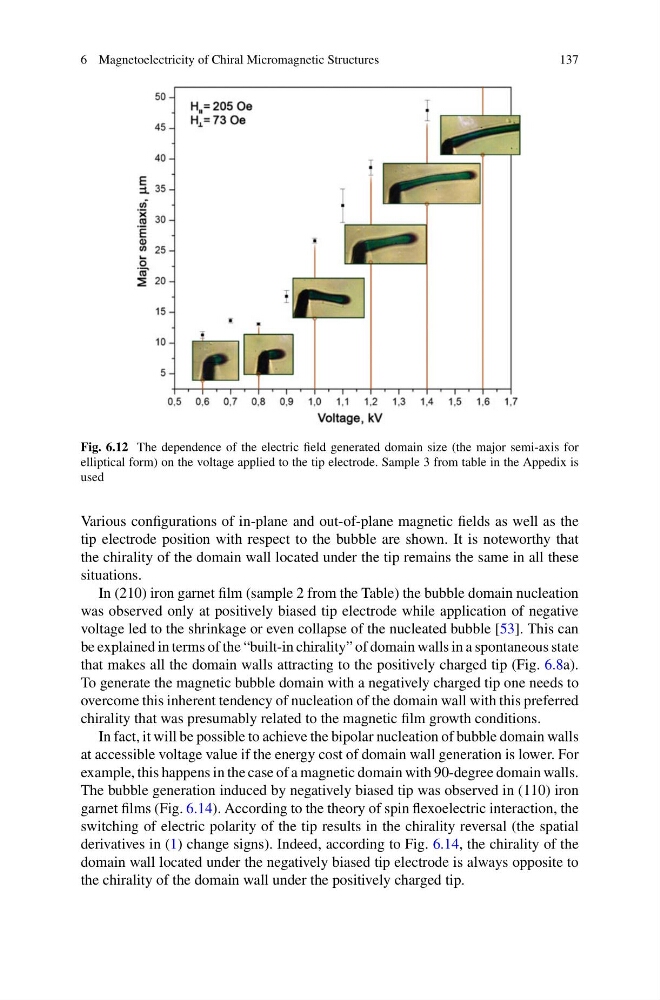
Fig. 6.12 The dependence of the electric field generated domain size (the major semi-axis for
elliptical form) on the voltage applied to the tip electrode. Sample 3 from table in the Appedix is
used
Various configurations of in-plane and out-of-plane magnetic fields as well as the
tip electrode position with respect to the bubble are shown. It is noteworthy that
the chirality of the domain wall located under the tip remains the same in all these
situations.
In (210) iron garnet film (sample 2 from the Table) the bubble domain nucleation
was observed only at positively biased tip electrode while application of negative
voltage led to the shrinkage or even collapse of the nucleated bubble [53]. This can
be explained in terms of the “built-in chirality” of domain walls in a spontaneous state
that makes all the domain walls attracting to the positively charged tip (Fig. 6.8a).
To generate the magnetic bubble domain with a negatively charged tip one needs to
overcome this inherent tendency of nucleation of the domain wall with this preferred
chirality that was presumably related to the magnetic film growth conditions.
In fact, it will be possible to achieve the bipolar nucleation of bubble domain walls
at accessible voltage value if the energy cost of domain wall generation is lower. For
example, this happens in the case of a magnetic domain with 90-degree domain walls.
The bubble generation induced by negatively biased tip was observed in (110) iron
garnet films (Fig. 6.14). According to the theory of spin flexoelectric interaction, the
switching of electric polarity of the tip results in the chirality reversal (the spatial
derivatives in (1) change signs). Indeed, according to Fig. 6.14, the chirality of the
domain wall located under the negatively biased tip electrode is always opposite to
the chirality of the domain wall under the positively charged tip.
137
Fig. 6.12 The dependence of the electric field generated domain size (the major semi-axis for
elliptical form) on the voltage applied to the tip electrode. Sample 3 from table in the Appedix is
used
Various configurations of in-plane and out-of-plane magnetic fields as well as the
tip electrode position with respect to the bubble are shown. It is noteworthy that
the chirality of the domain wall located under the tip remains the same in all these
situations.
In (210) iron garnet film (sample 2 from the Table) the bubble domain nucleation
was observed only at positively biased tip electrode while application of negative
voltage led to the shrinkage or even collapse of the nucleated bubble [53]. This can
be explained in terms of the “built-in chirality” of domain walls in a spontaneous state
that makes all the domain walls attracting to the positively charged tip (Fig. 6.8a).
To generate the magnetic bubble domain with a negatively charged tip one needs to
overcome this inherent tendency of nucleation of the domain wall with this preferred
chirality that was presumably related to the magnetic film growth conditions.
In fact, it will be possible to achieve the bipolar nucleation of bubble domain walls
at accessible voltage value if the energy cost of domain wall generation is lower. For
example, this happens in the case of a magnetic domain with 90-degree domain walls.
The bubble generation induced by negatively biased tip was observed in (110) iron
garnet films (Fig. 6.14). According to the theory of spin flexoelectric interaction, the
switching of electric polarity of the tip results in the chirality reversal (the spatial
derivatives in (1) change signs). Indeed, according to Fig. 6.14, the chirality of the
domain wall located under the negatively biased tip electrode is always opposite to
the chirality of the domain wall under the positively charged tip.