

136
A. P. Pyatakov et al.
a)
b)
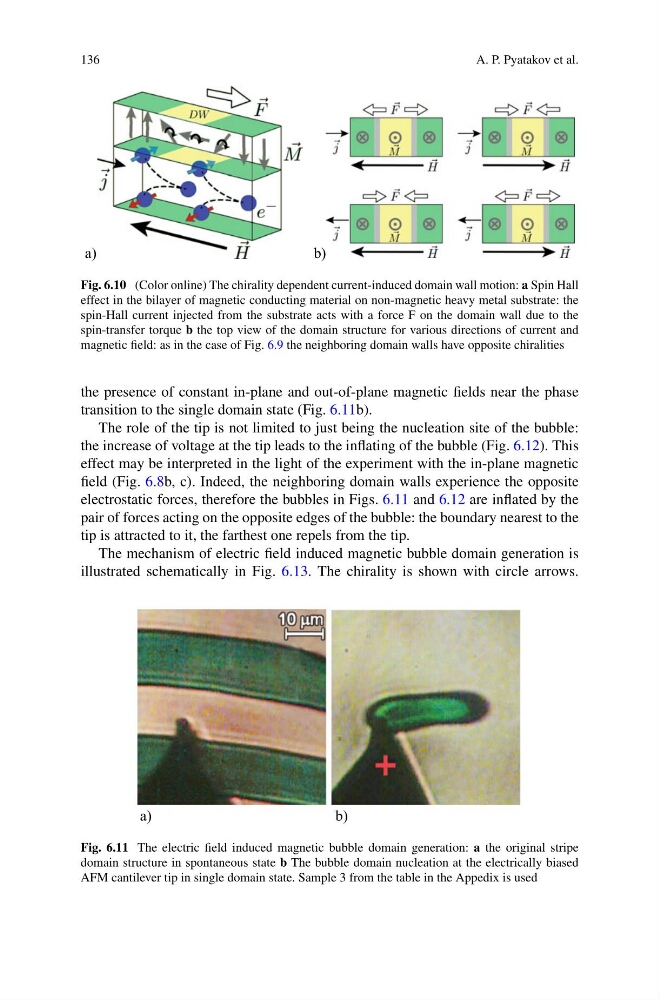
Fig. 6.10 (Color online) The chirality dependent current-induced domain wall motion: a Spin Hall
effect in the bilayer of magnetic conducting material on non-magnetic heavy metal substrate: the
spin-Hall current injected from the substrate acts with a force F on the domain wall due to the
spin-transfer torque b the top view of the domain structure for various directions of current and
magnetic field: as in the case of Fig. 6.9 the neighboring domain walls have opposite chiralities
the presence of constant in-plane and out-of-plane magnetic fields near the phase
transition to the single domain state (Fig. 6.11b).
The role of the tip is not limited to just being the nucleation site of the bubble:
the increase of voltage at the tip leads to the inflating of the bubble (Fig. 6.12). This
effect may be interpreted in the light of the experiment with the in-plane magnetic
field (Fig. 6.8b, c). Indeed, the neighboring domain walls experience the opposite
electrostatic forces, therefore the bubbles in Figs. 6.11 and 6.12 are inflated by the
pair of forces acting on the opposite edges of the bubble: the boundary nearest to the
tip is attracted to it, the farthest one repels from the tip.
The mechanism of electric field induced magnetic bubble domain generation is
illustrated schematically in Fig. 6.13. The chirality is shown with circle arrows.
a)
b)
Fig. 6.11 The electric field induced magnetic bubble domain generation: a the original stripe
domain structure in spontaneous state b The bubble domain nucleation at the electrically biased
AFM cantilever tip in single domain state. Sample 3 from the table in the Appedix is used
A. P. Pyatakov et al.
a)
b)
Fig. 6.10 (Color online) The chirality dependent current-induced domain wall motion: a Spin Hall
effect in the bilayer of magnetic conducting material on non-magnetic heavy metal substrate: the
spin-Hall current injected from the substrate acts with a force F on the domain wall due to the
spin-transfer torque b the top view of the domain structure for various directions of current and
magnetic field: as in the case of Fig. 6.9 the neighboring domain walls have opposite chiralities
the presence of constant in-plane and out-of-plane magnetic fields near the phase
transition to the single domain state (Fig. 6.11b).
The role of the tip is not limited to just being the nucleation site of the bubble:
the increase of voltage at the tip leads to the inflating of the bubble (Fig. 6.12). This
effect may be interpreted in the light of the experiment with the in-plane magnetic
field (Fig. 6.8b, c). Indeed, the neighboring domain walls experience the opposite
electrostatic forces, therefore the bubbles in Figs. 6.11 and 6.12 are inflated by the
pair of forces acting on the opposite edges of the bubble: the boundary nearest to the
tip is attracted to it, the farthest one repels from the tip.
The mechanism of electric field induced magnetic bubble domain generation is
illustrated schematically in Fig. 6.13. The chirality is shown with circle arrows.
a)
b)
Fig. 6.11 The electric field induced magnetic bubble domain generation: a the original stripe
domain structure in spontaneous state b The bubble domain nucleation at the electrically biased
AFM cantilever tip in single domain state. Sample 3 from the table in the Appedix is used