

6 Magnetoelectricity of Chiral Micromagnetic Structures
133
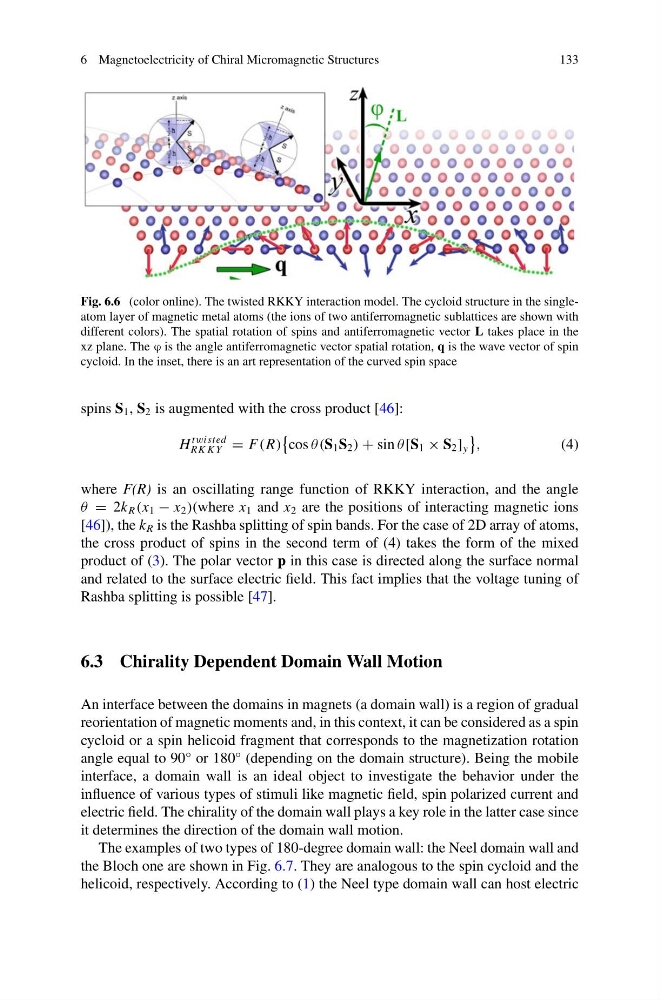
Fig. 6.6 (color online). The twisted RKKY interaction model. The cycloid structure in the singleatom layer of magnetic metal atoms (the ions of two antiferromagnetic sublattices are shown with
different colors). The spatial rotation of spins and antiferromagnetic vector L takes place in the
xz plane. The ϕ is the angle antiferromagnetic vector spatial rotation, q is the wave vector of spin
cycloid. In the inset, there is an art representation of the curved spin space
spins S 1 , S 2 is augmented with the cross product [46]:
H
twisted
RK K Y = F(R)
cos θ (S 1 S 2 ) + sin θ [S 1 × S 2 ] y
,
(4)
where F(R) is an oscillating range function of RKKY interaction, and the angle
θ = 2k R (x 1 − x 2 )(where x 1 and x 2 are the positions of interacting magnetic ions
[46]), the k R is the Rashba splitting of spin bands. For the case of 2D array of atoms,
the cross product of spins in the second term of (4) takes the form of the mixed
product of (3). The polar vector p in this case is directed along the surface normal
and related to the surface electric field. This fact implies that the voltage tuning of
Rashba splitting is possible [47].
6.3 Chirality Dependent Domain Wall Motion
An interface between the domains in magnets (a domain wall) is a region of gradual
reorientation of magnetic moments and, in this context, it can be considered as a spin
cycloid or a spin helicoid fragment that corresponds to the magnetization rotation
angle equal to 90° or 180° (depending on the domain structure). Being the mobile
interface, a domain wall is an ideal object to investigate the behavior under the
influence of various types of stimuli like magnetic field, spin polarized current and
electric field. The chirality of the domain wall plays a key role in the latter case since
it determines the direction of the domain wall motion.
The examples of two types of 180-degree domain wall: the Neel domain wall and
the Bloch one are shown in Fig. 6.7. They are analogous to the spin cycloid and the
helicoid, respectively. According to (1) the Neel type domain wall can host electric
133
Fig. 6.6 (color online). The twisted RKKY interaction model. The cycloid structure in the singleatom layer of magnetic metal atoms (the ions of two antiferromagnetic sublattices are shown with
different colors). The spatial rotation of spins and antiferromagnetic vector L takes place in the
xz plane. The ϕ is the angle antiferromagnetic vector spatial rotation, q is the wave vector of spin
cycloid. In the inset, there is an art representation of the curved spin space
spins S 1 , S 2 is augmented with the cross product [46]:
H
twisted
RK K Y = F(R)
cos θ (S 1 S 2 ) + sin θ [S 1 × S 2 ] y
,
(4)
where F(R) is an oscillating range function of RKKY interaction, and the angle
θ = 2k R (x 1 − x 2 )(where x 1 and x 2 are the positions of interacting magnetic ions
[46]), the k R is the Rashba splitting of spin bands. For the case of 2D array of atoms,
the cross product of spins in the second term of (4) takes the form of the mixed
product of (3). The polar vector p in this case is directed along the surface normal
and related to the surface electric field. This fact implies that the voltage tuning of
Rashba splitting is possible [47].
6.3 Chirality Dependent Domain Wall Motion
An interface between the domains in magnets (a domain wall) is a region of gradual
reorientation of magnetic moments and, in this context, it can be considered as a spin
cycloid or a spin helicoid fragment that corresponds to the magnetization rotation
angle equal to 90° or 180° (depending on the domain structure). Being the mobile
interface, a domain wall is an ideal object to investigate the behavior under the
influence of various types of stimuli like magnetic field, spin polarized current and
electric field. The chirality of the domain wall plays a key role in the latter case since
it determines the direction of the domain wall motion.
The examples of two types of 180-degree domain wall: the Neel domain wall and
the Bloch one are shown in Fig. 6.7. They are analogous to the spin cycloid and the
helicoid, respectively. According to (1) the Neel type domain wall can host electric