

132
A. P. Pyatakov et al.
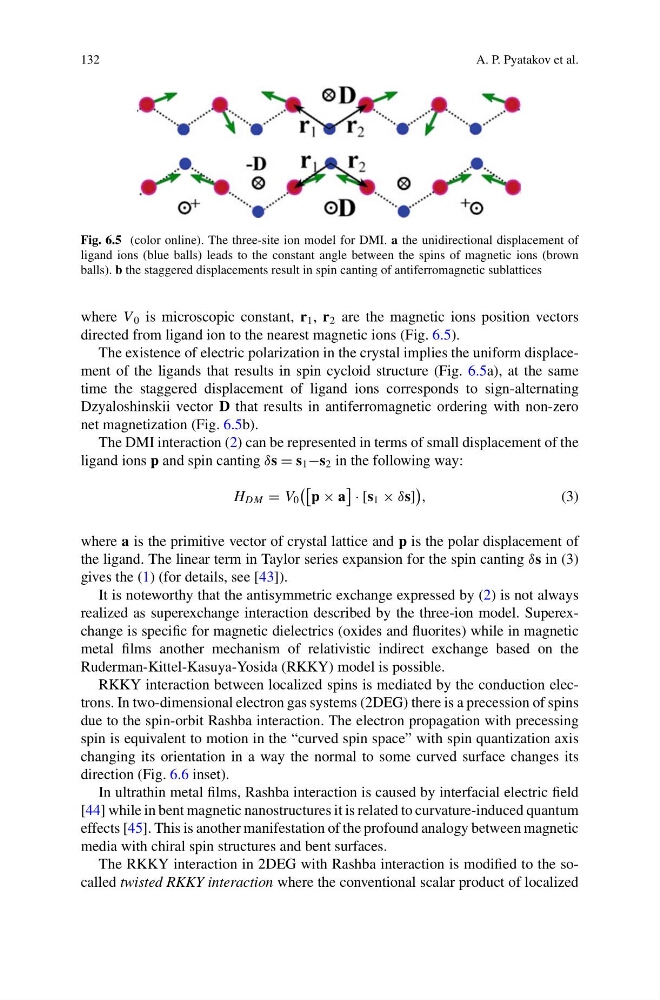
Fig. 6.5 (color online). The three-site ion model for DMI. a the unidirectional displacement of
ligand ions (blue balls) leads to the constant angle between the spins of magnetic ions (brown
balls). b the staggered displacements result in spin canting of antiferromagnetic sublattices
where V 0 is microscopic constant, r 1 , r 2 are the magnetic ions position vectors
directed from ligand ion to the nearest magnetic ions (Fig. 6.5).
The existence of electric polarization in the crystal implies the uniform displacement of the ligands that results in spin cycloid structure (Fig. 6.5a), at the same
time the staggered displacement of ligand ions corresponds to sign-alternating
Dzyaloshinskii vector D that results in antiferromagnetic ordering with non-zero
net magnetization (Fig. 6.5b).
The DMI interaction (2) can be represented in terms of small displacement of the
ligand ions p and spin canting δs = s 1 −s 2 in the following way:
H DM = V 0
p × a
· [s 1 × δs]
,
(3)
where a is the primitive vector of crystal lattice and p is the polar displacement of
the ligand. The linear term in Taylor series expansion for the spin canting δs in (3)
gives the (1) (for details, see [43]).
It is noteworthy that the antisymmetric exchange expressed by (2) is not always
realized as superexchange interaction described by the three-ion model. Superexchange is specific for magnetic dielectrics (oxides and fluorites) while in magnetic
metal films another mechanism of relativistic indirect exchange based on the
Ruderman-Kittel-Kasuya-Yosida (RKKY) model is possible.
RKKY interaction between localized spins is mediated by the conduction electrons. In two-dimensional electron gas systems (2DEG) there is a precession of spins
due to the spin-orbit Rashba interaction. The electron propagation with precessing
spin is equivalent to motion in the “curved spin space” with spin quantization axis
changing its orientation in a way the normal to some curved surface changes its
direction (Fig. 6.6 inset).
In ultrathin metal films, Rashba interaction is caused by interfacial electric field
[44] while in bent magnetic nanostructures it is related to curvature-induced quantum
effects [45]. This is another manifestation of the profound analogy between magnetic
media with chiral spin structures and bent surfaces.
The RKKY interaction in 2DEG with Rashba interaction is modified to the socalled twisted RKKY interaction where the conventional scalar product of localized
A. P. Pyatakov et al.
Fig. 6.5 (color online). The three-site ion model for DMI. a the unidirectional displacement of
ligand ions (blue balls) leads to the constant angle between the spins of magnetic ions (brown
balls). b the staggered displacements result in spin canting of antiferromagnetic sublattices
where V 0 is microscopic constant, r 1 , r 2 are the magnetic ions position vectors
directed from ligand ion to the nearest magnetic ions (Fig. 6.5).
The existence of electric polarization in the crystal implies the uniform displacement of the ligands that results in spin cycloid structure (Fig. 6.5a), at the same
time the staggered displacement of ligand ions corresponds to sign-alternating
Dzyaloshinskii vector D that results in antiferromagnetic ordering with non-zero
net magnetization (Fig. 6.5b).
The DMI interaction (2) can be represented in terms of small displacement of the
ligand ions p and spin canting δs = s 1 −s 2 in the following way:
H DM = V 0
p × a
· [s 1 × δs]
,
(3)
where a is the primitive vector of crystal lattice and p is the polar displacement of
the ligand. The linear term in Taylor series expansion for the spin canting δs in (3)
gives the (1) (for details, see [43]).
It is noteworthy that the antisymmetric exchange expressed by (2) is not always
realized as superexchange interaction described by the three-ion model. Superexchange is specific for magnetic dielectrics (oxides and fluorites) while in magnetic
metal films another mechanism of relativistic indirect exchange based on the
Ruderman-Kittel-Kasuya-Yosida (RKKY) model is possible.
RKKY interaction between localized spins is mediated by the conduction electrons. In two-dimensional electron gas systems (2DEG) there is a precession of spins
due to the spin-orbit Rashba interaction. The electron propagation with precessing
spin is equivalent to motion in the “curved spin space” with spin quantization axis
changing its orientation in a way the normal to some curved surface changes its
direction (Fig. 6.6 inset).
In ultrathin metal films, Rashba interaction is caused by interfacial electric field
[44] while in bent magnetic nanostructures it is related to curvature-induced quantum
effects [45]. This is another manifestation of the profound analogy between magnetic
media with chiral spin structures and bent surfaces.
The RKKY interaction in 2DEG with Rashba interaction is modified to the socalled twisted RKKY interaction where the conventional scalar product of localized