

6 Magnetoelectricity of Chiral Micromagnetic Structures
131
a)
b)
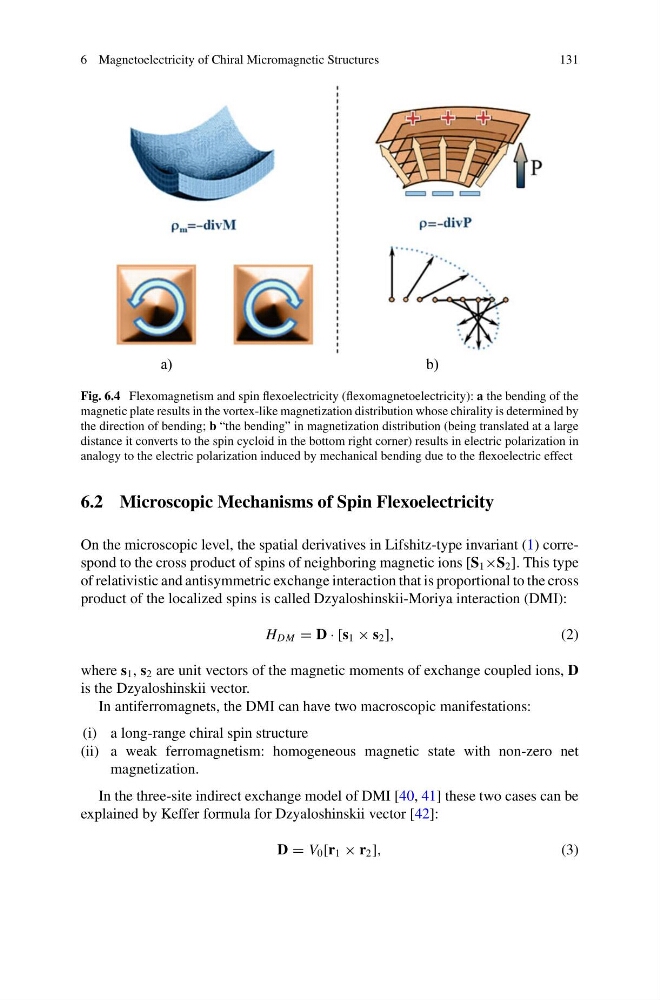
Fig. 6.4 Flexomagnetism and spin flexoelectricity (flexomagnetoelectricity): a the bending of the
magnetic plate results in the vortex-like magnetization distribution whose chirality is determined by
the direction of bending; b “the bending” in magnetization distribution (being translated at a large
distance it converts to the spin cycloid in the bottom right corner) results in electric polarization in
analogy to the electric polarization induced by mechanical bending due to the flexoelectric effect
6.2 Microscopic Mechanisms of Spin Flexoelectricity
On the microscopic level, the spatial derivatives in Lifshitz-type invariant (1) correspond to the cross product of spins of neighboring magnetic ions [S 1 ×S 2 ]. This type
of relativistic and antisymmetric exchange interaction that is proportional to the cross
product of the localized spins is called Dzyaloshinskii-Moriya interaction (DMI):
H DM = D · [s 1 × s 2 ],
(2)
where s 1 , s 2 are unit vectors of the magnetic moments of exchange coupled ions, D
is the Dzyaloshinskii vector.
In antiferromagnets, the DMI can have two macroscopic manifestations:
(i) a long-range chiral spin structure
(ii) a weak ferromagnetism: homogeneous magnetic state with non-zero net
magnetization.
In the three-site indirect exchange model of DMI [40, 41] these two cases can be
explained by Keffer formula for Dzyaloshinskii vector [42]:
D = V 0 [r 1 × r 2 ],
(3)
131
a)
b)
Fig. 6.4 Flexomagnetism and spin flexoelectricity (flexomagnetoelectricity): a the bending of the
magnetic plate results in the vortex-like magnetization distribution whose chirality is determined by
the direction of bending; b “the bending” in magnetization distribution (being translated at a large
distance it converts to the spin cycloid in the bottom right corner) results in electric polarization in
analogy to the electric polarization induced by mechanical bending due to the flexoelectric effect
6.2 Microscopic Mechanisms of Spin Flexoelectricity
On the microscopic level, the spatial derivatives in Lifshitz-type invariant (1) correspond to the cross product of spins of neighboring magnetic ions [S 1 ×S 2 ]. This type
of relativistic and antisymmetric exchange interaction that is proportional to the cross
product of the localized spins is called Dzyaloshinskii-Moriya interaction (DMI):
H DM = D · [s 1 × s 2 ],
(2)
where s 1 , s 2 are unit vectors of the magnetic moments of exchange coupled ions, D
is the Dzyaloshinskii vector.
In antiferromagnets, the DMI can have two macroscopic manifestations:
(i) a long-range chiral spin structure
(ii) a weak ferromagnetism: homogeneous magnetic state with non-zero net
magnetization.
In the three-site indirect exchange model of DMI [40, 41] these two cases can be
explained by Keffer formula for Dzyaloshinskii vector [42]:
D = V 0 [r 1 × r 2 ],
(3)