

6 Magnetoelectricity of Chiral Micromagnetic Structures
129
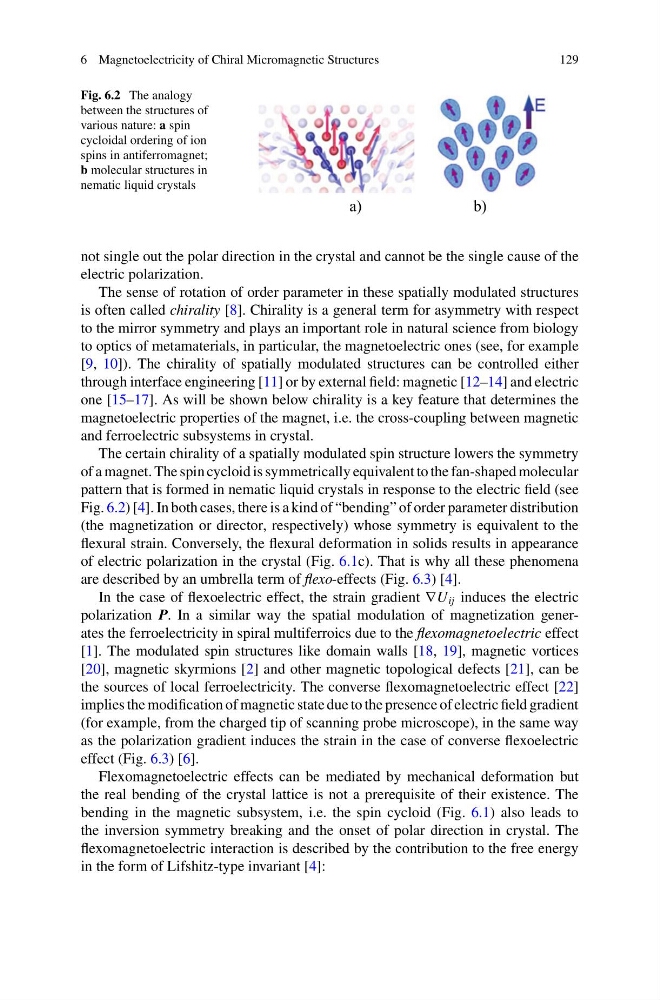
Fig. 6.2 The analogy
between the structures of
various nature: a spin
cycloidal ordering of ion
spins in antiferromagnet;
b molecular structures in
nematic liquid crystals
a)
b)
not single out the polar direction in the crystal and cannot be the single cause of the
electric polarization.
The sense of rotation of order parameter in these spatially modulated structures
is often called chirality [8]. Chirality is a general term for asymmetry with respect
to the mirror symmetry and plays an important role in natural science from biology
to optics of metamaterials, in particular, the magnetoelectric ones (see, for example
[9, 10]). The chirality of spatially modulated structures can be controlled either
through interface engineering [11] or by external field: magnetic [12–14] and electric
one [15–17]. As will be shown below chirality is a key feature that determines the
magnetoelectric properties of the magnet, i.e. the cross-coupling between magnetic
and ferroelectric subsystems in crystal.
The certain chirality of a spatially modulated spin structure lowers the symmetry
of a magnet. The spin cycloid is symmetrically equivalent to the fan-shaped molecular
pattern that is formed in nematic liquid crystals in response to the electric field (see
Fig. 6.2) [4]. In both cases, there is a kind of “bending” of order parameter distribution
(the magnetization or director, respectively) whose symmetry is equivalent to the
flexural strain. Conversely, the flexural deformation in solids results in appearance
of electric polarization in the crystal (Fig. 6.1c). That is why all these phenomena
are described by an umbrella term of flexo-effects (Fig. 6.3) [4].
In the case of flexoelectric effect, the strain gradient ∇U ij induces the electric
polarization P. In a similar way the spatial modulation of magnetization generates the ferroelectricity in spiral multiferroics due to the flexomagnetoelectric effect
[1]. The modulated spin structures like domain walls [18, 19], magnetic vortices
[20], magnetic skyrmions [2] and other magnetic topological defects [21], can be
the sources of local ferroelectricity. The converse flexomagnetoelectric effect [22]
implies the modification of magnetic state due to the presence of electric field gradient
(for example, from the charged tip of scanning probe microscope), in the same way
as the polarization gradient induces the strain in the case of converse flexoelectric
effect (Fig. 6.3) [6].
Flexomagnetoelectric effects can be mediated by mechanical deformation but
the real bending of the crystal lattice is not a prerequisite of their existence. The
bending in the magnetic subsystem, i.e. the spin cycloid (Fig. 6.1) also leads to
the inversion symmetry breaking and the onset of polar direction in crystal. The
flexomagnetoelectric interaction is described by the contribution to the free energy
in the form of Lifshitz-type invariant [4]:
129
Fig. 6.2 The analogy
between the structures of
various nature: a spin
cycloidal ordering of ion
spins in antiferromagnet;
b molecular structures in
nematic liquid crystals
a)
b)
not single out the polar direction in the crystal and cannot be the single cause of the
electric polarization.
The sense of rotation of order parameter in these spatially modulated structures
is often called chirality [8]. Chirality is a general term for asymmetry with respect
to the mirror symmetry and plays an important role in natural science from biology
to optics of metamaterials, in particular, the magnetoelectric ones (see, for example
[9, 10]). The chirality of spatially modulated structures can be controlled either
through interface engineering [11] or by external field: magnetic [12–14] and electric
one [15–17]. As will be shown below chirality is a key feature that determines the
magnetoelectric properties of the magnet, i.e. the cross-coupling between magnetic
and ferroelectric subsystems in crystal.
The certain chirality of a spatially modulated spin structure lowers the symmetry
of a magnet. The spin cycloid is symmetrically equivalent to the fan-shaped molecular
pattern that is formed in nematic liquid crystals in response to the electric field (see
Fig. 6.2) [4]. In both cases, there is a kind of “bending” of order parameter distribution
(the magnetization or director, respectively) whose symmetry is equivalent to the
flexural strain. Conversely, the flexural deformation in solids results in appearance
of electric polarization in the crystal (Fig. 6.1c). That is why all these phenomena
are described by an umbrella term of flexo-effects (Fig. 6.3) [4].
In the case of flexoelectric effect, the strain gradient ∇U ij induces the electric
polarization P. In a similar way the spatial modulation of magnetization generates the ferroelectricity in spiral multiferroics due to the flexomagnetoelectric effect
[1]. The modulated spin structures like domain walls [18, 19], magnetic vortices
[20], magnetic skyrmions [2] and other magnetic topological defects [21], can be
the sources of local ferroelectricity. The converse flexomagnetoelectric effect [22]
implies the modification of magnetic state due to the presence of electric field gradient
(for example, from the charged tip of scanning probe microscope), in the same way
as the polarization gradient induces the strain in the case of converse flexoelectric
effect (Fig. 6.3) [6].
Flexomagnetoelectric effects can be mediated by mechanical deformation but
the real bending of the crystal lattice is not a prerequisite of their existence. The
bending in the magnetic subsystem, i.e. the spin cycloid (Fig. 6.1) also leads to
the inversion symmetry breaking and the onset of polar direction in crystal. The
flexomagnetoelectric interaction is described by the contribution to the free energy
in the form of Lifshitz-type invariant [4]: