

128
A. P. Pyatakov et al.
In the case of magnetically ordered media the order parameters can be magnetization (for ferro- and ferrimagnets), antiferromagnetic vector (for antiferromagnets) and toroidal moment (for ferrotoroidal media). In ferroelectrics the analogue
of magnetization is electric polarization. In the case of liquid crystals the role of the
order parameter is played by the director, i.e. the average molecular orientation.
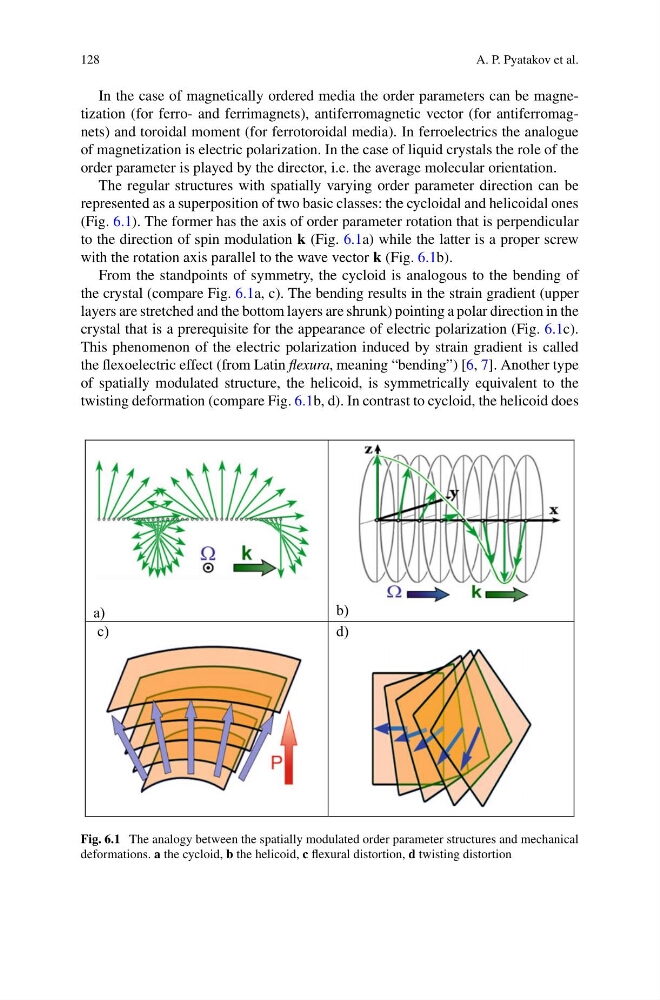
The regular structures with spatially varying order parameter direction can be
represented as a superposition of two basic classes: the cycloidal and helicoidal ones
(Fig. 6.1). The former has the axis of order parameter rotation that is perpendicular
to the direction of spin modulation k (Fig. 6.1a) while the latter is a proper screw
with the rotation axis parallel to the wave vector k (Fig. 6.1b).
From the standpoints of symmetry, the cycloid is analogous to the bending of
the crystal (compare Fig. 6.1a, c). The bending results in the strain gradient (upper
layers are stretched and the bottom layers are shrunk) pointing a polar direction in the
crystal that is a prerequisite for the appearance of electric polarization (Fig. 6.1c).
This phenomenon of the electric polarization induced by strain gradient is called
the flexoelectric effect (from Latin flexura, meaning “bending”) [6, 7]. Another type
of spatially modulated structure, the helicoid, is symmetrically equivalent to the
twisting deformation (compare Fig. 6.1b, d). In contrast to cycloid, the helicoid does
а)
b)
c)
d)
Fig. 6.1 The analogy between the spatially modulated order parameter structures and mechanical
deformations. a the cycloid, b the helicoid, c flexural distortion, d twisting distortion
A. P. Pyatakov et al.
In the case of magnetically ordered media the order parameters can be magnetization (for ferro- and ferrimagnets), antiferromagnetic vector (for antiferromagnets) and toroidal moment (for ferrotoroidal media). In ferroelectrics the analogue
of magnetization is electric polarization. In the case of liquid crystals the role of the
order parameter is played by the director, i.e. the average molecular orientation.
The regular structures with spatially varying order parameter direction can be
represented as a superposition of two basic classes: the cycloidal and helicoidal ones
(Fig. 6.1). The former has the axis of order parameter rotation that is perpendicular
to the direction of spin modulation k (Fig. 6.1a) while the latter is a proper screw
with the rotation axis parallel to the wave vector k (Fig. 6.1b).
From the standpoints of symmetry, the cycloid is analogous to the bending of
the crystal (compare Fig. 6.1a, c). The bending results in the strain gradient (upper
layers are stretched and the bottom layers are shrunk) pointing a polar direction in the
crystal that is a prerequisite for the appearance of electric polarization (Fig. 6.1c).
This phenomenon of the electric polarization induced by strain gradient is called
the flexoelectric effect (from Latin flexura, meaning “bending”) [6, 7]. Another type
of spatially modulated structure, the helicoid, is symmetrically equivalent to the
twisting deformation (compare Fig. 6.1b, d). In contrast to cycloid, the helicoid does
а)
b)
c)
d)
Fig. 6.1 The analogy between the spatially modulated order parameter structures and mechanical
deformations. a the cycloid, b the helicoid, c flexural distortion, d twisting distortion