

120
H. Ishihara et al.
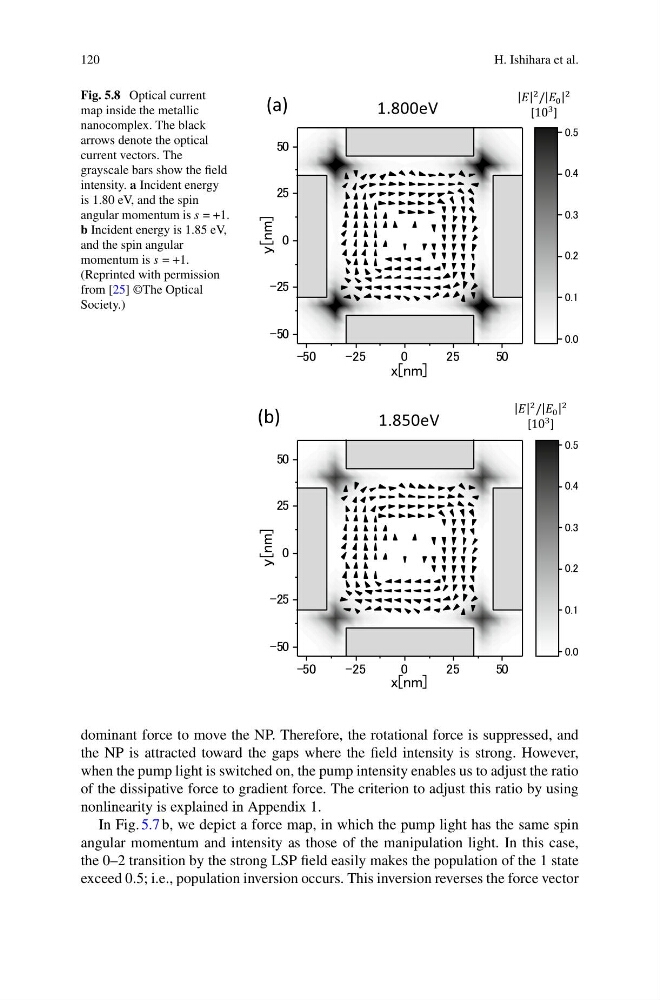
Fig. 5.8 Optical current
map inside the metallic
nanocomplex. The black
arrows denote the optical
current vectors. The
grayscale bars show the field
intensity. a Incident energy
is 1.80 eV, and the spin
angular momentum is s = +1.
b Incident energy is 1.85 eV,
and the spin angular
momentum is s = +1.
(Reprinted with permission
from [25] ©The Optical
Society.)
dominant force to move the NP. Therefore, the rotational force is suppressed, and
the NP is attracted toward the gaps where the field intensity is strong. However,
when the pump light is switched on, the pump intensity enables us to adjust the ratio
of the dissipative force to gradient force. The criterion to adjust this ratio by using
nonlinearity is explained in Appendix 1.
In Fig. 5.7 b, we depict a force map, in which the pump light has the same spin
angular momentum and intensity as those of the manipulation light. In this case,
the 0–2 transition by the strong LSP field easily makes the population of the 1 state
exceed 0.5; i.e., population inversion occurs. This inversion reverses the force vector
H. Ishihara et al.
Fig. 5.8 Optical current
map inside the metallic
nanocomplex. The black
arrows denote the optical
current vectors. The
grayscale bars show the field
intensity. a Incident energy
is 1.80 eV, and the spin
angular momentum is s = +1.
b Incident energy is 1.85 eV,
and the spin angular
momentum is s = +1.
(Reprinted with permission
from [25] ©The Optical
Society.)
dominant force to move the NP. Therefore, the rotational force is suppressed, and
the NP is attracted toward the gaps where the field intensity is strong. However,
when the pump light is switched on, the pump intensity enables us to adjust the ratio
of the dissipative force to gradient force. The criterion to adjust this ratio by using
nonlinearity is explained in Appendix 1.
In Fig. 5.7 b, we depict a force map, in which the pump light has the same spin
angular momentum and intensity as those of the manipulation light. In this case,
the 0–2 transition by the strong LSP field easily makes the population of the 1 state
exceed 0.5; i.e., population inversion occurs. This inversion reverses the force vector