

5 Light–Nanomatter Chiral Interaction in Optical-Force Effects
119
d
dt
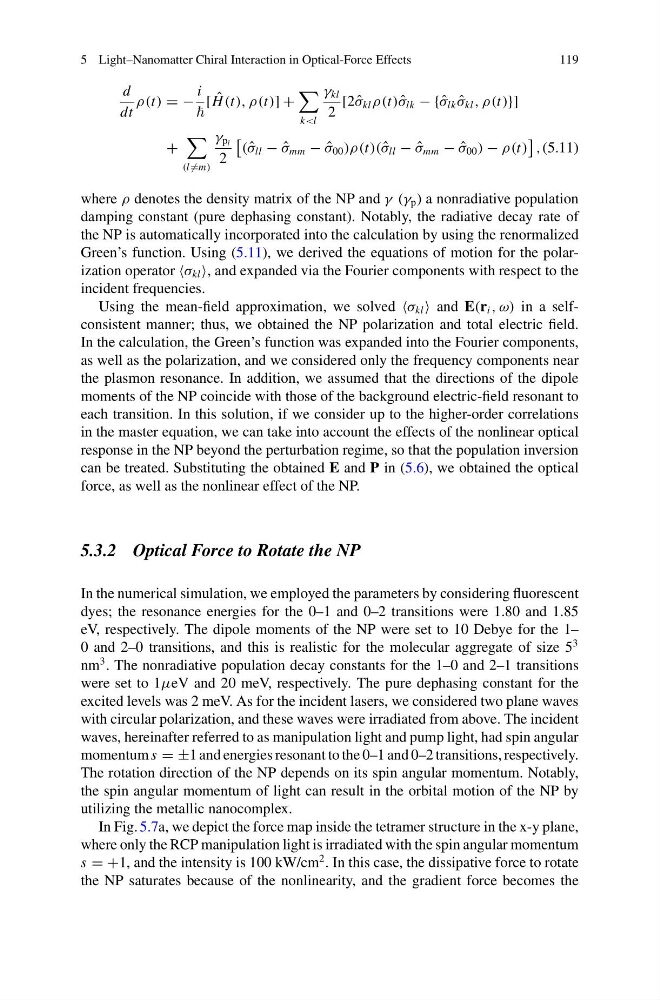
ρ(t) = −
i
[ ˆ
H (t), ρ(t)] +
k
2
[2 ˆ
σ kl ρ(t) ˆ
σ lk − { ˆ
σ lk ˆ
σ kl , ρ(t)}]
+
(l =m)
γ p l
2
( ˆ
σ ll − ˆ
σ mm − ˆ
σ 00 )ρ(t)( ˆ
σ ll − ˆ
σ mm − ˆ
σ 00 ) − ρ(t)
, (5.11)
where ρ denotes the density matrix of the NP and γ (γ p ) a nonradiative population
damping constant (pure dephasing constant). Notably, the radiative decay rate of
the NP is automatically incorporated into the calculation by using the renormalized
Green’s function. Using (5.11), we derived the equations of motion for the polarization operator σ kl , and expanded via the Fourier components with respect to the
incident frequencies.
Using the mean-field approximation, we solved σ kl and E(r i , ω) in a selfconsistent manner; thus, we obtained the NP polarization and total electric field.
In the calculation, the Green’s function was expanded into the Fourier components,
as well as the polarization, and we considered only the frequency components near
the plasmon resonance. In addition, we assumed that the directions of the dipole
moments of the NP coincide with those of the background electric-field resonant to
each transition. In this solution, if we consider up to the higher-order correlations
in the master equation, we can take into account the effects of the nonlinear optical
response in the NP beyond the perturbation regime, so that the population inversion
can be treated. Substituting the obtained E and P in (5.6), we obtained the optical
force, as well as the nonlinear effect of the NP.
5.3.2 Optical Force to Rotate the NP
In the numerical simulation, we employed the parameters by considering fluorescent
dyes; the resonance energies for the 0–1 and 0–2 transitions were 1.80 and 1.85
eV, respectively. The dipole moments of the NP were set to 10 Debye for the 1–
0 and 2–0 transitions, and this is realistic for the molecular aggregate of size 5
3
nm
3 . The nonradiative population decay constants for the 1–0 and 2–1 transitions
were set to 1μeV and 20 meV, respectively. The pure dephasing constant for the
excited levels was 2 meV. As for the incident lasers, we considered two plane waves
with circular polarization, and these waves were irradiated from above. The incident
waves, hereinafter referred to as manipulation light and pump light, had spin angular
momentum s = ±1 and energies resonant to the 0–1 and 0–2 transitions, respectively.
The rotation direction of the NP depends on its spin angular momentum. Notably,
the spin angular momentum of light can result in the orbital motion of the NP by
utilizing the metallic nanocomplex.
In Fig. 5.7a, we depict the force map inside the tetramer structure in the x-y plane,
where only the RCP manipulation light is irradiated with the spin angular momentum
s = +1, and the intensity is 100 kW/cm
2 . In this case, the dissipative force to rotate
the NP saturates because of the nonlinearity, and the gradient force becomes the
119
d
dt
ρ(t) = −
i
[ ˆ
H (t), ρ(t)] +
k
2
[2 ˆ
σ kl ρ(t) ˆ
σ lk − { ˆ
σ lk ˆ
σ kl , ρ(t)}]
+
(l =m)
γ p l
2
( ˆ
σ ll − ˆ
σ mm − ˆ
σ 00 )ρ(t)( ˆ
σ ll − ˆ
σ mm − ˆ
σ 00 ) − ρ(t)
, (5.11)
where ρ denotes the density matrix of the NP and γ (γ p ) a nonradiative population
damping constant (pure dephasing constant). Notably, the radiative decay rate of
the NP is automatically incorporated into the calculation by using the renormalized
Green’s function. Using (5.11), we derived the equations of motion for the polarization operator σ kl , and expanded via the Fourier components with respect to the
incident frequencies.
Using the mean-field approximation, we solved σ kl and E(r i , ω) in a selfconsistent manner; thus, we obtained the NP polarization and total electric field.
In the calculation, the Green’s function was expanded into the Fourier components,
as well as the polarization, and we considered only the frequency components near
the plasmon resonance. In addition, we assumed that the directions of the dipole
moments of the NP coincide with those of the background electric-field resonant to
each transition. In this solution, if we consider up to the higher-order correlations
in the master equation, we can take into account the effects of the nonlinear optical
response in the NP beyond the perturbation regime, so that the population inversion
can be treated. Substituting the obtained E and P in (5.6), we obtained the optical
force, as well as the nonlinear effect of the NP.
5.3.2 Optical Force to Rotate the NP
In the numerical simulation, we employed the parameters by considering fluorescent
dyes; the resonance energies for the 0–1 and 0–2 transitions were 1.80 and 1.85
eV, respectively. The dipole moments of the NP were set to 10 Debye for the 1–
0 and 2–0 transitions, and this is realistic for the molecular aggregate of size 5
3
nm
3 . The nonradiative population decay constants for the 1–0 and 2–1 transitions
were set to 1μeV and 20 meV, respectively. The pure dephasing constant for the
excited levels was 2 meV. As for the incident lasers, we considered two plane waves
with circular polarization, and these waves were irradiated from above. The incident
waves, hereinafter referred to as manipulation light and pump light, had spin angular
momentum s = ±1 and energies resonant to the 0–1 and 0–2 transitions, respectively.
The rotation direction of the NP depends on its spin angular momentum. Notably,
the spin angular momentum of light can result in the orbital motion of the NP by
utilizing the metallic nanocomplex.
In Fig. 5.7a, we depict the force map inside the tetramer structure in the x-y plane,
where only the RCP manipulation light is irradiated with the spin angular momentum
s = +1, and the intensity is 100 kW/cm
2 . In this case, the dissipative force to rotate
the NP saturates because of the nonlinearity, and the gradient force becomes the