

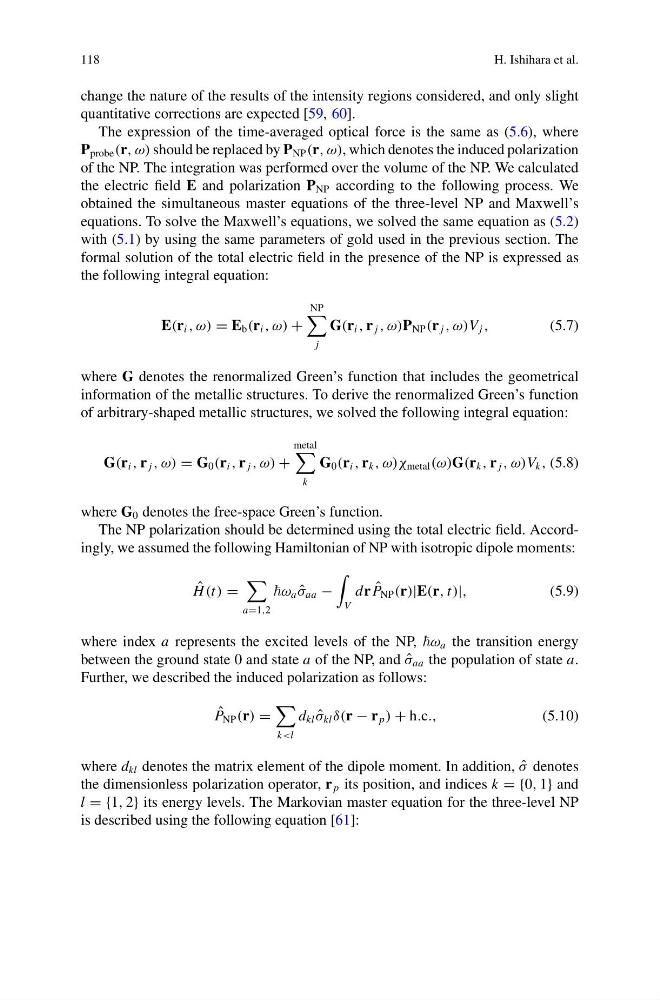
118
H. Ishihara et al.
change the nature of the results of the intensity regions considered, and only slight
quantitative corrections are expected [59, 60].
The expression of the time-averaged optical force is the same as (5.6), where
P probe (r, ω) should be replaced by P NP (r, ω), which denotes the induced polarization
of the NP. The integration was performed over the volume of the NP. We calculated
the electric field E and polarization P NP according to the following process. We
obtained the simultaneous master equations of the three-level NP and Maxwell’s
equations. To solve the Maxwell’s equations, we solved the same equation as (5.2)
with (5.1) by using the same parameters of gold used in the previous section. The
formal solution of the total electric field in the presence of the NP is expressed as
the following integral equation:
E(r i , ω) = E b (r i , ω) +
NP
j
G(r i , r j , ω)P NP (r j , ω)V j ,
(5.7)
where G denotes the renormalized Green’s function that includes the geometrical
information of the metallic structures. To derive the renormalized Green’s function
of arbitrary-shaped metallic structures, we solved the following integral equation:
G(r i , r j , ω) = G 0 (r i , r j , ω) +
metal
k
G 0 (r i , r k , ω)χ metal (ω)G(r k , r j , ω)V k , (5.8)
where G 0 denotes the free-space Green’s function.
The NP polarization should be determined using the total electric field. Accordingly, we assumed the following Hamiltonian of NP with isotropic dipole moments:
ˆ
H (t) =
a=1,2
ω a ˆ
σ aa −
V
dr ˆ
P NP (r)|E(r, t)|,
(5.9)
where index a represents the excited levels of the NP, ω a the transition energy
between the ground state 0 and state a of the NP, and ˆ
σ aa the population of state a.
Further, we described the induced polarization as follows:
ˆ
P NP (r) =
k
σ kl δ(r − r p ) + h.c.,
(5.10)
where d kl denotes the matrix element of the dipole moment. In addition, ˆ
σ denotes
the dimensionless polarization operator, r p its position, and indices k = {0, 1} and
l = {1, 2} its energy levels. The Markovian master equation for the three-level NP
is described using the following equation [61]:
H. Ishihara et al.
change the nature of the results of the intensity regions considered, and only slight
quantitative corrections are expected [59, 60].
The expression of the time-averaged optical force is the same as (5.6), where
P probe (r, ω) should be replaced by P NP (r, ω), which denotes the induced polarization
of the NP. The integration was performed over the volume of the NP. We calculated
the electric field E and polarization P NP according to the following process. We
obtained the simultaneous master equations of the three-level NP and Maxwell’s
equations. To solve the Maxwell’s equations, we solved the same equation as (5.2)
with (5.1) by using the same parameters of gold used in the previous section. The
formal solution of the total electric field in the presence of the NP is expressed as
the following integral equation:
E(r i , ω) = E b (r i , ω) +
NP
j
G(r i , r j , ω)P NP (r j , ω)V j ,
(5.7)
where G denotes the renormalized Green’s function that includes the geometrical
information of the metallic structures. To derive the renormalized Green’s function
of arbitrary-shaped metallic structures, we solved the following integral equation:
G(r i , r j , ω) = G 0 (r i , r j , ω) +
metal
k
G 0 (r i , r k , ω)χ metal (ω)G(r k , r j , ω)V k , (5.8)
where G 0 denotes the free-space Green’s function.
The NP polarization should be determined using the total electric field. Accordingly, we assumed the following Hamiltonian of NP with isotropic dipole moments:
ˆ
H (t) =
a=1,2
ω a ˆ
σ aa −
V
dr ˆ
P NP (r)|E(r, t)|,
(5.9)
where index a represents the excited levels of the NP, ω a the transition energy
between the ground state 0 and state a of the NP, and ˆ
σ aa the population of state a.
Further, we described the induced polarization as follows:
ˆ
P NP (r) =
k
σ kl δ(r − r p ) + h.c.,
(5.10)
where d kl denotes the matrix element of the dipole moment. In addition, ˆ
σ denotes
the dimensionless polarization operator, r p its position, and indices k = {0, 1} and
l = {1, 2} its energy levels. The Markovian master equation for the three-level NP
is described using the following equation [61]: