

112
H. Ishihara et al.
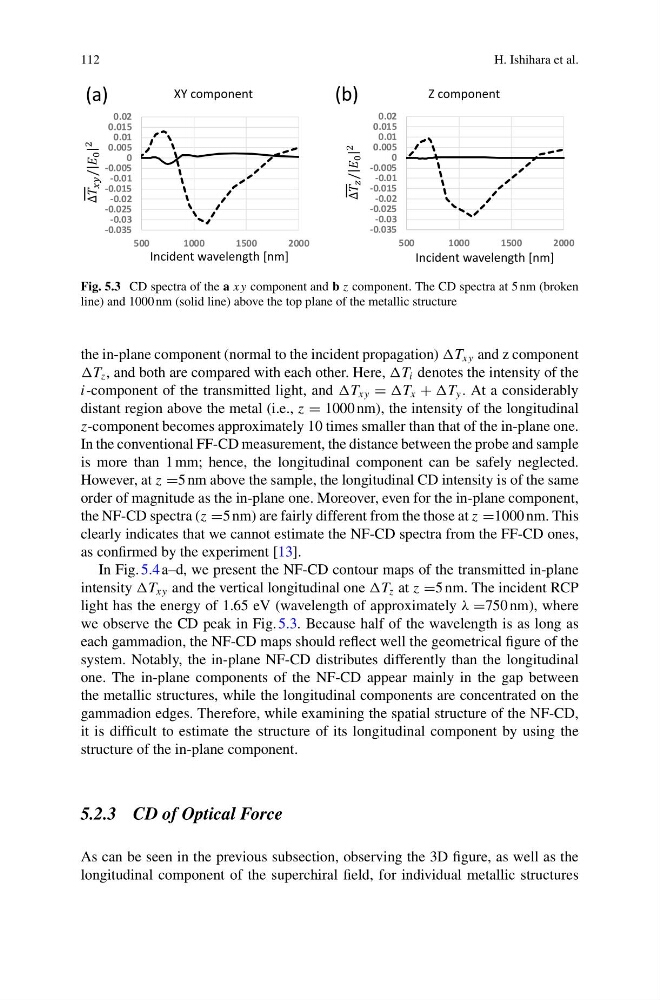
Fig. 5.3 CD spectra of the a xy component and b z component. The CD spectra at 5 nm (broken
line) and 1000 nm (solid line) above the top plane of the metallic structure
the in-plane component (normal to the incident propagation) xy and z component
z , and both are compared with each other. Here, i denotes the intensity of the
i-component of the transmitted light, and xy = x + y . At a considerably
distant region above the metal (i.e., z = 1000 nm), the intensity of the longitudinal
z-component becomes approximately 10 times smaller than that of the in-plane one.
In the conventional FF-CD measurement, the distance between the probe and sample
is more than 1 mm; hence, the longitudinal component can be safely neglected.
However, at z =5 nm above the sample, the longitudinal CD intensity is of the same
order of magnitude as the in-plane one. Moreover, even for the in-plane component,
the NF-CD spectra (z =5 nm) are fairly different from the those at z =1000 nm. This
clearly indicates that we cannot estimate the NF-CD spectra from the FF-CD ones,
as confirmed by the experiment [13].
In Fig. 5.4 a–d, we present the NF-CD contour maps of the transmitted in-plane
intensity xy and the vertical longitudinal one z at z =5 nm. The incident RCP
light has the energy of 1.65 eV (wavelength of approximately λ =750 nm), where
we observe the CD peak in Fig. 5.3. Because half of the wavelength is as long as
each gammadion, the NF-CD maps should reflect well the geometrical figure of the
system. Notably, the in-plane NF-CD distributes differently than the longitudinal
one. The in-plane components of the NF-CD appear mainly in the gap between
the metallic structures, while the longitudinal components are concentrated on the
gammadion edges. Therefore, while examining the spatial structure of the NF-CD,
it is difficult to estimate the structure of its longitudinal component by using the
structure of the in-plane component.
5.2.3 CD of Optical Force
As can be seen in the previous subsection, observing the 3D figure, as well as the
longitudinal component of the superchiral field, for individual metallic structures
H. Ishihara et al.
Fig. 5.3 CD spectra of the a xy component and b z component. The CD spectra at 5 nm (broken
line) and 1000 nm (solid line) above the top plane of the metallic structure
the in-plane component (normal to the incident propagation) xy and z component
z , and both are compared with each other. Here, i denotes the intensity of the
i-component of the transmitted light, and xy = x + y . At a considerably
distant region above the metal (i.e., z = 1000 nm), the intensity of the longitudinal
z-component becomes approximately 10 times smaller than that of the in-plane one.
In the conventional FF-CD measurement, the distance between the probe and sample
is more than 1 mm; hence, the longitudinal component can be safely neglected.
However, at z =5 nm above the sample, the longitudinal CD intensity is of the same
order of magnitude as the in-plane one. Moreover, even for the in-plane component,
the NF-CD spectra (z =5 nm) are fairly different from the those at z =1000 nm. This
clearly indicates that we cannot estimate the NF-CD spectra from the FF-CD ones,
as confirmed by the experiment [13].
In Fig. 5.4 a–d, we present the NF-CD contour maps of the transmitted in-plane
intensity xy and the vertical longitudinal one z at z =5 nm. The incident RCP
light has the energy of 1.65 eV (wavelength of approximately λ =750 nm), where
we observe the CD peak in Fig. 5.3. Because half of the wavelength is as long as
each gammadion, the NF-CD maps should reflect well the geometrical figure of the
system. Notably, the in-plane NF-CD distributes differently than the longitudinal
one. The in-plane components of the NF-CD appear mainly in the gap between
the metallic structures, while the longitudinal components are concentrated on the
gammadion edges. Therefore, while examining the spatial structure of the NF-CD,
it is difficult to estimate the structure of its longitudinal component by using the
structure of the in-plane component.
5.2.3 CD of Optical Force
As can be seen in the previous subsection, observing the 3D figure, as well as the
longitudinal component of the superchiral field, for individual metallic structures