

110
H. Ishihara et al.
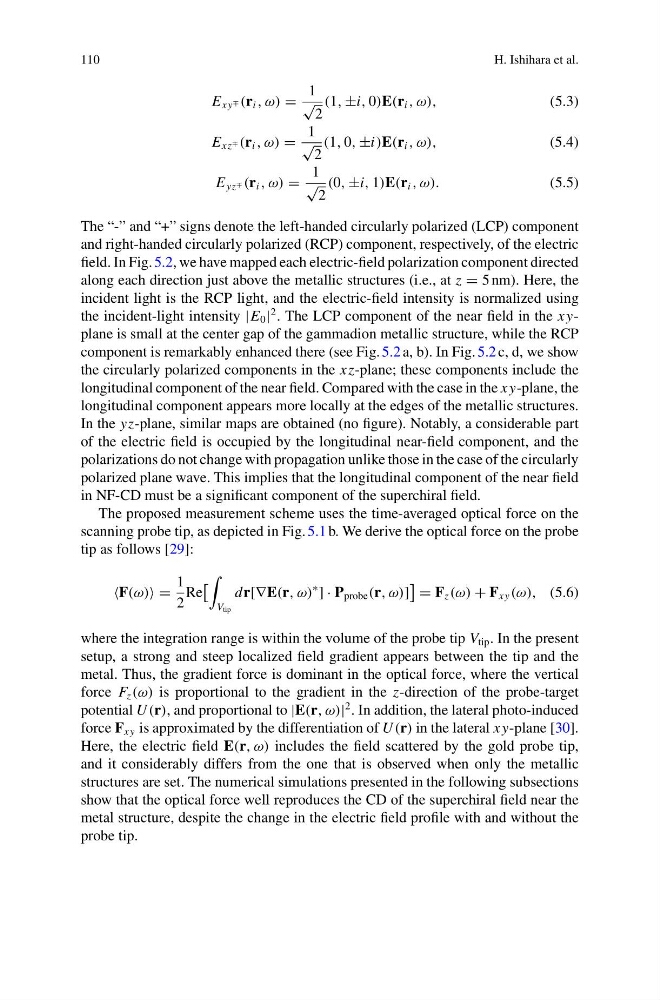
E xy ∓ (r i , ω) =
1
√
2
(1, ±i, 0)E(r i , ω),
(5.3)
E xz ∓ (r i , ω) =
1
√
2
(1, 0, ±i)E(r i , ω),
(5.4)
E yz ∓ (r i , ω) =
1
√
2
(0, ±i, 1)E(r i , ω).
(5.5)
The “-” and “+” signs denote the left-handed circularly polarized (LCP) component
and right-handed circularly polarized (RCP) component, respectively, of the electric
field. In Fig. 5.2, we have mapped each electric-field polarization component directed
along each direction just above the metallic structures (i.e., at z = 5 nm). Here, the
incident light is the RCP light, and the electric-field intensity is normalized using
the incident-light intensity |E 0 |
2 . The LCP component of the near field in the x yplane is small at the center gap of the gammadion metallic structure, while the RCP
component is remarkably enhanced there (see Fig. 5.2 a, b). In Fig. 5.2 c, d, we show
the circularly polarized components in the xz-plane; these components include the
longitudinal component of the near field. Compared with the case in the x y-plane, the
longitudinal component appears more locally at the edges of the metallic structures.
In the yz-plane, similar maps are obtained (no figure). Notably, a considerable part
of the electric field is occupied by the longitudinal near-field component, and the
polarizations do not change with propagation unlike those in the case of the circularly
polarized plane wave. This implies that the longitudinal component of the near field
in NF-CD must be a significant component of the superchiral field.
The proposed measurement scheme uses the time-averaged optical force on the
scanning probe tip, as depicted in Fig. 5.1 b. We derive the optical force on the probe
tip as follows [29]:
F(ω) =
1
2
Re
V tip
dr[∇E(r, ω)
∗
] · P probe (r, ω)]
= F z (ω) + F xy (ω), (5.6)
where the integration range is within the volume of the probe tip V tip . In the present
setup, a strong and steep localized field gradient appears between the tip and the
metal. Thus, the gradient force is dominant in the optical force, where the vertical
force F z (ω) is proportional to the gradient in the z-direction of the probe-target
potential U (r), and proportional to |E(r, ω)|
2 . In addition, the lateral photo-induced
force F xy is approximated by the differentiation of U (r) in the lateral x y-plane [30].
Here, the electric field E(r, ω) includes the field scattered by the gold probe tip,
and it considerably differs from the one that is observed when only the metallic
structures are set. The numerical simulations presented in the following subsections
show that the optical force well reproduces the CD of the superchiral field near the
metal structure, despite the change in the electric field profile with and without the
probe tip.
H. Ishihara et al.
E xy ∓ (r i , ω) =
1
√
2
(1, ±i, 0)E(r i , ω),
(5.3)
E xz ∓ (r i , ω) =
1
√
2
(1, 0, ±i)E(r i , ω),
(5.4)
E yz ∓ (r i , ω) =
1
√
2
(0, ±i, 1)E(r i , ω).
(5.5)
The “-” and “+” signs denote the left-handed circularly polarized (LCP) component
and right-handed circularly polarized (RCP) component, respectively, of the electric
field. In Fig. 5.2, we have mapped each electric-field polarization component directed
along each direction just above the metallic structures (i.e., at z = 5 nm). Here, the
incident light is the RCP light, and the electric-field intensity is normalized using
the incident-light intensity |E 0 |
2 . The LCP component of the near field in the x yplane is small at the center gap of the gammadion metallic structure, while the RCP
component is remarkably enhanced there (see Fig. 5.2 a, b). In Fig. 5.2 c, d, we show
the circularly polarized components in the xz-plane; these components include the
longitudinal component of the near field. Compared with the case in the x y-plane, the
longitudinal component appears more locally at the edges of the metallic structures.
In the yz-plane, similar maps are obtained (no figure). Notably, a considerable part
of the electric field is occupied by the longitudinal near-field component, and the
polarizations do not change with propagation unlike those in the case of the circularly
polarized plane wave. This implies that the longitudinal component of the near field
in NF-CD must be a significant component of the superchiral field.
The proposed measurement scheme uses the time-averaged optical force on the
scanning probe tip, as depicted in Fig. 5.1 b. We derive the optical force on the probe
tip as follows [29]:
F(ω) =
1
2
Re
V tip
dr[∇E(r, ω)
∗
] · P probe (r, ω)]
= F z (ω) + F xy (ω), (5.6)
where the integration range is within the volume of the probe tip V tip . In the present
setup, a strong and steep localized field gradient appears between the tip and the
metal. Thus, the gradient force is dominant in the optical force, where the vertical
force F z (ω) is proportional to the gradient in the z-direction of the probe-target
potential U (r), and proportional to |E(r, ω)|
2 . In addition, the lateral photo-induced
force F xy is approximated by the differentiation of U (r) in the lateral x y-plane [30].
Here, the electric field E(r, ω) includes the field scattered by the gold probe tip,
and it considerably differs from the one that is observed when only the metallic
structures are set. The numerical simulations presented in the following subsections
show that the optical force well reproduces the CD of the superchiral field near the
metal structure, despite the change in the electric field profile with and without the
probe tip.