

4 Chirality and Antiferromagnetism in Optical Metasurfaces
97
diffracted beam could contain four parts: two orthogonal linear-polarization components and two spin components, which can be used to reconstruct the state of incident
polarization. It holds the working principle of a metasurface-based polarimetry [54].
III. Chiral meta-holograms and vectorial anticounterfeiting
If the encoded phase profile in (4.8) is used to generate a holographic image,
such a metasurface is called as meta-hologram that is different from the traditional
holograms. Due to the distinct polarization response in a subwavelength pixel, the
chiral meta-holograms could generate the spin-dependent or vectorial images in a
large angle-of-view, without the high-order diffraction and twin-image issues that
exists in the traditional holograms. For a chiral meta-hologram, the generated image
also has a spin-dependent behavior. If the chiral meta-hologram works in a Fresnel
distance, it will generate a real holographic image along the propagating direction
of the circularly polarized incident light with one spin but form a virtual image
for the other spin [44]. However, a Fraunhofer metahologram illuminated by the
circularly polarized light with both spins will create the real images with centersymmetry properties [49]. Both Frensnel and Fraunhofer metaholograms have been
experimentally demonstrated with the good agreement.
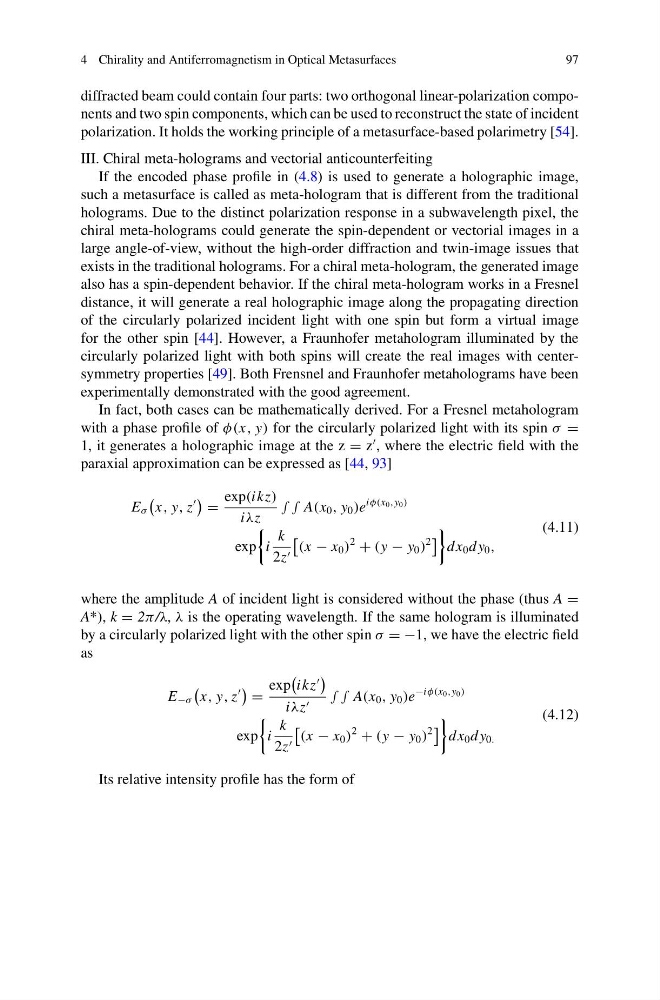
In fact, both cases can be mathematically derived. For a Fresnel metahologram
with a phase profile of φ(x, y) for the circularly polarized light with its spin σ =
1, it generates a holographic image at the z = z
, where the electric field with the
paraxial approximation can be expressed as [44, 93]
E σ
x, y, z
=
exp(ikz)
iλz
∫ ∫ A(x 0 , y 0 )e
iφ(x 0 ,y 0 )
exp
i
k
2z
(x − x 0 )
2
+ (y − y 0 )
2
dx 0 dy 0 ,
(4.11)
where the amplitude A of incident light is considered without the phase (thus A =
A*), k = 2π /λ, λ is the operating wavelength. If the same hologram is illuminated
by a circularly polarized light with the other spin σ = −1, we have the electric field
as
E −σ
x, y, z
=
exp
ikz
iλz ∫ ∫ A(x 0 , y 0 )e
−iφ(x 0 ,y 0 )
exp
i
k
2z
(x − x 0 )
2
+ (y − y 0 )
2
dx 0 dy 0.
(4.12)
Its relative intensity profile has the form of
97
diffracted beam could contain four parts: two orthogonal linear-polarization components and two spin components, which can be used to reconstruct the state of incident
polarization. It holds the working principle of a metasurface-based polarimetry [54].
III. Chiral meta-holograms and vectorial anticounterfeiting
If the encoded phase profile in (4.8) is used to generate a holographic image,
such a metasurface is called as meta-hologram that is different from the traditional
holograms. Due to the distinct polarization response in a subwavelength pixel, the
chiral meta-holograms could generate the spin-dependent or vectorial images in a
large angle-of-view, without the high-order diffraction and twin-image issues that
exists in the traditional holograms. For a chiral meta-hologram, the generated image
also has a spin-dependent behavior. If the chiral meta-hologram works in a Fresnel
distance, it will generate a real holographic image along the propagating direction
of the circularly polarized incident light with one spin but form a virtual image
for the other spin [44]. However, a Fraunhofer metahologram illuminated by the
circularly polarized light with both spins will create the real images with centersymmetry properties [49]. Both Frensnel and Fraunhofer metaholograms have been
experimentally demonstrated with the good agreement.
In fact, both cases can be mathematically derived. For a Fresnel metahologram
with a phase profile of φ(x, y) for the circularly polarized light with its spin σ =
1, it generates a holographic image at the z = z
, where the electric field with the
paraxial approximation can be expressed as [44, 93]
E σ
x, y, z
=
exp(ikz)
iλz
∫ ∫ A(x 0 , y 0 )e
iφ(x 0 ,y 0 )
exp
i
k
2z
(x − x 0 )
2
+ (y − y 0 )
2
dx 0 dy 0 ,
(4.11)
where the amplitude A of incident light is considered without the phase (thus A =
A*), k = 2π /λ, λ is the operating wavelength. If the same hologram is illuminated
by a circularly polarized light with the other spin σ = −1, we have the electric field
as
E −σ
x, y, z
=
exp
ikz
iλz ∫ ∫ A(x 0 , y 0 )e
−iφ(x 0 ,y 0 )
exp
i
k
2z
(x − x 0 )
2
+ (y − y 0 )
2
dx 0 dy 0.
(4.12)
Its relative intensity profile has the form of