

96
K. Huang
to demonstrate lenses, holograms and gratings for optical imaging, vectorial holographic anticounterfeiting and beam splitter. In addition, when illuminated by a
linearly polarized beam, the chiral metasurfaces will induce the spin-dependent shifts
of beam centroids, which is usually related with the spin Hall effects of light [17].
I. Metalenses and imaging
To realize a focusing spherical-aberration-free lens by using chiral metasurfaces,
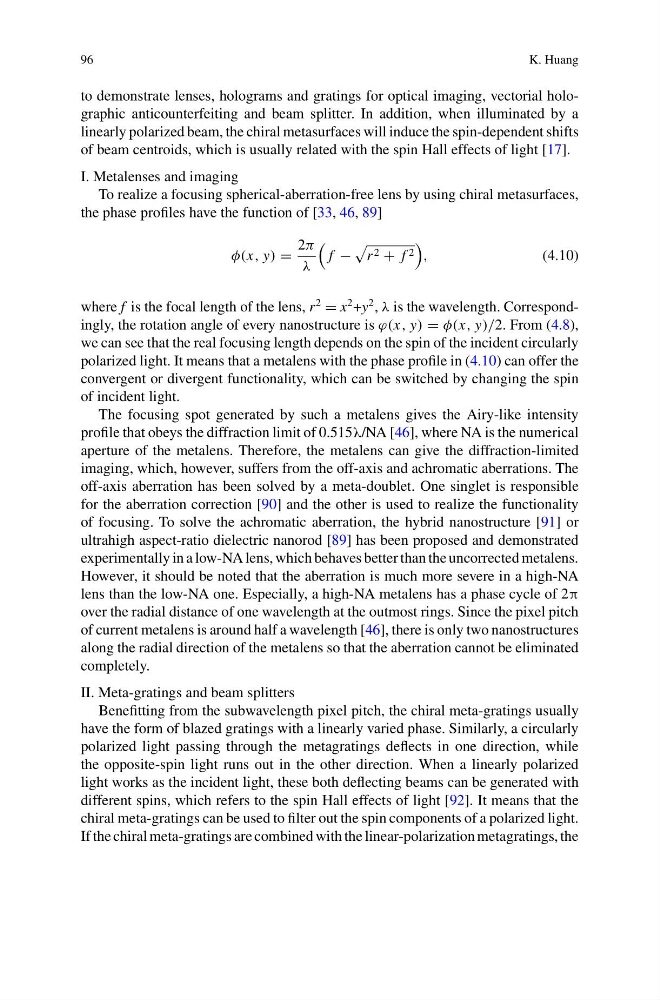
the phase profiles have the function of [33, 46, 89]
φ(x, y) =
2π
λ
f −
r 2 + f 2
,
(4.10)
where f is the focal length of the lens, r
2
= x
2 +y
2 , λ is the wavelength. Correspondingly, the rotation angle of every nanostructure is ϕ(x, y) = φ(x, y)/2. From (4.8),
we can see that the real focusing length depends on the spin of the incident circularly
polarized light. It means that a metalens with the phase profile in (4.10) can offer the
convergent or divergent functionality, which can be switched by changing the spin
of incident light.
The focusing spot generated by such a metalens gives the Airy-like intensity
profile that obeys the diffraction limit of 0.515λ/NA [46], where NA is the numerical
aperture of the metalens. Therefore, the metalens can give the diffraction-limited
imaging, which, however, suffers from the off-axis and achromatic aberrations. The
off-axis aberration has been solved by a meta-doublet. One singlet is responsible
for the aberration correction [90] and the other is used to realize the functionality
of focusing. To solve the achromatic aberration, the hybrid nanostructure [91] or
ultrahigh aspect-ratio dielectric nanorod [89] has been proposed and demonstrated
experimentally in a low-NA lens, which behaves better than the uncorrected metalens.
However, it should be noted that the aberration is much more severe in a high-NA
lens than the low-NA one. Especially, a high-NA metalens has a phase cycle of 2π
over the radial distance of one wavelength at the outmost rings. Since the pixel pitch
of current metalens is around half a wavelength [46], there is only two nanostructures
along the radial direction of the metalens so that the aberration cannot be eliminated
completely.
II. Meta-gratings and beam splitters
Benefitting from the subwavelength pixel pitch, the chiral meta-gratings usually
have the form of blazed gratings with a linearly varied phase. Similarly, a circularly
polarized light passing through the metagratings deflects in one direction, while
the opposite-spin light runs out in the other direction. When a linearly polarized
light works as the incident light, these both deflecting beams can be generated with
different spins, which refers to the spin Hall effects of light [92]. It means that the
chiral meta-gratings can be used to filter out the spin components of a polarized light.
If the chiral meta-gratings are combined with the linear-polarization metagratings, the
K. Huang
to demonstrate lenses, holograms and gratings for optical imaging, vectorial holographic anticounterfeiting and beam splitter. In addition, when illuminated by a
linearly polarized beam, the chiral metasurfaces will induce the spin-dependent shifts
of beam centroids, which is usually related with the spin Hall effects of light [17].
I. Metalenses and imaging
To realize a focusing spherical-aberration-free lens by using chiral metasurfaces,
the phase profiles have the function of [33, 46, 89]
φ(x, y) =
2π
λ
f −
r 2 + f 2
,
(4.10)
where f is the focal length of the lens, r
2
= x
2 +y
2 , λ is the wavelength. Correspondingly, the rotation angle of every nanostructure is ϕ(x, y) = φ(x, y)/2. From (4.8),
we can see that the real focusing length depends on the spin of the incident circularly
polarized light. It means that a metalens with the phase profile in (4.10) can offer the
convergent or divergent functionality, which can be switched by changing the spin
of incident light.
The focusing spot generated by such a metalens gives the Airy-like intensity
profile that obeys the diffraction limit of 0.515λ/NA [46], where NA is the numerical
aperture of the metalens. Therefore, the metalens can give the diffraction-limited
imaging, which, however, suffers from the off-axis and achromatic aberrations. The
off-axis aberration has been solved by a meta-doublet. One singlet is responsible
for the aberration correction [90] and the other is used to realize the functionality
of focusing. To solve the achromatic aberration, the hybrid nanostructure [91] or
ultrahigh aspect-ratio dielectric nanorod [89] has been proposed and demonstrated
experimentally in a low-NA lens, which behaves better than the uncorrected metalens.
However, it should be noted that the aberration is much more severe in a high-NA
lens than the low-NA one. Especially, a high-NA metalens has a phase cycle of 2π
over the radial distance of one wavelength at the outmost rings. Since the pixel pitch
of current metalens is around half a wavelength [46], there is only two nanostructures
along the radial direction of the metalens so that the aberration cannot be eliminated
completely.
II. Meta-gratings and beam splitters
Benefitting from the subwavelength pixel pitch, the chiral meta-gratings usually
have the form of blazed gratings with a linearly varied phase. Similarly, a circularly
polarized light passing through the metagratings deflects in one direction, while
the opposite-spin light runs out in the other direction. When a linearly polarized
light works as the incident light, these both deflecting beams can be generated with
different spins, which refers to the spin Hall effects of light [92]. It means that the
chiral meta-gratings can be used to filter out the spin components of a polarized light.
If the chiral meta-gratings are combined with the linear-polarization metagratings, the