

98
K. Huang
I −σ (x, y, z) =
E −σ
x, y, z
2 =
E −σ
x, y, z
∗
2
=
exp
−ikz
iλ(−z )
∫ ∫ A
∗
(x 0 , y 0 )e
iφ(x 0 ,y 0 ) exp
i
k
2(−z )
(x − x 0 )
2
+ (y − y 0 )
2
dx 0 dy 0
2
=
Eσ
x, y, −z
2 = I −σ
x, y, −z
(4.13)
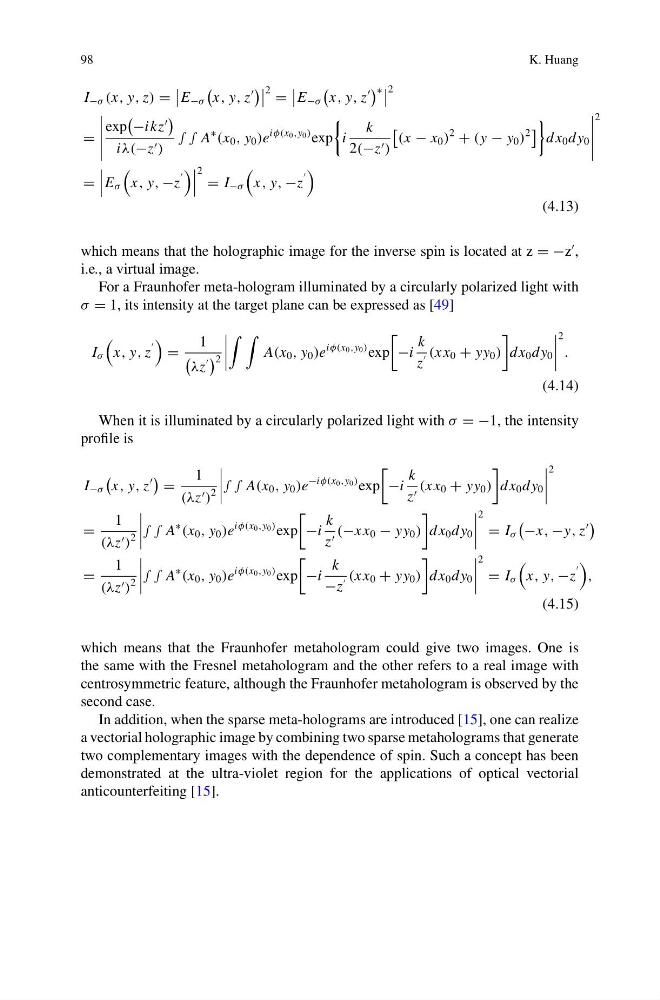
which means that the holographic image for the inverse spin is located at z = −z
,
i.e., a virtual image.
For a Fraunhofer meta-hologram illuminated by a circularly polarized light with
σ = 1, its intensity at the target plane can be expressed as [49]
I σ
x, y, z
=
1
λz
2
A(x 0 , y 0 )e
iφ(x 0 ,y 0 ) exp
−i
k
z
(x x 0 + yy 0 )
dx 0 dy 0
2
.
(4.14)
When it is illuminated by a circularly polarized light with σ = −1, the intensity
profile is
I −σ
x, y, z
=
1
(λz )
2
∫ ∫ A(x 0 , y 0 )e
−iφ(x 0 ,y 0 ) exp
−i
k
z (x x 0 + yy 0 )
dx 0 dy 0
2
=
1
(λz )
2
∫ ∫ A
∗
(x 0 , y 0 )e
iφ(x 0 ,y 0 ) exp
−i
k
z (−x x 0 − yy 0 )
dx 0 dy 0
2
= I σ
−x, −y, z
=
1
(λz )
2
∫ ∫ A
∗
(x 0 , y 0 )e
iφ(x 0 ,y 0 ) exp
−i
k
−z
(x x 0 + yy 0 )
dx 0 dy 0
2
= I σ
x, y, −z
,
(4.15)
which means that the Fraunhofer metahologram could give two images. One is
the same with the Fresnel metahologram and the other refers to a real image with
centrosymmetric feature, although the Fraunhofer metahologram is observed by the
second case.
In addition, when the sparse meta-holograms are introduced [15], one can realize
a vectorial holographic image by combining two sparse metaholograms that generate
two complementary images with the dependence of spin. Such a concept has been
demonstrated at the ultra-violet region for the applications of optical vectorial
anticounterfeiting [15].
K. Huang
I −σ (x, y, z) =
E −σ
x, y, z
2 =
E −σ
x, y, z
∗
2
=
exp
−ikz
iλ(−z )
∫ ∫ A
∗
(x 0 , y 0 )e
iφ(x 0 ,y 0 ) exp
i
k
2(−z )
(x − x 0 )
2
+ (y − y 0 )
2
dx 0 dy 0
2
=
Eσ
x, y, −z
2 = I −σ
x, y, −z
(4.13)
which means that the holographic image for the inverse spin is located at z = −z
,
i.e., a virtual image.
For a Fraunhofer meta-hologram illuminated by a circularly polarized light with
σ = 1, its intensity at the target plane can be expressed as [49]
I σ
x, y, z
=
1
λz
2
A(x 0 , y 0 )e
iφ(x 0 ,y 0 ) exp
−i
k
z
(x x 0 + yy 0 )
dx 0 dy 0
2
.
(4.14)
When it is illuminated by a circularly polarized light with σ = −1, the intensity
profile is
I −σ
x, y, z
=
1
(λz )
2
∫ ∫ A(x 0 , y 0 )e
−iφ(x 0 ,y 0 ) exp
−i
k
z (x x 0 + yy 0 )
dx 0 dy 0
2
=
1
(λz )
2
∫ ∫ A
∗
(x 0 , y 0 )e
iφ(x 0 ,y 0 ) exp
−i
k
z (−x x 0 − yy 0 )
dx 0 dy 0
2
= I σ
−x, −y, z
=
1
(λz )
2
∫ ∫ A
∗
(x 0 , y 0 )e
iφ(x 0 ,y 0 ) exp
−i
k
−z
(x x 0 + yy 0 )
dx 0 dy 0
2
= I σ
x, y, −z
,
(4.15)
which means that the Fraunhofer metahologram could give two images. One is
the same with the Fresnel metahologram and the other refers to a real image with
centrosymmetric feature, although the Fraunhofer metahologram is observed by the
second case.
In addition, when the sparse meta-holograms are introduced [15], one can realize
a vectorial holographic image by combining two sparse metaholograms that generate
two complementary images with the dependence of spin. Such a concept has been
demonstrated at the ultra-violet region for the applications of optical vectorial
anticounterfeiting [15].