

73
3.5.2 Whole Embryo Culture
The mammalians whole embryo culture is a validated test for embryotoxicity studies (Scientific Committee on Consumer Products 2007) that evaluates the development from the early somite stage (3–5 somites) to a late stage (21–25 somites). The
rat is sometimes preferred to the mice because the embryos are larger and the necessary manipulation easier; in this species, the preimplantation process requires
48 hours to be complete. During this period in which the embryo does not depend
on the placenta, morphogenesis and organogenesis take place. Central nervous system, heart, vertebrae, limb buds, and craniofacial structures develop in vitro with a
similar rate to that of in vivo. The requirement of oxygen increases rapidly during
the late gastrulation and early neurulation; therefore, the embryo, partially deprived
of membranes, is cultured in an incubator with increasing concentration of oxygen.
The morphogenetic process is easily followed, so that the endpoints of this test are
the malformation rate and the corresponding concentration at which 50% of embryos
are malformed (Brannen et al. 2016; Piersma 2011; Schenk et al. 2010).
The accumulation of zinc oxide nanoparticles in mouse embryos induced morphological changes and expression of apoptotic and antioxidant genes in a dosedependent manner. The maturation process and the number of somites at the end of
the exposure were reduced by 80% at the higher dose, and multiple malformations
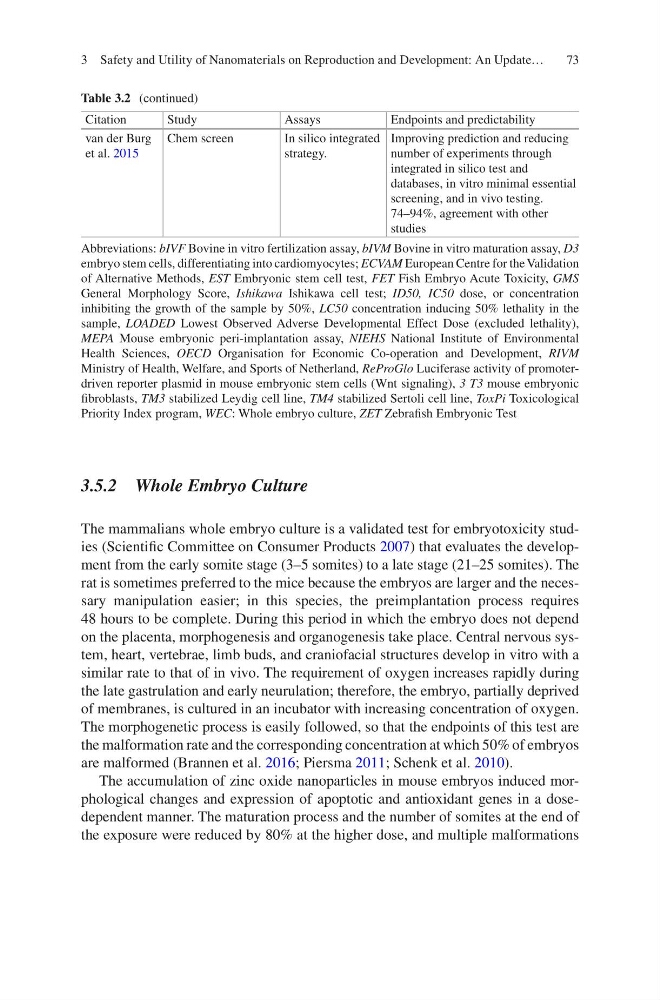
Table 3.2 (continued)
Citation
Study
Assays
Endpoints and predictability
van der Burg
et al. 2015
Chem screen
In silico integrated
strategy.
Improving prediction and reducing
number of experiments through
integrated in silico test and
databases, in vitro minimal essential
screening, and in vivo testing.
74–94%, agreement with other
studies
Abbreviations: bIVF Bovine in vitro fertilization assay, bIVM Bovine in vitro maturation assay, D3
embryo stem cells, differentiating into cardiomyocytes; ECVAM European Centre for the Validation
of Alternative Methods, EST Embryonic stem cell test, FET Fish Embryo Acute Toxicity, GMS
General Morphology Score, Ishikawa Ishikawa cell test; ID50, IC50 dose, or concentration
inhibiting the growth of the sample by 50%, LC50 concentration inducing 50% lethality in the
sample, LOADED Lowest Observed Adverse Developmental Effect Dose (excluded lethality),
MEPA Mouse embryonic peri-implantation assay, NIEHS National Institute of Environmental
Health Sciences, OECD Organisation for Economic Co-operation and Development, RIVM
Ministry of Health, Welfare, and Sports of Netherland, ReProGlo Luciferase activity of promoterdriven reporter plasmid in mouse embryonic stem cells (Wnt signaling), 3 T3 mouse embryonic
fibroblasts, TM3 stabilized Leydig cell line, TM4 stabilized Sertoli cell line, ToxPi Toxicological
Priority Index program, WEC: Whole embryo culture, ZET Zebrafish Embryonic Test
3 Safety and Utility of Nanomaterials on Reproduction and Development: An Update…
3.5.2 Whole Embryo Culture
The mammalians whole embryo culture is a validated test for embryotoxicity studies (Scientific Committee on Consumer Products 2007) that evaluates the development from the early somite stage (3–5 somites) to a late stage (21–25 somites). The
rat is sometimes preferred to the mice because the embryos are larger and the necessary manipulation easier; in this species, the preimplantation process requires
48 hours to be complete. During this period in which the embryo does not depend
on the placenta, morphogenesis and organogenesis take place. Central nervous system, heart, vertebrae, limb buds, and craniofacial structures develop in vitro with a
similar rate to that of in vivo. The requirement of oxygen increases rapidly during
the late gastrulation and early neurulation; therefore, the embryo, partially deprived
of membranes, is cultured in an incubator with increasing concentration of oxygen.
The morphogenetic process is easily followed, so that the endpoints of this test are
the malformation rate and the corresponding concentration at which 50% of embryos
are malformed (Brannen et al. 2016; Piersma 2011; Schenk et al. 2010).
The accumulation of zinc oxide nanoparticles in mouse embryos induced morphological changes and expression of apoptotic and antioxidant genes in a dosedependent manner. The maturation process and the number of somites at the end of
the exposure were reduced by 80% at the higher dose, and multiple malformations
Table 3.2 (continued)
Citation
Study
Assays
Endpoints and predictability
van der Burg
et al. 2015
Chem screen
In silico integrated
strategy.
Improving prediction and reducing
number of experiments through
integrated in silico test and
databases, in vitro minimal essential
screening, and in vivo testing.
74–94%, agreement with other
studies
Abbreviations: bIVF Bovine in vitro fertilization assay, bIVM Bovine in vitro maturation assay, D3
embryo stem cells, differentiating into cardiomyocytes; ECVAM European Centre for the Validation
of Alternative Methods, EST Embryonic stem cell test, FET Fish Embryo Acute Toxicity, GMS
General Morphology Score, Ishikawa Ishikawa cell test; ID50, IC50 dose, or concentration
inhibiting the growth of the sample by 50%, LC50 concentration inducing 50% lethality in the
sample, LOADED Lowest Observed Adverse Developmental Effect Dose (excluded lethality),
MEPA Mouse embryonic peri-implantation assay, NIEHS National Institute of Environmental
Health Sciences, OECD Organisation for Economic Co-operation and Development, RIVM
Ministry of Health, Welfare, and Sports of Netherland, ReProGlo Luciferase activity of promoterdriven reporter plasmid in mouse embryonic stem cells (Wnt signaling), 3 T3 mouse embryonic
fibroblasts, TM3 stabilized Leydig cell line, TM4 stabilized Sertoli cell line, ToxPi Toxicological
Priority Index program, WEC: Whole embryo culture, ZET Zebrafish Embryonic Test
3 Safety and Utility of Nanomaterials on Reproduction and Development: An Update…